One new CD whose songs have been getting lots of eartime lately is St. Vincent's Marry Me. St. Vincent is the name used by Annie Clark, a multi-instrumentalist, songwriter, and vocalist still in her early 20s. Judging from this debut, we'll be hearing a lot more from her - at least I hope we will. What's perhaps most impressive (and at times, frustrating) is Clark's range, stretching from the clamorous dissonance that closes "Now, Now" to the delicacy of the somewhat creepy "Landmines." In between (and here's where the "frustrating" comes in), Clark is maybe a bit too restless and too clever with a handful of pastiches, drawing from various popular musics all the way back to the '30s. In general I prefer the songs that are a bit harder to place and a bit, well, noisier, such as "Your Lips Are Red."
That said, the CD's title track, which comes across all Carole King at first, has much more going on than mere compositional sophistication (which it does have, in common with King's work). Take the opening melodic phrase (more or less the chorus): sounds effortless, a classic piano-ballad line, right? It is...but it also rises up over an octave-and-a-half range, including a couple of precipitous leaps (such as the 9th between the second "marry" and "me"). And Clark sinuously works her phrasing with and against the meter (the first two phrases are six beats long, divided in half - even though the overall feel of the track is two-like rather than three-ish: I apologize for the highly technical language). And of course she fools you: with that piano, that title, and the first two lines, we're set up for a lyric that, uh, rather changes course. (The character maybe should get together with the narrator of R.E.M.'s "The One I Love" in fooling people into thinking of late-night K-Tel sunset love...and who's that, outside the house with a pair of binoculars? Why it's Sting, stalking his ex to the tune of "Every Breath You Take"...)
In a way, if there's a problem with the CD, maybe it's sequencing. "Now, Now" makes an auspicious opening track, yes - but it also means that the more straightforward songs (not that Clark is ever all that straightforward) seem a bit less impressive by comparison. The album is frontloaded, I think (I'm posting three of the first four tracks), and ending with two primarily acoustic pastiches might not have been the best idea. Given that the last four tracks are all fairly quiet, the CD quite nearly goes from loudest to quietest track - I almost think "Now, Now" might have worked better as a closer.
But hey: that's why Jesus and Einstein and Sherlock Holmes invented shuffle mode.
St. Vincent "Marry Me" (Marry Me 2007)
St. Vincent "Now, Now" (Marry Me 2007)
St. Vincent "Your Lips Are Red" (Marry Me 2007)
Update: Excellent! Pitchfork confirms that the album title is a reference to the running joke on Arrested Development.


8.28.2007
good guess
Been busy...pre-semester preparation, meetings, etc. At one meeting, we were asked to introduce ourselves and, as a bit of a joke (connected to the subject of a paper we were to be evaluating), were asked also to name our favorite color. Naturally, many folks tried to be witty: "clear"; "blue...no! yellow!" etc. And naturally, I had to follow suit. So I said "Pantone 357."
This was a completely wild guess: in my daily life I don't have any particular need to know Pantone's colors, so for all I knew I'd just named some horrifying shade of puke-mustard beige.
Actually, I do like the color: (This is, of course, my computer's approximation and probably not utterly accurate...)
This was a completely wild guess: in my daily life I don't have any particular need to know Pantone's colors, so for all I knew I'd just named some horrifying shade of puke-mustard beige.
Actually, I do like the color:
 (This is, of course, my computer's approximation and probably not utterly accurate...)
8.24.2007
sophisticated visual humor from those wacky Buffy folks
Apparently, this screen capture (from "Empty Places" in Season 7 of Buffy the Vampire Slayer) contains a secret clue concerning part of the compelling appeal of Faith (pictured).  What kind of chips are those?
 What kind of chips are those?
8.23.2007
maybe if they were singing and dancing in giant bottle costumes as well?
So I'm walking through the Metro Market today, and some guy working there practically sings out to me as I'm passing him, saying, "while you shop or while you dine, enjoy some beer or have some wine." (Slight paraphrase, probably.) And I'm thinking, why do companies think such inanities help sell anything? Who are these marketing droids anyway? Are they, in fact, really human?
Look: in real life (i.e., the thing we live in), people do not, in fact, talk in rhyming trochees. As much as the notion of drunken shopping might appeal, this kind of approach actively repels me. And it's not the guy's fault, of course: unless he's the kind of guy who tries to organize a swing choir amongst his neighbors, he was most likely told that he had to say this, in so many words, by some brilliant management type. I really dislike the fact that more and more jobs essentially require people to humiliate themselves in public. I'm thinking of the poor folks hired (no doubt at minimum wage) to stand out in the freezing cold and rain to stand on a corner and wiggle an oversized guitar advertising pizza, or even (although this leaps on over into actively annoying) the folks at cell-phone stands in malls who accost you with questions like, "sir, may I ask you who's your service provider?" (The answer I really want to give to this one - if I were suddenly granted the power of invincibility - is "your mother.")
What's amusing is that all of these folks are compelled to speak in ways that normal humans just living their lives do not speak. The cold-calling salesperson phoning you at work, for example: invariably, the call begins something like "and how are you doing today?" This is not a question anyone actually calling a business for legitimate purposes asks. This is not a question anyone making a personal call to someone at work asks. This is a question only asked by people forced to be annoying for a living.
Most people do not enjoy watching others (have to) humiliate themselves. Some years ago, a local judge got the brilliant idea that people would be less likely to commit various minor crimes (like drunk driving) if, as part of their punishment, they'd have to stand in a public place wearing a sandwich board saying something like MY NAME IS BRUCE TINSLEY AND I AM A DRUNK DRIVER. (Note: the name "Bruce Tinsley" should not be taken as a reference to thedrunk artist behind the idiotic conservative "comic" "Mallard Fillmore." It's just a coincidence, the sort of thing that happens when a blogger just comes up with a random cramming together of first and last name.) While that would surely be a disincentive (and almost as surely not be the sort of thing you're going to remember while drunkenly reeling past the rhyming bartender at the Metro Market for the fifteenth time), what made me angry about this policy is that it also assaults innocent members of the general public with this poor shmuck's humiliation. I did nothing to deserve having to watch this guy be forced to feel red-hot shame on a public street corner; leave me out of it.
Okay, I'm probably just a bitter old fart who should give it a rest already and not be put out by the fact that people are forced to act like asses to earn a few measly dollars. But the irony here is: if that rhyming dude had just had a big old sign in front of him, or even just said, like a normal person, "hey - how about a beer while you're shopping?" I might have never written this. Because I'd be drunk instead, awkwardly getting Buffalo sauce on my shirt while grabbing another sample wing from the deli counter.
Look: in real life (i.e., the thing we live in), people do not, in fact, talk in rhyming trochees. As much as the notion of drunken shopping might appeal, this kind of approach actively repels me. And it's not the guy's fault, of course: unless he's the kind of guy who tries to organize a swing choir amongst his neighbors, he was most likely told that he had to say this, in so many words, by some brilliant management type. I really dislike the fact that more and more jobs essentially require people to humiliate themselves in public. I'm thinking of the poor folks hired (no doubt at minimum wage) to stand out in the freezing cold and rain to stand on a corner and wiggle an oversized guitar advertising pizza, or even (although this leaps on over into actively annoying) the folks at cell-phone stands in malls who accost you with questions like, "sir, may I ask you who's your service provider?" (The answer I really want to give to this one - if I were suddenly granted the power of invincibility - is "your mother.")
What's amusing is that all of these folks are compelled to speak in ways that normal humans just living their lives do not speak. The cold-calling salesperson phoning you at work, for example: invariably, the call begins something like "and how are you doing today?" This is not a question anyone actually calling a business for legitimate purposes asks. This is not a question anyone making a personal call to someone at work asks. This is a question only asked by people forced to be annoying for a living.
Most people do not enjoy watching others (have to) humiliate themselves. Some years ago, a local judge got the brilliant idea that people would be less likely to commit various minor crimes (like drunk driving) if, as part of their punishment, they'd have to stand in a public place wearing a sandwich board saying something like MY NAME IS BRUCE TINSLEY AND I AM A DRUNK DRIVER. (Note: the name "Bruce Tinsley" should not be taken as a reference to the
Okay, I'm probably just a bitter old fart who should give it a rest already and not be put out by the fact that people are forced to act like asses to earn a few measly dollars. But the irony here is: if that rhyming dude had just had a big old sign in front of him, or even just said, like a normal person, "hey - how about a beer while you're shopping?" I might have never written this. Because I'd be drunk instead, awkwardly getting Buffalo sauce on my shirt while grabbing another sample wing from the deli counter.
8.20.2007
it's all relative
Two interesting updates have come to me via the comments area on past posts. In this post, I wondered aloud whether then-Arizona, currently-Milwaukee baseball player Craig Counsell was related to Judd Counsell, drummer with the Hold Steady. Turns out the answer is yes, as Judd's comment in that post indicates.
And earlier, I'd gotten a comment from an Allen Crocker, whose father's name is Lance Crocker - the name I made up for the character in the song linked in that post.
I wonder if my neighbor Engelbert Jolie is related to Angelina in any way? (Hey - it can't hurt to try...)
And earlier, I'd gotten a comment from an Allen Crocker, whose father's name is Lance Crocker - the name I made up for the character in the song linked in that post.
I wonder if my neighbor Engelbert Jolie is related to Angelina in any way? (Hey - it can't hurt to try...)
8.17.2007
you gotta say yes to another excess
In honor of the 30th anniversary of Elvis's death yesterday, two songs which, in their own ways, embody a principle of excess...something poor Elvis never did learn how to deal with. (It's somehow appropriate that this is a day late, too...)
Pink Floyd "See Saw" (A Saucerful of Secrets, 1968): The audio equivalent of a meringue sauna, and a variation on the infamous metal slogan: "everything swimming in everything else." It's exceedingly pretty, but writer Richard Wright smartly realizes that such prettiness can become cloying (even if that's half the intended effect) without a bit of something else, so the song is quite restless harmonically and is interrupted several times by a seemingly out-of-nowhere cross-rhythmic bit on xylophone. I am not entirely certain anyone was fully awake while this was recorded.
The Bonzo Dog Band "Canyons of Your Mind" (Tadpoles, 1969): From the sublime to the ridiculous, the brilliant Vivian Stanshall's tribute to Elvis. The overwrought horns, the stodgy fifties chord sequence, Stanshall's vocal mannerisms, and, of course, his absurdist lyrics, simultaneously constitute both a vicious attack on and a curiously loving homage to Mr. Presley. Plus - The Worst Guitar Solo In The World.
Pink Floyd "See Saw" (A Saucerful of Secrets, 1968): The audio equivalent of a meringue sauna, and a variation on the infamous metal slogan: "everything swimming in everything else." It's exceedingly pretty, but writer Richard Wright smartly realizes that such prettiness can become cloying (even if that's half the intended effect) without a bit of something else, so the song is quite restless harmonically and is interrupted several times by a seemingly out-of-nowhere cross-rhythmic bit on xylophone. I am not entirely certain anyone was fully awake while this was recorded.
The Bonzo Dog Band "Canyons of Your Mind" (Tadpoles, 1969): From the sublime to the ridiculous, the brilliant Vivian Stanshall's tribute to Elvis. The overwrought horns, the stodgy fifties chord sequence, Stanshall's vocal mannerisms, and, of course, his absurdist lyrics, simultaneously constitute both a vicious attack on and a curiously loving homage to Mr. Presley. Plus - The Worst Guitar Solo In The World.
The Wrong Eno!
For some reason, it recently occurred to me that there's a bunch of mostly non-related, semi-famous guys named Eno. I am not entirely certain what to do with this information.
Our Five Guys Named Eno are: Brian ("non-musician," "sound landscaper," theorist, and known bald man), Roger (a/k/a "Brian's younger brother" or "the Eno with hair"), Jim (Spoon's drummer), Will (the playwright), and William Phelps Eno (a/k/a the dead one).
One possibility is to make up a quiz testing one's knowledge of all things Eno. I figured it'd be more fun if two people competed, and then when one person gets an answer wrong, the other one can shout "it's the wrong Eno!" really loud.
Another idea is to pitch a sitcom. I'm thinking something like...Brian's in New York City giving a lecture on, I don't know, the effects of tape-delayed bell tones on people's perceptions of perfumes, for which Roger has agreed to provide the music. Jim's in town because Spoon has a gig the same night, and Will's attending opening night of a new play. As it happens, after all these events conclude, the various Enos coincidentally end up at the same bar when - the co-presence of so many mostly unrelated Enos calls up the ghost of William Phelps Eno himself. Wacky hijinks ensue, from which various Enos might learn something or other.
Our Five Guys Named Eno are: Brian ("non-musician," "sound landscaper," theorist, and known bald man), Roger (a/k/a "Brian's younger brother" or "the Eno with hair"), Jim (Spoon's drummer), Will (the playwright), and William Phelps Eno (a/k/a the dead one).
One possibility is to make up a quiz testing one's knowledge of all things Eno. I figured it'd be more fun if two people competed, and then when one person gets an answer wrong, the other one can shout "it's the wrong Eno!" really loud.
Another idea is to pitch a sitcom. I'm thinking something like...Brian's in New York City giving a lecture on, I don't know, the effects of tape-delayed bell tones on people's perceptions of perfumes, for which Roger has agreed to provide the music. Jim's in town because Spoon has a gig the same night, and Will's attending opening night of a new play. As it happens, after all these events conclude, the various Enos coincidentally end up at the same bar when - the co-presence of so many mostly unrelated Enos calls up the ghost of William Phelps Eno himself. Wacky hijinks ensue, from which various Enos might learn something or other.
8.15.2007
what a lovely lovely lovely world
A small publisher, Beaufort Books, has agreed to publish O.J. Simpson's "hypothetical" book about the killings of Nicole Brown and Ron Goldman. Ironically, rights and ownership of the manuscript have been awarded to the Goldman family - and so the book's publication is being reframed as, somehow, an attempt to "honor the memory of the victims" of the murders. Yeah, if I were murdered, I'd sure want the chief suspect - who, of course, has obviously dedicated his every waking moment since to a search for the "real killer" (and who, unrelatedly, has removed every mirror from his mansion) - writing all about how he did it. I'd feel really honored for sure.
The title of the book, formerly If I Did It, is now slated to be Ha-Ha-Ha I've Totally Gotten Away With It You Stupid Bastards: Fuck You, I'm Off to Play Golf.
The title of the book, formerly If I Did It, is now slated to be Ha-Ha-Ha I've Totally Gotten Away With It You Stupid Bastards: Fuck You, I'm Off to Play Golf.
8.14.2007
Feast of the King
Found at a Speedway near Southridge. On sale two for a buck, 89 cents each, so of course I bought two. If I were a real Elvis fan, I'd have bought the box. And consumed it in one night.
The banana flavor is subtler than I would have guessed - Reese's are so sweet they have to emphasize that aromatic, almost acrid aspect of banana in order for it to pop. It's subtler than the Reese's caramel cups - whose caramel flavor comes across nearly in the manner of a hot pepper, just cutting across your taste buds and agitating your nostrils.
As I note at my Flickr site (where you can see the full-size image: clicky!), Elvis would have made a sandwich out of these, surrounding them with steamy bacon and putting the whole thing between two slices of trimmed Wonder Bread. Mmm - that's eatin'!
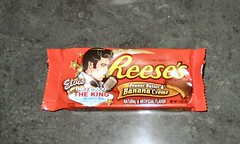
The banana flavor is subtler than I would have guessed - Reese's are so sweet they have to emphasize that aromatic, almost acrid aspect of banana in order for it to pop. It's subtler than the Reese's caramel cups - whose caramel flavor comes across nearly in the manner of a hot pepper, just cutting across your taste buds and agitating your nostrils.
As I note at my Flickr site (where you can see the full-size image: clicky!), Elvis would have made a sandwich out of these, surrounding them with steamy bacon and putting the whole thing between two slices of trimmed Wonder Bread. Mmm - that's eatin'!
8.12.2007
second quarter report
Before I get into the post proper: look, just give me the "Most Boring Title" award now.
Anyway: here's a list, with comments and sound files, of the 2007 releases I bought from April through June of this year - which continues to shape up to be a very good year for music.
Björk Volta: A little more song-oriented than her last one, with the usual unusual arrangement touches: sampled foghorns, a brass choir (actually, two of them), stomping feet and crunched branches, etc. The best of it works as well as anything she's done, while some of it...doesn't.
The Clientele God Save the Clientele: When I'm in the right mood, I love this stuff. When I'm not, it's all a blur. Unfortunately, I'm not in that rainswept, late-night mood all that often. Maybe in autumn...
Elk City New Believers: See this post - the links to the tracks are dead, though.
Great Northern Trading Twilight for Daylight: See this post - the links to the tracks are - that's right - dead.
Charlotte Hatherley The Deep Blue: Another brilliant record from Hatherley. She shows some courage, given her background as a player and purveyor of loudish guitar-pop, in opening her second full-length CD with an atmospheric, keyboard-based instrumental...and it is a bit disconcerting at first. But in fact, she shows that she's as masterful with a more expansive sound world as she is in more guitar-based writing. She can still do the slightly off-center guitar-rock thing, as "Behave" more than capably demonstrates - but the range she demonstrates in being able to also do the narcotic "Dawn Treader" suggests she might well be the heir of one of her musical idols, Andy Partridge. (The admiration is mutual: he co-wrote this song.)
Je Suis France Afrikan Majik: Read about it here - sorry, linky all gone.
The Marlboro Chorus American Dreamers: Previously addressed here.
Maxïmo Park Our Earthly Pleasures: Not as immediately appealing as their debut CD, still the band is capable of indelible choruses topping punchy and energetic tunes. A bit more keyboards fleshing out the sound here, too. Plus there's something about singer Paul Smith's voice and accent that I really like.
Paul McCartney Memory Almost Full: I confess that I'm not terribly familiar with, oh, the last two decades or so of McCartney's career - but that's largely because whenever I'd hear bits and pieces of his work during that period, they'd strike me as primarily competent but terribly uninspired. There were some good moments...but he rarely seemed truly committed to making the best art he could. By contrast, Memory Almost Full sounds like the work of an engaged, creative musician. One thing that plagues older musicians is how to deal with current trends: ignore them and you risk old-fogeydom; incorporate them shallowly and your music will seem desperate and dilettante-ish. McCartney avoids these problems by working largely in a classic mode that's still fairly prevalent practice among current musicians - a mode he himself bears credit for inventing, of course. The other tendency older, successful musicians have is taking for granted the enormous resources available to them, resulting in excessively fussed-over surfaces and credits for eighteen different keyboard players and two separate choirs. Many of the basic tracks here sound home-recorded (in the mode of McCartney's first two solo albums), and "My Ever Present Past" has pleasingly rough edges in the pinched, snarly guitar tone and clipped drums. Not that everything is simple and basic: "Mr. Bellamy" is one of McCartney's operetta character sketches (in the manner of "Uncle Albert/Admiral Halsey"), featuring an arrangement for a small orchestra. Much has been made of the relatively serious tone of this album: that of an aging man, going through a bitter divorce and having already lost the love of his life. That's true - and McCartney's notorious sentimentality is far more astringently cut here than his reputation would suggest. (As an aside, I think that he's never been as much a sentimentalist as that reputation claims.) The album drags a little bit in the middle, but it ends interestingly: "The End of the End" is the most emotive track on the album (and the one most approaching sentimentality), but it actually earns both its gravitas and its sweetness. A lot of albums would end with a track like that - instead, McCartney ends this one with a roaring, discordant blast called "Nod Your Head" - as if to say "don't count me out." And we shouldn't, either.
Modest Mouse We Were Dead Before the Ship Even Sank: Kind of a mess. Johnny Marr continues his incredible disappearing act (would you know he's playing guitar here if he weren't credited?), and Isaac Brock amplifies all the vocal tics, screams, and general bugged-eye-ness of his singing style to an annoying degree.
The National Boxer: One of those bands that tend to inspire either feverish devotion or a frustrated boredom (the frustration arising from an ability to figure out what the devoted could possibly be hearing). As usual with such divides, I'm not really on either side - although I lean far more toward the devoted end of that spectrum. The band divides, I think, because it doesn't overvalue "excitement," and its appeal lies largely in the subtleties of its craft. Take the opening of "Fake Empire": until the drums come in, nearly two minutes into the song, you're persuaded the song's in 4/4 - in fact, all along you've been hearing a rolling subdivision of a 3/4 measure (4 groups of 3 sixteenth-notes each, if you're scoring along at home). That might all be fancy musicians' play - except for the way it puts you off-center, making you feel things aren't quite as they seem...and then you listen to the lyrics, which are exactly about that, whether within a relationship or (or, and/or) as a citizen. "Squalor Victoria" puts an early eighties post-punk drum part (heavy on the toms: several tracks use a similar drum set-up) against a gradually building horns-and-strings backdrop. And vocalist Matt Berninger doesn't overstate: he sounds like a younger, more tuneful, and less jaded Leonard Cohen - again, not something to get the excitable youth over at Pitchfork all aroused. (Oh wait: they gave it an 8.6. That's okay: I am required by music-blogger regulation to piss on Pitchfork at least once a year. Nothing personal - it's just business.)
The Ponys Turn the Lights Out: This is a relatively recent acquisition, and one I therefore haven't really gotten a spin on yet. So far, so good - doesn't blow me away yet, though.
Mary Timony Band The Shapes We Make: Even though I enjoyed Timony's odd little quasi-medieval hobbity allegories, I think she's most effective with a little more direct energy in the music: that is to say, with a band, where she can play off other musicians and highlight the underheralded fact that she's a wicked clever guitarist. And a very distinctive one as well: both tracks I've posted feature solo guitar openings, and both parts are instantly recognizable as being Timony's playing. And check out the quick little sparkley notes she makes of double-timing the guitar lick near the end of "Rockman"...
Wilco Sky Blue Sky: Seems like everyone I know is holding their nose at this one. I think the problem is that Wilco's fans (and Wilco's own musical interests, in fact) come in at least two flavors: there's the sort of indie-rock experimental group, who started paying attention to Wilco around Summerteeth and, of course, drooled all over Yankee Hotel Foxtrot. That group reacted fairly positively to A Ghost Is Born, since at least some of the previous album's experimentation carried over to it...but notice how many songs on Ghost are, essentially, jams. And the fact is, the other half of Wilco's fanbase is alt-country/Americana-type fans...and they, on the other hand, have been wondering since Summerteeth when Jeff Tweedy was going to get his head out of his ass and write some good ol' country-folk-rock tunes again.
The first thing that struck me in listening to Sky Blue Sky was how much Tweedy's voice has come to sound like Jerry Garcia's. Of course, that's probably because the rest of this CD sounds astonishingly like the best album the Grateful Dead never put out in the late '70s. Back to that indie-rock crowd: generally speaking, a severe allergic reaction ensues whenever the Grateful Dead (or, worse, post-Dead "jam bands") is mentioned.
So is this Wilco's return to simple, direct songwriting with none of that pesky experimentalism? No: it's just the experimentation, right on the surface for the last few albums, is more subtly deployed here. Take "Impossible Germany": the voicing of those three guitars (two of which have almost identical tones) is rather tricky and discordant, not the sort of thing your average bunch of stoned fratboys is going to come up with. Or "Shake It Off" (damn, the rhythm and keyboards are totally Mars Hotel...), which switches up its rhythms in peculiar ways and leads to an instrumental section that, rather than noodle endlessly, sort of stomps around a bit before returning to a calm that, as an aftermath, seems quite deceptive. Speaking of, the album does becalm a bit too often, and while it certainly backs off from the restlessly overt soundscaping of Foxtrot and Ghost, there's more going on here than casual dismissals of the album's "boring" sound suggests.
postscript:
Physical CDs purchased: 7 (2 major-label, 5 indie)
Paid downloads: 5
Other downloads: 1
Promo (mailed to me): 1
Anyway: here's a list, with comments and sound files, of the 2007 releases I bought from April through June of this year - which continues to shape up to be a very good year for music.
Björk Volta: A little more song-oriented than her last one, with the usual unusual arrangement touches: sampled foghorns, a brass choir (actually, two of them), stomping feet and crunched branches, etc. The best of it works as well as anything she's done, while some of it...doesn't.
"Wanderlust"
"The Dull Flame of Desire" (ft. Antony Hegarty)
The Clientele God Save the Clientele: When I'm in the right mood, I love this stuff. When I'm not, it's all a blur. Unfortunately, I'm not in that rainswept, late-night mood all that often. Maybe in autumn...
Elk City New Believers: See this post - the links to the tracks are dead, though.
Great Northern Trading Twilight for Daylight: See this post - the links to the tracks are - that's right - dead.
Charlotte Hatherley The Deep Blue: Another brilliant record from Hatherley. She shows some courage, given her background as a player and purveyor of loudish guitar-pop, in opening her second full-length CD with an atmospheric, keyboard-based instrumental...and it is a bit disconcerting at first. But in fact, she shows that she's as masterful with a more expansive sound world as she is in more guitar-based writing. She can still do the slightly off-center guitar-rock thing, as "Behave" more than capably demonstrates - but the range she demonstrates in being able to also do the narcotic "Dawn Treader" suggests she might well be the heir of one of her musical idols, Andy Partridge. (The admiration is mutual: he co-wrote this song.)
Je Suis France Afrikan Majik: Read about it here - sorry, linky all gone.
The Marlboro Chorus American Dreamers: Previously addressed here.
Maxïmo Park Our Earthly Pleasures: Not as immediately appealing as their debut CD, still the band is capable of indelible choruses topping punchy and energetic tunes. A bit more keyboards fleshing out the sound here, too. Plus there's something about singer Paul Smith's voice and accent that I really like.
"Karaoke Plays"
"A Fortnight's Time"
Paul McCartney Memory Almost Full: I confess that I'm not terribly familiar with, oh, the last two decades or so of McCartney's career - but that's largely because whenever I'd hear bits and pieces of his work during that period, they'd strike me as primarily competent but terribly uninspired. There were some good moments...but he rarely seemed truly committed to making the best art he could. By contrast, Memory Almost Full sounds like the work of an engaged, creative musician. One thing that plagues older musicians is how to deal with current trends: ignore them and you risk old-fogeydom; incorporate them shallowly and your music will seem desperate and dilettante-ish. McCartney avoids these problems by working largely in a classic mode that's still fairly prevalent practice among current musicians - a mode he himself bears credit for inventing, of course. The other tendency older, successful musicians have is taking for granted the enormous resources available to them, resulting in excessively fussed-over surfaces and credits for eighteen different keyboard players and two separate choirs. Many of the basic tracks here sound home-recorded (in the mode of McCartney's first two solo albums), and "My Ever Present Past" has pleasingly rough edges in the pinched, snarly guitar tone and clipped drums. Not that everything is simple and basic: "Mr. Bellamy" is one of McCartney's operetta character sketches (in the manner of "Uncle Albert/Admiral Halsey"), featuring an arrangement for a small orchestra. Much has been made of the relatively serious tone of this album: that of an aging man, going through a bitter divorce and having already lost the love of his life. That's true - and McCartney's notorious sentimentality is far more astringently cut here than his reputation would suggest. (As an aside, I think that he's never been as much a sentimentalist as that reputation claims.) The album drags a little bit in the middle, but it ends interestingly: "The End of the End" is the most emotive track on the album (and the one most approaching sentimentality), but it actually earns both its gravitas and its sweetness. A lot of albums would end with a track like that - instead, McCartney ends this one with a roaring, discordant blast called "Nod Your Head" - as if to say "don't count me out." And we shouldn't, either.
Modest Mouse We Were Dead Before the Ship Even Sank: Kind of a mess. Johnny Marr continues his incredible disappearing act (would you know he's playing guitar here if he weren't credited?), and Isaac Brock amplifies all the vocal tics, screams, and general bugged-eye-ness of his singing style to an annoying degree.
The National Boxer: One of those bands that tend to inspire either feverish devotion or a frustrated boredom (the frustration arising from an ability to figure out what the devoted could possibly be hearing). As usual with such divides, I'm not really on either side - although I lean far more toward the devoted end of that spectrum. The band divides, I think, because it doesn't overvalue "excitement," and its appeal lies largely in the subtleties of its craft. Take the opening of "Fake Empire": until the drums come in, nearly two minutes into the song, you're persuaded the song's in 4/4 - in fact, all along you've been hearing a rolling subdivision of a 3/4 measure (4 groups of 3 sixteenth-notes each, if you're scoring along at home). That might all be fancy musicians' play - except for the way it puts you off-center, making you feel things aren't quite as they seem...and then you listen to the lyrics, which are exactly about that, whether within a relationship or (or, and/or) as a citizen. "Squalor Victoria" puts an early eighties post-punk drum part (heavy on the toms: several tracks use a similar drum set-up) against a gradually building horns-and-strings backdrop. And vocalist Matt Berninger doesn't overstate: he sounds like a younger, more tuneful, and less jaded Leonard Cohen - again, not something to get the excitable youth over at Pitchfork all aroused. (Oh wait: they gave it an 8.6. That's okay: I am required by music-blogger regulation to piss on Pitchfork at least once a year. Nothing personal - it's just business.)
The Ponys Turn the Lights Out: This is a relatively recent acquisition, and one I therefore haven't really gotten a spin on yet. So far, so good - doesn't blow me away yet, though.
"Double Vision"
"1209 Seminary"
Mary Timony Band The Shapes We Make: Even though I enjoyed Timony's odd little quasi-medieval hobbity allegories, I think she's most effective with a little more direct energy in the music: that is to say, with a band, where she can play off other musicians and highlight the underheralded fact that she's a wicked clever guitarist. And a very distinctive one as well: both tracks I've posted feature solo guitar openings, and both parts are instantly recognizable as being Timony's playing. And check out the quick little sparkley notes she makes of double-timing the guitar lick near the end of "Rockman"...
"Sharpshooter"
"Rockman"
Wilco Sky Blue Sky: Seems like everyone I know is holding their nose at this one. I think the problem is that Wilco's fans (and Wilco's own musical interests, in fact) come in at least two flavors: there's the sort of indie-rock experimental group, who started paying attention to Wilco around Summerteeth and, of course, drooled all over Yankee Hotel Foxtrot. That group reacted fairly positively to A Ghost Is Born, since at least some of the previous album's experimentation carried over to it...but notice how many songs on Ghost are, essentially, jams. And the fact is, the other half of Wilco's fanbase is alt-country/Americana-type fans...and they, on the other hand, have been wondering since Summerteeth when Jeff Tweedy was going to get his head out of his ass and write some good ol' country-folk-rock tunes again.
The first thing that struck me in listening to Sky Blue Sky was how much Tweedy's voice has come to sound like Jerry Garcia's. Of course, that's probably because the rest of this CD sounds astonishingly like the best album the Grateful Dead never put out in the late '70s. Back to that indie-rock crowd: generally speaking, a severe allergic reaction ensues whenever the Grateful Dead (or, worse, post-Dead "jam bands") is mentioned.
So is this Wilco's return to simple, direct songwriting with none of that pesky experimentalism? No: it's just the experimentation, right on the surface for the last few albums, is more subtly deployed here. Take "Impossible Germany": the voicing of those three guitars (two of which have almost identical tones) is rather tricky and discordant, not the sort of thing your average bunch of stoned fratboys is going to come up with. Or "Shake It Off" (damn, the rhythm and keyboards are totally Mars Hotel...), which switches up its rhythms in peculiar ways and leads to an instrumental section that, rather than noodle endlessly, sort of stomps around a bit before returning to a calm that, as an aftermath, seems quite deceptive. Speaking of, the album does becalm a bit too often, and while it certainly backs off from the restlessly overt soundscaping of Foxtrot and Ghost, there's more going on here than casual dismissals of the album's "boring" sound suggests.
postscript:
Physical CDs purchased: 7 (2 major-label, 5 indie)
Paid downloads: 5
Other downloads: 1
Promo (mailed to me): 1
8.10.2007
Wrens in British air
In keeping with my mission to post every scrap of non-album goodness the Wrens ever release, here are the two songs they performed on the BBC early in 2006, "Everyone Choose Sides" and "Boys You Won't." I am assuming that the files were labeled using the British date system, and so this is from March 2, 2006...but if they were labeled by an American after the fact, that would be February 3, 2006. A mystery!
As the BBC Symphony Orchestra failed to show, these songs feature acoustic Wrens, two guitars, a piano (which may not technically be acoustic), and some percussion. They get a remarkably full sound from that ensemble: credit their arranging and vocal skills.
These songs are edited from this file, which also contains interviews with the Wrens and that night's support act, the Favours. Thanks to "eltim" at the Wrens message board for that link!
(Note: the song is called "Everyone Choose Sides" - an imperative of sorts - not "Everyone Chooses Sides" - a kind of generalized statement. Damned sloppy file labelers!)
The Wrens "Everyone Choose Sides" (live and acoustic on BBC Radio Humberside, March 2, 2006)
The Wrens "Boys You Won't" (live and acoustic on BBC Radio Humberside, March 2, 2006)
As the BBC Symphony Orchestra failed to show, these songs feature acoustic Wrens, two guitars, a piano (which may not technically be acoustic), and some percussion. They get a remarkably full sound from that ensemble: credit their arranging and vocal skills.
These songs are edited from this file, which also contains interviews with the Wrens and that night's support act, the Favours. Thanks to "eltim" at the Wrens message board for that link!
(Note: the song is called "Everyone Choose Sides" - an imperative of sorts - not "Everyone Chooses Sides" - a kind of generalized statement. Damned sloppy file labelers!)
The Wrens "Everyone Choose Sides" (live and acoustic on BBC Radio Humberside, March 2, 2006)
The Wrens "Boys You Won't" (live and acoustic on BBC Radio Humberside, March 2, 2006)
8.09.2007
I got three pianos and a snare drum, y'all
Via Fluxblog, here's a fascinating interview in NewMusicBox with Matthew and Eleanor Friedberger of The Fiery Furnaces. The interview has some very smart things to say about what makes rock music rock music: the importance of performance, and (somewhat paradoxically) the importance of recordings. In particular, this comment from Matthew:
Elsewhere, the interviewer points out that even a very close, accurate transcription of a rock recording, even performed by sympathetic, skillful chamber musicians, would lack something...that something being, at least, the notion that the performer is part of the performance, the performer brings something of himself or herself to the performance, and in an essential rather than merely ornamental way. Even more so: creating such a transcription to be performed misses the point. Such a transcription might be interesting or useful in other ways...but for performance (or recording), only as a rough guide, a sort of elaborated skeleton for the performers to flesh out with something of their own.
The other part of rock is that it so often is primarily experiential in nature. What's most important is what's going on when you're hearing it, particularly in a live setting. An interesting and underexamined listening skill, actually, is knowing when and how to foreground time: Matthew points out that something like Neil Young's "Cortez the Killer" isn't necessarily meant to be attended to in all its detail; more that it creates a flow of experience (which might, as he points out, just be being stoned). By contrast, a longish Queen song (he's probably thinking of "Bohemian Rhapsody," of course) has a sequence of parts, a lot of information: many different sounds and structures interacting. It wants to be listened to, in other words (no matter how much it also wants you to pump your fists in the air as well). I remember when I was in college, I had Philip Glass's Einstein on the Beach playing, and my friend Eileen came by and asked me what the hell was this and that it was driving her nuts, repeating the same phrase over and over. Essentially, I think, she was listening in expectation that something was going to happen, and happen in the sort of teleological manner of classical music. In fact, she was confusing the ground with the surface: those repeating arpeggios aren't for listening to, they're for providing a way of framing time, within which the slowly evolving series of small changes gradually transfigures the music, rather in the way one might slowly revolve a kaleidoscope.
The most disappointing part of the interview isn't part of the interview, really: the interviewer quotes Amanda Petrusich's review in Pitchfork of Rehearsing My Choir, wherein Petrusich writes that "you can pick it apart, but can you dance to it, roll around on the floor with it, weep to it under your favorite blanket?" That's very poetic: maybe you should try listening to it? (Part of Petrusich's problem is that figure/ground issue as well, I'm guessing...) I think it's rather tragic that, at this point in musical history, people are still telling particular music exactly what it should do to and for them...rather than letting the music inform them how they should react. It's as inane and idiotic as criticizing a Bach fugue for not having a phat bass part.
You know the Beatles as Musicians books? There's no Dylan book like that. But even that book is really hard-pressed to talk about the tones on the Beatles records. What's the guitar solo on "Taxman"? You could try to transcribe it, but you have to talk about its overdriven sound. I wouldn't see how you could technically notate the colors of rock. And it's even more complicated on Dylan records since they come out of this sort of Chicago imitation of crazy background/foreground relationships. Think of Chuck Berry and what he's playing in relation to the band - the piano in the background. The strangest thing is how it's over there on the record, the piano and his voice. You could maybe write a piece for three pianos with the snare drum fff. There's a big problem talking technically about rock music. Maybe there isn't, but I'm too illiterate to see how you could properly notate it, especially Dylan. It's really the singing. And that's where rock music is interesting, I think. It's the different ways, the weird things people do when they sing.
Elsewhere, the interviewer points out that even a very close, accurate transcription of a rock recording, even performed by sympathetic, skillful chamber musicians, would lack something...that something being, at least, the notion that the performer is part of the performance, the performer brings something of himself or herself to the performance, and in an essential rather than merely ornamental way. Even more so: creating such a transcription to be performed misses the point. Such a transcription might be interesting or useful in other ways...but for performance (or recording), only as a rough guide, a sort of elaborated skeleton for the performers to flesh out with something of their own.
The other part of rock is that it so often is primarily experiential in nature. What's most important is what's going on when you're hearing it, particularly in a live setting. An interesting and underexamined listening skill, actually, is knowing when and how to foreground time: Matthew points out that something like Neil Young's "Cortez the Killer" isn't necessarily meant to be attended to in all its detail; more that it creates a flow of experience (which might, as he points out, just be being stoned). By contrast, a longish Queen song (he's probably thinking of "Bohemian Rhapsody," of course) has a sequence of parts, a lot of information: many different sounds and structures interacting. It wants to be listened to, in other words (no matter how much it also wants you to pump your fists in the air as well). I remember when I was in college, I had Philip Glass's Einstein on the Beach playing, and my friend Eileen came by and asked me what the hell was this and that it was driving her nuts, repeating the same phrase over and over. Essentially, I think, she was listening in expectation that something was going to happen, and happen in the sort of teleological manner of classical music. In fact, she was confusing the ground with the surface: those repeating arpeggios aren't for listening to, they're for providing a way of framing time, within which the slowly evolving series of small changes gradually transfigures the music, rather in the way one might slowly revolve a kaleidoscope.
The most disappointing part of the interview isn't part of the interview, really: the interviewer quotes Amanda Petrusich's review in Pitchfork of Rehearsing My Choir, wherein Petrusich writes that "you can pick it apart, but can you dance to it, roll around on the floor with it, weep to it under your favorite blanket?" That's very poetic: maybe you should try listening to it? (Part of Petrusich's problem is that figure/ground issue as well, I'm guessing...) I think it's rather tragic that, at this point in musical history, people are still telling particular music exactly what it should do to and for them...rather than letting the music inform them how they should react. It's as inane and idiotic as criticizing a Bach fugue for not having a phat bass part.
8.06.2007
sick and wrong
Those pranksters from Negativland are at it again: they're set to release a DVD/CD set, with the DVD consisting of visuals to accompany the band's "greatest hits" and the CD...well, to quote from the promo e-mail: "a truly silly and bizarre 50-minute bonus CD of 100% acapella versions of Negativland's work by The 180 Gs, a five-person black acapella group from Detroit, that has endeavored to 'cover' Negativland's cut up collage work in R 'n B, Doo-Wop, and Gospel styles."
This being Negativland, I would consider it advisable to withhold judgment on the accuracy of that bio...especially given a look at the 180 Gs' myspace page, wherein they are portrayed by various action figures. I note also the name of the town the band is supposedly from: it's a real town, but it has the same name as the Minnesota town where the murder took place that inspired Negativland's Incredible "Helter Stupid" Media Adventure. Finally - in a truly curious coincidence - the band's five brothers appear to have the same first names as the members of Negativland. What, I wonder, are the odds of that?
Anyway, I'll admit that I'm very curious indeed to hear anyone try to cover, in any style at all, "Car Bomb" or "The Playboy Channel." Instead, the cover of "Christianity Is Stupid" is the first mp3 available - all I can say is, listen to it. Here's Negativland's original for comparison.
The absurdly bizarre stylistic transformation of this cover (less bizarre with this particular track, which features a "preacher" in the first place) reminded me of a CD of covers I picked up a couple of years ago. The style is medieval, the words are in Latin, and the source...well, I'll let you figure that out yourself. Listen to "Symptoma mundi" by Rondellus.
(Incidentally, all this reminds me of a project I really wished someone had done years ago: in the wake of Devo doing its own quasi-muzak versions of its songs, I thought: why not do a real, old-school, Mantovani-type set of arrangements of The Residents - and hire an actual, old-school, Mantovani-type arranger to do it? You'd have to keep the bizarre harmonies and melodies - but I think slathering a zillion strings, cooing female choirs, and the like atop those avant-primitive Residents compositions would have been a brilliant idea.)
The 180 Gs "Christianity Is Stupid" (180 d'Gs to the Future! 2007)
Negativland "Christianity Is Stupid" (Escape from Noise, 1987)
Rondellus "Symptoma mundi" (Sabbatum, 2002)
This being Negativland, I would consider it advisable to withhold judgment on the accuracy of that bio...especially given a look at the 180 Gs' myspace page, wherein they are portrayed by various action figures. I note also the name of the town the band is supposedly from: it's a real town, but it has the same name as the Minnesota town where the murder took place that inspired Negativland's Incredible "Helter Stupid" Media Adventure. Finally - in a truly curious coincidence - the band's five brothers appear to have the same first names as the members of Negativland. What, I wonder, are the odds of that?
Anyway, I'll admit that I'm very curious indeed to hear anyone try to cover, in any style at all, "Car Bomb" or "The Playboy Channel." Instead, the cover of "Christianity Is Stupid" is the first mp3 available - all I can say is, listen to it. Here's Negativland's original for comparison.
The absurdly bizarre stylistic transformation of this cover (less bizarre with this particular track, which features a "preacher" in the first place) reminded me of a CD of covers I picked up a couple of years ago. The style is medieval, the words are in Latin, and the source...well, I'll let you figure that out yourself. Listen to "Symptoma mundi" by Rondellus.
(Incidentally, all this reminds me of a project I really wished someone had done years ago: in the wake of Devo doing its own quasi-muzak versions of its songs, I thought: why not do a real, old-school, Mantovani-type set of arrangements of The Residents - and hire an actual, old-school, Mantovani-type arranger to do it? You'd have to keep the bizarre harmonies and melodies - but I think slathering a zillion strings, cooing female choirs, and the like atop those avant-primitive Residents compositions would have been a brilliant idea.)
The 180 Gs "Christianity Is Stupid" (180 d'Gs to the Future! 2007)
Negativland "Christianity Is Stupid" (Escape from Noise, 1987)
Rondellus "Symptoma mundi" (Sabbatum, 2002)
8.05.2007
squib
Not even a tempest in a teacup - more like a small fart in a wind tunnel - is this now somewhat-aged controversy over whether Spoon plagiarized parts of its song "You Got Yr. Cherry Bomb" from relatively unknown Nashville act How I Became the Bomb's song "Killing Machine." (From that link you can download both tracks: I'll wait up for a bit until you go ahead and listen to them. I'd suggest listening to How I Became the Bomb's track first. And an aside: stop using complete sentences as band names, okay?)
You're back? Good. First, as many comments on the Nashville Cream site point out, the introductory chord sequence used in both tracks is an exceedingly common one (Am, D, G, Em - or ii, V, I, vi if you're into that way). I will leave it as an exercise to the reader to find other tracks that have the same or close variations on that chord sequence. At any rate, you can't copyright a mere chord sequence.
The reason I suggested listening to "Killing Machine" first is that it pretty much locks into that chord sequence and never lets go. Although the Spoon track does begin with the same chord sequence, it very quickly moves away from its most simple statement (4 bars, 1 chord per bar) into a demonstration of what a clever, resourceful band can do with only four or five chords.
Spoon uses several little musical tricks to lend variety to the song's limited harmonic means. The intro consists of two bars before the drum kit comes in, then four bars after that. The verse then begins on the G chord...which retrospectively throws into question whether the opening sequence should be written as I noted above, or whether the intro begins in the middle of a phrase that should be written G, Em, Am, D. In fact, in a not-unusual but still effective trick, the intro chords turn out to those of the instrumental bridge halfway through the song - not of the verses or chorus. The verse instead is basically two bars of G and two bars of C...at least, in outline. Here we discover Trick #2. The second bar of each chord changes the voicing, including an almost jazzy second (uh-oh...does this mean Britt Daniels is a Steely Dan fan?). Or at least that's what it does in the first phrase of each verse: when the phrase repeats, that fourth bar finds the bass descending to a B instead of holding on the C, which (along with that added D) effectively changes the chord to an inversion of G.
And here we find Trick #3: just as the intro chopped the typical four-bar phrase in half, making it ambiguous whether we were hearing the final two bars of one phrase or the first two of another, the last two bars of this phrase are, arguably, the first two bars of a transitional phrase into the chorus, which follows a descending bass from C, to G/B, to Am, and down to G, before moving into the chorus proper, beginning on D. If two bars seemed cut out of the intro, here we have an "extra" two bars symmetrically deployed at the other end of the verse. The chorus itself echoes both the chord structure of the second phrase of the verse (one chord for two bars, then a chord change at each bar) and the descending bassline gambit of the prechorus (the second bar of that D chord has a C in the bass, while the fourth bar is our old friend the G/B chord).
There's more - such as the way Am sometimes appears where you might expect C, or the way the verse chords are used as a brief instrumental interlude - and that's not even addressing the arrangement, which plays some clever changes on typical Motown arranging tricks (for example, that xylophone, which is heavily reverbed, but with the reverb itself mixed higher than the dry signal).
In other words, what probably sounds to most listeners at first like a simple retro-soul track turns out to be a lot more complex than it seems. (In fact a lot of classic Motown tracks turn out to be rather intricate upon examination.) I'm imagining rehearsals for this track were interesting: the phrasing is fluid and intuitive, but as I've illustrated it doesn't fall into typical four-bar patterns. I imagine the first several runthroughs featured a lot of early or missed entrances, particularly for the bass player!
Back to the plagiarism controversy: the fact that the two songs' introductions have the same chords (but not the same bass parts, as some have asserted) means very little given how different the rest of the songs are. And particularly, how much more creativity Spoon exhibits in putting together a very complex recording and arrangement that sounds perfectly effortless and straightforward.
Amusingly, though, there are two other curious similarities between the two tracks. Both feature somewhat unexpected codas, and of course both feature the word "bomb." But that's hardly enough to build a case on.
To my knowledge, though, no one's mentioned the real Spoon scandal: the sweetheart deal the band apparently has with Merge Records honchos concerning the catalog numbers of Spoon's releases.
Here's a list of the four full-length Spoon CDs on Merge and their catalog numbers:
Girls Can Tell MRG195
Kill the Moonlight MRG215
Gimme Fiction MRG265
Ga Ga Ga Ga Ga MRG295
They all end in 5! Coincidence...or CONSPIRACY!?!
You're back? Good. First, as many comments on the Nashville Cream site point out, the introductory chord sequence used in both tracks is an exceedingly common one (Am, D, G, Em - or ii, V, I, vi if you're into that way). I will leave it as an exercise to the reader to find other tracks that have the same or close variations on that chord sequence. At any rate, you can't copyright a mere chord sequence.
The reason I suggested listening to "Killing Machine" first is that it pretty much locks into that chord sequence and never lets go. Although the Spoon track does begin with the same chord sequence, it very quickly moves away from its most simple statement (4 bars, 1 chord per bar) into a demonstration of what a clever, resourceful band can do with only four or five chords.
Spoon uses several little musical tricks to lend variety to the song's limited harmonic means. The intro consists of two bars before the drum kit comes in, then four bars after that. The verse then begins on the G chord...which retrospectively throws into question whether the opening sequence should be written as I noted above, or whether the intro begins in the middle of a phrase that should be written G, Em, Am, D. In fact, in a not-unusual but still effective trick, the intro chords turn out to those of the instrumental bridge halfway through the song - not of the verses or chorus. The verse instead is basically two bars of G and two bars of C...at least, in outline. Here we discover Trick #2. The second bar of each chord changes the voicing, including an almost jazzy second (uh-oh...does this mean Britt Daniels is a Steely Dan fan?). Or at least that's what it does in the first phrase of each verse: when the phrase repeats, that fourth bar finds the bass descending to a B instead of holding on the C, which (along with that added D) effectively changes the chord to an inversion of G.
And here we find Trick #3: just as the intro chopped the typical four-bar phrase in half, making it ambiguous whether we were hearing the final two bars of one phrase or the first two of another, the last two bars of this phrase are, arguably, the first two bars of a transitional phrase into the chorus, which follows a descending bass from C, to G/B, to Am, and down to G, before moving into the chorus proper, beginning on D. If two bars seemed cut out of the intro, here we have an "extra" two bars symmetrically deployed at the other end of the verse. The chorus itself echoes both the chord structure of the second phrase of the verse (one chord for two bars, then a chord change at each bar) and the descending bassline gambit of the prechorus (the second bar of that D chord has a C in the bass, while the fourth bar is our old friend the G/B chord).
There's more - such as the way Am sometimes appears where you might expect C, or the way the verse chords are used as a brief instrumental interlude - and that's not even addressing the arrangement, which plays some clever changes on typical Motown arranging tricks (for example, that xylophone, which is heavily reverbed, but with the reverb itself mixed higher than the dry signal).
In other words, what probably sounds to most listeners at first like a simple retro-soul track turns out to be a lot more complex than it seems. (In fact a lot of classic Motown tracks turn out to be rather intricate upon examination.) I'm imagining rehearsals for this track were interesting: the phrasing is fluid and intuitive, but as I've illustrated it doesn't fall into typical four-bar patterns. I imagine the first several runthroughs featured a lot of early or missed entrances, particularly for the bass player!
Back to the plagiarism controversy: the fact that the two songs' introductions have the same chords (but not the same bass parts, as some have asserted) means very little given how different the rest of the songs are. And particularly, how much more creativity Spoon exhibits in putting together a very complex recording and arrangement that sounds perfectly effortless and straightforward.
Amusingly, though, there are two other curious similarities between the two tracks. Both feature somewhat unexpected codas, and of course both feature the word "bomb." But that's hardly enough to build a case on.
To my knowledge, though, no one's mentioned the real Spoon scandal: the sweetheart deal the band apparently has with Merge Records honchos concerning the catalog numbers of Spoon's releases.
Here's a list of the four full-length Spoon CDs on Merge and their catalog numbers:
Girls Can Tell MRG195
Kill the Moonlight MRG215
Gimme Fiction MRG265
Ga Ga Ga Ga Ga MRG295
They all end in 5! Coincidence...or CONSPIRACY!?!
8.02.2007
look it up!
I have no interest in subscribing to The Economist...but this cover image, reproduced on a look-at-me mailing, is brilliant:

8.01.2007
t-shirt for math geeks
No idea why I thought of this...but I set to work making a mockup anyway...
click to embiggen
Update: You know what's really awesome here - or really scary if you think that way? I did not realize it when I posted this, but...in fact, this is my 666th post.

Update: You know what's really awesome here - or really scary if you think that way? I did not realize it when I posted this, but...in fact, this is my 666th post.
pants-down science!
Researchers have come up with a list of 237 reasons people have sex.
First: what the hell is wrong with the paper that the list itself isn't in the article - you know, perhaps so you can check entries off to see how many you've used? More importantly, such a list would facilitate the efforts of clever people to find new, hitherto unutilized reasons: "I bought a new pair of shoes! Let's do it, baby!" It would also have been useful to know which reasons potential partners find most compelling. (I'm guessing "new pair of shoes" would rank pretty low.)
Update: Faithful reader Janet (and that's Janet ID, an abbreviation of her surname - not "Janet Id") points out that the online article links to a PDF file listing the top 50 reasons, for men and for women. Unsurprisingly, many of the nominally different reasons are pretty much the same: please explain the difference between "I was 'horny'" and "I was sexually aroused and wanted the release," for instance. I too am amused by one of the answers: "it just happened." "You know, I was walking down the street on my way to work, and all of a sudden I was behind a dumpster in the alley having sex. I have no idea how that happened!"
First: what the hell is wrong with the paper that the list itself isn't in the article - you know, perhaps so you can check entries off to see how many you've used? More importantly, such a list would facilitate the efforts of clever people to find new, hitherto unutilized reasons: "I bought a new pair of shoes! Let's do it, baby!" It would also have been useful to know which reasons potential partners find most compelling. (I'm guessing "new pair of shoes" would rank pretty low.)
Update: Faithful reader Janet (and that's Janet ID, an abbreviation of her surname - not "Janet Id") points out that the online article links to a PDF file listing the top 50 reasons, for men and for women. Unsurprisingly, many of the nominally different reasons are pretty much the same: please explain the difference between "I was 'horny'" and "I was sexually aroused and wanted the release," for instance. I too am amused by one of the answers: "it just happened." "You know, I was walking down the street on my way to work, and all of a sudden I was behind a dumpster in the alley having sex. I have no idea how that happened!"
Subscribe to:
Posts (Atom)

