I pulled out an old Starflyer 59 CD the other day (The Fashion Focus), and this track, "Sundown," suddenly reminded me very strongly of Tom Verlaine. Initially, it was the drums and little spoken bit at the beginning - there's some particular Verlaine track where he does that, but for some reason I haven't been able to find the exact one I'm thinking of. Anyway, the bass and opening guitar sound are also rather Verlainesque, don't you think?
Even though I'm not sure it was the track I'm thinking of, coincidentally Verlaine's song "One Time at Sundown" ("coincidentally" because of the title's similarity to that of the Starflyer 59 track) comes fairly close, at least in its opening. (This one's from Flash Light.)
Speaking of Verlaine, it's absolutely criminal that his catalog is so neglected. There needs to be a full-scale reissue of everything he's done, with the usual bonus tracks, etc. (And it's frankly weird that Warm and Cool - his weakest album, if you ask me - is the one that's been reissued so far.) Then again, it's sad that Verlaine himself has all but retired from making music - as far as I know, his last recorded track is the relatively hard-to-find cover of Kris Kristofferson's "The Hawk," which came out in 2002 on a tribute compilation called Don't Let the Bastards Get You Down.
Starflyer 59 "Sundown"
Tom Verlaine "One Time at Sundown"
Tom Verlaine "The Hawk (El Gavilan)"

10.31.2005

reason sleeps, monsters creep
"Get me some chocolate milk / and some small, high-intensity chips"
--first line of a song about a kid who's decided to kidnap Santa; the only other thing I know is that he's strung a tripwire at the bottom of his chimney, which he's connected to a tranquilizer gun.
(This is what happens when I wake up early, anxious that I've overslept, because of the time shift - then fall back half-asleep and dreaming: I come up with peculiar ideas for songs. This one sounds like it's by Steely Dan - or better, Nova Social: check out the song samples; warning: opening-page Flash animation includes bleepy robot noises).
--first line of a song about a kid who's decided to kidnap Santa; the only other thing I know is that he's strung a tripwire at the bottom of his chimney, which he's connected to a tranquilizer gun.
(This is what happens when I wake up early, anxious that I've overslept, because of the time shift - then fall back half-asleep and dreaming: I come up with peculiar ideas for songs. This one sounds like it's by Steely Dan - or better, Nova Social: check out the song samples; warning: opening-page Flash animation includes bleepy robot noises).
10.30.2005
Journalism 101
Here are two different stories about Madison's Halloween celebrations (no, I wasn't there):
This one's from Madison's Wisconsin State Journal - and this one's from the Milwaukee Journal Sentinel (in both cases, the online editions).
It's rather astonishing how different the two reports are, in both tone and content. Reading the Wisconsin State Journal, you'd get the impression that police were forced to resort to pepper spray only after a few diehard partiers refused to leave the scene - whereas the Journal Sentinel report paints the cops as pre-emptive warriors, pepper-spraying the crowds and locking them in the bars before they even had a chance to disperse.
I've linked to copies of the articles...because it would surprise me not at all if one or both of them is extensively rewritten before too long.
This one's from Madison's Wisconsin State Journal - and this one's from the Milwaukee Journal Sentinel (in both cases, the online editions).
It's rather astonishing how different the two reports are, in both tone and content. Reading the Wisconsin State Journal, you'd get the impression that police were forced to resort to pepper spray only after a few diehard partiers refused to leave the scene - whereas the Journal Sentinel report paints the cops as pre-emptive warriors, pepper-spraying the crowds and locking them in the bars before they even had a chance to disperse.
I've linked to copies of the articles...because it would surprise me not at all if one or both of them is extensively rewritten before too long.
10.28.2005
with voices out of nowhere...
Once in a while, a song will come out of the blue, unheralded, and just blow me away. I mentioned, in 2004's year-end survey, that one of my favorite songs of the year appeared on a compilation of songs put out by folks on the Robyn Hitchcock mailing list. Usually, such vanity projects have maybe one good song on them, surrounded by a couple of okay ones, surrounded by a mass of terrifyingly bad tracks: this one's actually pretty good, with only one or two ear-torture devices. Then again, it also includes an appalling early and primitive track by the dreaded Monkey Typing Pool.
Anyway, here's Popsicle Thieves with "Touch You Natalie Jane." What I love about this is its arrangement, and the way seemingly every rhythm in the song sort of grows out of the rhythm of the name "Natalie Jane." (I also like that the band name is a goofily bad takeoff on Bicycle Thieves - which name the act also has recorded under - from the Italian film, of course.)
Back when I was reviewing CDs for Milk magazine, of course I received way too many CDs, most of which (using my scarily reliable "Is the cover art crap?" culling method) turned out to have little reason to exist. Every once in a while, though, an unprepossessing little CD ended up being more impressive than it looked. One of those was Robert Nix's It's a Complicated World, from 1998. The cover's nothing but a shot of some California burb (Pasadena maybe?) with Nix's name and the CD's title in very late-'90s distressed typography. The songs, though, despite being almost entirely recorded by Nix at home, with semi-cheesy rhythm programming, are cleverly arranged for all that, and Nix's voice has an almost John Cale-like quality that I like. The title track is probably my favorite.
Popsicle Thieves "Touch You Natalie Jane"
Robert Nix "It's a Complicated World"
Anyway, here's Popsicle Thieves with "Touch You Natalie Jane." What I love about this is its arrangement, and the way seemingly every rhythm in the song sort of grows out of the rhythm of the name "Natalie Jane." (I also like that the band name is a goofily bad takeoff on Bicycle Thieves - which name the act also has recorded under - from the Italian film, of course.)
Back when I was reviewing CDs for Milk magazine, of course I received way too many CDs, most of which (using my scarily reliable "Is the cover art crap?" culling method) turned out to have little reason to exist. Every once in a while, though, an unprepossessing little CD ended up being more impressive than it looked. One of those was Robert Nix's It's a Complicated World, from 1998. The cover's nothing but a shot of some California burb (Pasadena maybe?) with Nix's name and the CD's title in very late-'90s distressed typography. The songs, though, despite being almost entirely recorded by Nix at home, with semi-cheesy rhythm programming, are cleverly arranged for all that, and Nix's voice has an almost John Cale-like quality that I like. The title track is probably my favorite.
Popsicle Thieves "Touch You Natalie Jane"
Robert Nix "It's a Complicated World"
10.27.2005
help me out here...
It seems to me that a short story ought to begin as follows:
Since he couldn't figure out how anyone else could possibly do it, as a young child he'd always assumed the voiceovers on ads and TV shows were done by Jesus.
Since he couldn't figure out how anyone else could possibly do it, as a young child he'd always assumed the voiceovers on ads and TV shows were done by Jesus.
10.26.2005
Boo!
Been busy. Eventually a new mp3 will be posted, but not for a few days. Anyway, until then, random thoughts.
I've been trying to come up with a Halloween costume, and have been less successful in coming up with a costume as such. Instead, it's more like a Halloween conceptual artwork or something. There are two versions.
Subtle (relatively): Go to store, fill cart with several large cans of fava beans and a few bottles of "a nice Chianti." See if clerk catches on, looks concerned.
Unsubtle: Dress in orange jumpsuit, borrow friend's hockey mask (note to self: do I have any Canadian friends?), have friend strap me to a handtruck. Have self wheeled to grocery store; have friend fill cart with above merchandise.
Alternate: Dress up like Dracula. Acquire university meal card; find on-campus blood drive; stand in line with meal card.
I've been trying to come up with a Halloween costume, and have been less successful in coming up with a costume as such. Instead, it's more like a Halloween conceptual artwork or something. There are two versions.
Subtle (relatively): Go to store, fill cart with several large cans of fava beans and a few bottles of "a nice Chianti." See if clerk catches on, looks concerned.
Unsubtle: Dress in orange jumpsuit, borrow friend's hockey mask (note to self: do I have any Canadian friends?), have friend strap me to a handtruck. Have self wheeled to grocery store; have friend fill cart with above merchandise.
Alternate: Dress up like Dracula. Acquire university meal card; find on-campus blood drive; stand in line with meal card.
10.23.2005
Nielsenesque: Recounting of Humorous Anecdote Regarding Nuptials, Collecting
My favorite exchange of this weekend's wedding follows. First, you need to know that both newlyweds, but especially the groom, are major collectors of action figures and the like. This was at a lunch the day after the wedding itself:
Bride (joking): Hey, all I really wanted was this cool ring.
Guest (likewise): Yeah, you could probably get some pretty good money for it on eBay.
Groom (playing along, with mock plaintiveness): Hey, what about me?
Guest: She could probably get pretty good money for you on eBay too.
Bride: Nah - I've already unwrapped him and played with him.
Bride (joking): Hey, all I really wanted was this cool ring.
Guest (likewise): Yeah, you could probably get some pretty good money for it on eBay.
Groom (playing along, with mock plaintiveness): Hey, what about me?
Guest: She could probably get pretty good money for you on eBay too.
Bride: Nah - I've already unwrapped him and played with him.
10.21.2005
road report
So I'm down here in Dallas (okay, actually Plano, Texas) for the wedding of a couple of friends of ours. One thing I've noticed, architects down here are very odd - or perhaps their clients are. I've seen two of the ugliest buildings I've ever seen - unfortunately, the batteries died on our camera before I could get good (bad) pictures. (Then again, around here there's simply no place that isn't five freeways on top of one another, so it's not as if I could have found anywhere to photograph from anyway.)
I'm forced, therefore, to use images I've found online which don't convey anywhere near the full horror of these buildings. First up is the Embassy Suite near DFW, which looks rather as if ten to twenty Mediterranean villas perished in a terrifying multi-villa pileup. You know how a rhinoceros might look cute from, oh, half a mile away? (Actually, baby rhinos look rather like large, ambulatory footballs - and in fact are quite cute.) Then imagine that as you get closer, its hideous rhinocerocity becomes more and more apparent, until you're face to face with a big, pachydermous, dropkick argument against "Intelligent Design." Something similar is the case as one approaches this hotel - except there's never even a chance you'd think the building is attractive. And the closer you get, the more its full horror comes into view, until you're wishing you had lots and lots of dynamite on hand to improve its appearance.
Second is the Frisco RoughRiders' (already getting points off for the oh-so-modern intercapitalization) baseball stadium (Frisco's a northern Dallas burb). The Renaissance, as is well known, arose when artists rediscovered the glory of classical design, its form, order, and utility, and strove to emulate it in their own work, even while deeply believing they could never achieve its full glory. This stadium instead makes one imagine that its architects believed wholeheartedly that the utter pinacle of architectural genius and inspiration breathes forth from the sacred architectonics of the suburban McMansion - and that, all Modernist-like, the essence of the McMansion form is a quality known by the ancient Romans as fuckinghugiosity, and that their sworn duties were to strive to achieve that form. So, the Frisco minor league ballpark looks rather like the most gargantuan, horrifying suburban monstrosity every conceived. What you can't see in this picture is the multiplying series of - I dunno, buttresses, cornices, flanges, offhandles (despite this blog's title, I'm no architect) - that imbricate in horripilating complexity beyond reason. It's like a Godzilla-type movie with a nuclear-irradiated gigantic mutated Cape Cod or something. Just terrifying.
I'm forced, therefore, to use images I've found online which don't convey anywhere near the full horror of these buildings. First up is the Embassy Suite near DFW, which looks rather as if ten to twenty Mediterranean villas perished in a terrifying multi-villa pileup. You know how a rhinoceros might look cute from, oh, half a mile away? (Actually, baby rhinos look rather like large, ambulatory footballs - and in fact are quite cute.) Then imagine that as you get closer, its hideous rhinocerocity becomes more and more apparent, until you're face to face with a big, pachydermous, dropkick argument against "Intelligent Design." Something similar is the case as one approaches this hotel - except there's never even a chance you'd think the building is attractive. And the closer you get, the more its full horror comes into view, until you're wishing you had lots and lots of dynamite on hand to improve its appearance.
Second is the Frisco RoughRiders' (already getting points off for the oh-so-modern intercapitalization) baseball stadium (Frisco's a northern Dallas burb). The Renaissance, as is well known, arose when artists rediscovered the glory of classical design, its form, order, and utility, and strove to emulate it in their own work, even while deeply believing they could never achieve its full glory. This stadium instead makes one imagine that its architects believed wholeheartedly that the utter pinacle of architectural genius and inspiration breathes forth from the sacred architectonics of the suburban McMansion - and that, all Modernist-like, the essence of the McMansion form is a quality known by the ancient Romans as fuckinghugiosity, and that their sworn duties were to strive to achieve that form. So, the Frisco minor league ballpark looks rather like the most gargantuan, horrifying suburban monstrosity every conceived. What you can't see in this picture is the multiplying series of - I dunno, buttresses, cornices, flanges, offhandles (despite this blog's title, I'm no architect) - that imbricate in horripilating complexity beyond reason. It's like a Godzilla-type movie with a nuclear-irradiated gigantic mutated Cape Cod or something. Just terrifying.
10.19.2005
D.W.B.
Much talk has ensued in the wake of the NBA's imposition of a dress code (banning chains and medallions, headwear, and sleeveless shirts, among other items) on its players. The ban does not apply to coaches or owners, who are free to continue to look like they're loitering near the frozen vegies at the supermarket, waiting for the free sample pizza to be done. But so far, there's been little discussion of the penalties the NBA has proposed for players found in violation of the code. Here's an outline of some likely penalties:
First offense: In addition to conforming to the dress code, players are required to wear a life-size, wrap-around mask of Hugh Beaumont in his best-known role as Ward Cleaver.
Second offense: Players must perform several hours of community service in the form of driving a Dodge minivan, obsessing over lawncare, and fibbing about their golf scores while barbecuing in the backyard.
Third offense: Only rumors exist about the penalties for the third offense - but recently, the plastic surgeon who worked on Michael Jackson's nose and lips was seen scurrying out of NBA Commissioner David Stern's office.
First offense: In addition to conforming to the dress code, players are required to wear a life-size, wrap-around mask of Hugh Beaumont in his best-known role as Ward Cleaver.
Second offense: Players must perform several hours of community service in the form of driving a Dodge minivan, obsessing over lawncare, and fibbing about their golf scores while barbecuing in the backyard.
Third offense: Only rumors exist about the penalties for the third offense - but recently, the plastic surgeon who worked on Michael Jackson's nose and lips was seen scurrying out of NBA Commissioner David Stern's office.
remediated
I'm looking forward to next spring's all-CGI movie remake of the comic-book take on the famous videogame based on the hit movie adaptation of the renowned graphic novel's interpretation of the beloved videogame take-off on the blockbuster cinematic version of the comic.
Aren't you?
Aren't you?
10.17.2005
name that tune!
Here's something I've always wondered about. First up, here's XTC's "Take This Town" from the soundtrack to the 1980 film Times Square. (I've never seen the movie - but the soundtrack is pretty cool.)
Okay, so you've listened to that track. No doubt that little whistling melody in the chorus is lodged firmly inside your skull.
Now listen to the next song: Mission of Burma's "New Nails" (from 1982). Okay, in the middle section, when Roger Miller's singing about "the shores of Galilee," hear that guitar part? That's right: it's the same little melody from the XTC song.
It's possible, of course, that for whatever reason Miller thought to borrow the XTC melody for the guitar line for this part of the song. It's even possible that the similarity between the two parts - both melodic and rhythmic - is just a coincidence.
But I'm wondering whether both songs don't draw from a pre-existing melody...an old TV show theme, a hymn, a march, something like that? Does that tune ring any bells for anyone?
XTC "Take This Town"
Mission of Burma "New Nails"
Okay, so you've listened to that track. No doubt that little whistling melody in the chorus is lodged firmly inside your skull.
Now listen to the next song: Mission of Burma's "New Nails" (from 1982). Okay, in the middle section, when Roger Miller's singing about "the shores of Galilee," hear that guitar part? That's right: it's the same little melody from the XTC song.
It's possible, of course, that for whatever reason Miller thought to borrow the XTC melody for the guitar line for this part of the song. It's even possible that the similarity between the two parts - both melodic and rhythmic - is just a coincidence.
But I'm wondering whether both songs don't draw from a pre-existing melody...an old TV show theme, a hymn, a march, something like that? Does that tune ring any bells for anyone?
XTC "Take This Town"
Mission of Burma "New Nails"
10.16.2005
t-shirt idea
Shopping recently, I noticed a bunch of rather horrifying purses that looked as if they were made from Wookiees. I decided the faux-fur thing needed some more, and more versatile, applications.
Thus, the faux-fur t-shirt.
I think one that looks made of squirrel, or rabbit, or dog, and with crudely lettered print saying I KILT IT MYSELF would be a good seller.
Thus, the faux-fur t-shirt.
I think one that looks made of squirrel, or rabbit, or dog, and with crudely lettered print saying I KILT IT MYSELF would be a good seller.
welcome to the 20th century
I've finally figured out how to use an RSS reader (thanks Joe!) and so now little elves whisper in my ears about my favorite websites' updates, news stories they think I might be interested in, etc. - which allows me to be all right up on top of important news as it happens whoo and therefore hoo.
It is this miracle of modern technology that allows me to be aware that Philip Pullman (author of the wonderful His Dark Materials trilogy, as well as other fine books nominally for teens but perfectly enjoyable for adults as well) has slammed the filmmakers of C.S. Lewis' Narnia series, calling the books "racist," "misogynist," and lacking in what he calls the chief Christian virtue, love. (His source for this last claim is some guy named Jesus: I dunno, I mistrust folks who go around using only their first names. He was a fine bowler, though.)
I can't evaluate his argument, since it's been 4,372 years since I've read the Lewis books (although, geez, hateful racist misogyny? Maybe I should...). The trailer for the first Narnia movie looked alternately intriguing (Big Kitty!) and...well, why didn't they just cut and paste the battle scenes from Return of the King into the movie instead of filming their own, near-carbon copies. (They did, didn't they?)
PS: A "carbon copy" is another archaism - it refers to the fact that existing carbon copies are used to date ancient artifacts, I believe.
It is this miracle of modern technology that allows me to be aware that Philip Pullman (author of the wonderful His Dark Materials trilogy, as well as other fine books nominally for teens but perfectly enjoyable for adults as well) has slammed the filmmakers of C.S. Lewis' Narnia series, calling the books "racist," "misogynist," and lacking in what he calls the chief Christian virtue, love. (His source for this last claim is some guy named Jesus: I dunno, I mistrust folks who go around using only their first names. He was a fine bowler, though.)
I can't evaluate his argument, since it's been 4,372 years since I've read the Lewis books (although, geez, hateful racist misogyny? Maybe I should...). The trailer for the first Narnia movie looked alternately intriguing (Big Kitty!) and...well, why didn't they just cut and paste the battle scenes from Return of the King into the movie instead of filming their own, near-carbon copies. (They did, didn't they?)
PS: A "carbon copy" is another archaism - it refers to the fact that existing carbon copies are used to date ancient artifacts, I believe.
10.15.2005
we're sorry - we are unable to complete this call as dialed. You'll be hearing from our legal representatives shortly.
I remember a couple of years ago, during another in an ongoing series of online discussions about copyright and digital music, facetiously suggesting that if only I'd copyrighted a composition consisting solely of the note E (scored for any instrument in any octave and for any duration), I could (so long as I had really good and really sleazy lawyers) make quite a living suing everydamnedbody who incorporated, in toto, my composition into their own music.
Well, here's someone thinking along similar lines. And just think: you've probably performed several of their compositions this very day!
(Of course, the problem is - and it might be amusing to write them a legal letter, every bit as serious as their website - it's likely that most of the number sequences were in use well before they copyrighted it. I am not sure, but I don't believe one can copyright melodies in the public domain - an old folk song, say.)
The site is, however, useful in providing a musical score for anyone's phone number, should you need to, say, play it on a synth or something.
Well, here's someone thinking along similar lines. And just think: you've probably performed several of their compositions this very day!
(Of course, the problem is - and it might be amusing to write them a legal letter, every bit as serious as their website - it's likely that most of the number sequences were in use well before they copyrighted it. I am not sure, but I don't believe one can copyright melodies in the public domain - an old folk song, say.)
The site is, however, useful in providing a musical score for anyone's phone number, should you need to, say, play it on a synth or something.
10.12.2005
shocking revelation!
Travel with me back to those halcyon days of the early '80s, when Lower East Side hipsters that cut their hair with scissors while chatting on big old clunky era-appropriate telephones were actually able to land tracks in the charts! To a time before people recognized that "performance art" meant people who couldn't dance dancing, people who couldn't play an instrument playing an instrument, people who couldn't act acting, people who couldn't paint painting, and people who were quite skilled at removing their clothing removing their clothing. Anyway: during such a rare cultural moment, it actually might have made sense for a major label to release a record more or less by a jazz artist with a track that was a knowing parody of Philip Glass-style minimalism. And hire beloved British eccentric - woodgrained vocalist Robert Wyatt - to sing on a few tracks. But: cover your bets by actually releasing the album as billed to a member of Pink Floyd. Good plan...except the member of Pink Floyd in question is the drummer, Nick Mason.
All of the above makes this track absurd to identify. See, technically the album is billed to Nick Mason's Fictitious Sports - but really, it's Carla Bley's band (and compositions) with Mason sitting in on drums. And Wyatt's a name artist in his own right, of course - being one of those people who are quite famous among people who've heard of him. So I tend to prefer the rather unwieldy "Robert Wyatt and Carla Bley with Nick Mason's Fictitious Sports" - just because it's a lot less misleading than "Nick Mason's Fictitious Sports" (the music sounds not a bit like anything Pink Floyd ever did).
Anyway: the track in question, "I'm a Mineralist," not only features a dead-on Glass parody in its middle section (play this for your Glass-fan friends and claim it's a newly discovered work circa Einstein on the Beach - they'll believe you) but, for groan-inducing humor fans, a lyric that's entirely a series of terrifyingly awful puns. (Don't forget that musicians sometimes refer to a trombone as a "bone"...)
Speaking of Laurie Anderson (yes, I was, many words ago), for some reason all the way later in 1998, a band with the brilliantly charming name of Honest Bob and the Factory-to-Dealer Incentives recorded this track called "My Dinner with Laurie" (which seems to have nothing to do with the similarly titled film from the same era). It does a pretty good job of nailing Anderson's phrasing and a few of her typical lyrical and musical devices (such as the instrumental middle section, with its jumpy additive rhythms), although its chorus makes no particular effort to be Andersonesque. But really, it's here because otherwise, the title of the first track would take up so much more space than the title of the second track.
Nick Mason's Fictitious Sports (with Carla Bley and Robert Wyatt) "I'm a Mineralist"
Honest Bob and the Factory-to-Dealer Incentives "My Dinner with Laurie"
All of the above makes this track absurd to identify. See, technically the album is billed to Nick Mason's Fictitious Sports - but really, it's Carla Bley's band (and compositions) with Mason sitting in on drums. And Wyatt's a name artist in his own right, of course - being one of those people who are quite famous among people who've heard of him. So I tend to prefer the rather unwieldy "Robert Wyatt and Carla Bley with Nick Mason's Fictitious Sports" - just because it's a lot less misleading than "Nick Mason's Fictitious Sports" (the music sounds not a bit like anything Pink Floyd ever did).
Anyway: the track in question, "I'm a Mineralist," not only features a dead-on Glass parody in its middle section (play this for your Glass-fan friends and claim it's a newly discovered work circa Einstein on the Beach - they'll believe you) but, for groan-inducing humor fans, a lyric that's entirely a series of terrifyingly awful puns. (Don't forget that musicians sometimes refer to a trombone as a "bone"...)
Speaking of Laurie Anderson (yes, I was, many words ago), for some reason all the way later in 1998, a band with the brilliantly charming name of Honest Bob and the Factory-to-Dealer Incentives recorded this track called "My Dinner with Laurie" (which seems to have nothing to do with the similarly titled film from the same era). It does a pretty good job of nailing Anderson's phrasing and a few of her typical lyrical and musical devices (such as the instrumental middle section, with its jumpy additive rhythms), although its chorus makes no particular effort to be Andersonesque. But really, it's here because otherwise, the title of the first track would take up so much more space than the title of the second track.
Nick Mason's Fictitious Sports (with Carla Bley and Robert Wyatt) "I'm a Mineralist"
Honest Bob and the Factory-to-Dealer Incentives "My Dinner with Laurie"
10.10.2005
The Mind Is Not a Corkscrew; and: Making the Word Safe for Democracy
I don't know what graphic and layout folks have been smoking lately, but it's messing with their minds. What else could explain the bizarro image-captioning strategy illustrated below? This example is from the latest issue of Magnet, but there's a similar example from a recent edition of Harper's (click on the image to see a larger, more legible version):
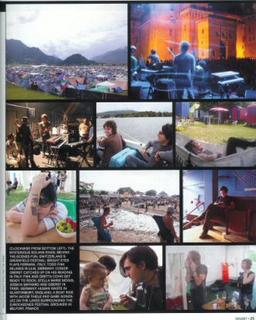
First, if you insist on using "clockwise" as a directional designator (even though there are images in the center of the "clock" - as if any clock hand, after moving through the twelve hours, then leaps to the center for a couple more hours), why start the "clock" at the "lower left" image, instead of the far more intuitive and typical upper left? Especially when the "lower left" image is not, in fact, in the lowermost row (since the lowest, leftmost area of the image is the captions themselves).
This design also forces the reader to jump back and forth between the image and a difficult-to-parse (because unnumbered) area of text. Frankly, I doubt I would have figured out which image is which if the visual content in some cases didn't tell me which caption went with the image.
It would have been much smarter either to place the captions directly beneath each image, in between the images in the black background areas; or to number the captions and images correspondingly.
-- -- --
In an amusing and unrelated note, it would appear Christopher Hitchens and his ilk are having their way with the language: in the article that goes with these photos (a tour diary from Jacob Thiele, keyboard player for the Faint and Bright Eyes), it's noted that recent editions of the game Risk have replaced the word "conquer" with the word "liberate."
Subtle move, Parker Brothers. I suppose Monopoly is now going to be called "Stimulating the Economic Recovery By Generating Supply-Side Capital to Grow the Ownership Society" or something?

First, if you insist on using "clockwise" as a directional designator (even though there are images in the center of the "clock" - as if any clock hand, after moving through the twelve hours, then leaps to the center for a couple more hours), why start the "clock" at the "lower left" image, instead of the far more intuitive and typical upper left? Especially when the "lower left" image is not, in fact, in the lowermost row (since the lowest, leftmost area of the image is the captions themselves).
This design also forces the reader to jump back and forth between the image and a difficult-to-parse (because unnumbered) area of text. Frankly, I doubt I would have figured out which image is which if the visual content in some cases didn't tell me which caption went with the image.
It would have been much smarter either to place the captions directly beneath each image, in between the images in the black background areas; or to number the captions and images correspondingly.
-- -- --
In an amusing and unrelated note, it would appear Christopher Hitchens and his ilk are having their way with the language: in the article that goes with these photos (a tour diary from Jacob Thiele, keyboard player for the Faint and Bright Eyes), it's noted that recent editions of the game Risk have replaced the word "conquer" with the word "liberate."
Subtle move, Parker Brothers. I suppose Monopoly is now going to be called "Stimulating the Economic Recovery By Generating Supply-Side Capital to Grow the Ownership Society" or something?
cheese?
I will not add to the deluge of fan-comment on Serenity (except to say that I really, really like it: I've seen it only twice, so I'm probably disqualified from true fanboy status) but I will say this:
Note to The Future: Please, please, please do not adorn my headstone with an animated GIF. I suppose every movie has to have one truly, irredeemably cheesy moment - that's this one's.
Note to The Future: Please, please, please do not adorn my headstone with an animated GIF. I suppose every movie has to have one truly, irredeemably cheesy moment - that's this one's.
10.08.2005
Grunting Fingers and the Vindication of Jack Ely
Some interesting conversation going on in the comments area of my "classically trained" post. Here's a followup.
I mention Andy Partridge's description of the writing of "Easter Theatre." Here's the full bit, released as one of the "b-sides" to the British CD single of the song. (Alas, CDs have no true b-side to speak of...) I don't think Partridge has any technical musical training (one clue: he refers to the notes of the initial chord as E, D-flat, and E-flat - whereas the musically trained would, rooting a chord on E, think of the other two notes as C-sharp and D-sharp) but this song - and the pseudo-orchestral arrangement he pulled out of his keyboard, as heard on the demo of the track also released on the single - demonstrate that lack of same is no obstacle at all toward musical creativity, given talent the scale of Andy Partridge's.
The way "Easter Theatre" was composed reminds me of a theory I have about Frank Zappa - who, although very literate musically, was also entirely self-taught. Somewhat in the way the XTC song evolves both musically and lyrically from the act of playing the guitar part (itself derived from physically exploring the fretboard and asking, what does this sound like?), I think a lot of Zappa's larger-scale works are episodic, story-based, and illustrative in structure. Even when there's no programmatic element given, the music tends to sound as if it's telling a story of sorts, or illustrating ideas, characters, or situations. It rarely feels structured in conventional musical terms (although the same is true of much 20c classical music, Zappa's main influence in these large-scale pieces I'm talking about.) Had Zappa been the sort of composer content to work for anyone else, he could have written some fine film soundtracks, I think.
Zappa makes a fine segue to this little bit that occurred to me as I happened to hear the Kingsmen's version of "Louie Louie" the other day (since Zappa used that song as raw material quite a lot). For years, vocalist Jack Ely has been slammed for what sounds like his early entry after the guitar solo. Given the overall sound of the vocals, it's been assumed that he was just too damned drunk to get it right.
Well, guess what: I don't think that mistake is Ely's fault at all. I think it's the rest of the band that screwed up. Every other part of "Louie Louie" is made up of regular old 8-bar phrases - except the guitar solo, which unaccountably is one 8-bar phrase followed by a 10-bar phrase. And when does Ely come in? Dot-on at the beginning of the 17th bar - which if the song were structured as expected would be exactly where he was supposed to come in. Now it's true that blues-based songs are sometimes a bit irregular, and close listening to the guitar solo suggests that the guitarist felt his phrase finished at the end of the 14th bar, and the remaining 4 (in his mind) bars were a sort of transition back to the verse. But (as this page points out - scroll down to the "rare autographed picture" section) Ely wasn't the band's regular vocalist, and in such a situation it would seem incumbent on the band to make sure Ely knew that the solo section was 18 bars long, not the expected 16. And really, the only threads to hang this theory on are (a) the aforementioned phrasing of the solo, and (b) the fact that the drummer notoriously shuts Ely up with a furious fill after Ely enters "early." So maybe it's Ely's fault - or maybe the band tossed in another 2 bars on the fly and, as instrumentalists rather than singers, went with the feel of the song rather than counting bars. Given all that, it's no surprise that estrangement soon set in between the band and Ely - who, despite being the singer on the band's only hit, was soon out of the band entirely. (For much more than you probably want to know about "Louie Louie," go to the top of the "Louie Louie" website mentioned above.)
Andy Partridge "Easter Theatre" explained
Andy Partridge "Easter Theatre" demo
The Kingsmen "Louie Louie"
(note: the ET background and "Louie Louie" are mono and low-res mp3s - fidelity not really being an issue in either case, and besides, how can you not have "Louie Louie" already in your collection?)
I mention Andy Partridge's description of the writing of "Easter Theatre." Here's the full bit, released as one of the "b-sides" to the British CD single of the song. (Alas, CDs have no true b-side to speak of...) I don't think Partridge has any technical musical training (one clue: he refers to the notes of the initial chord as E, D-flat, and E-flat - whereas the musically trained would, rooting a chord on E, think of the other two notes as C-sharp and D-sharp) but this song - and the pseudo-orchestral arrangement he pulled out of his keyboard, as heard on the demo of the track also released on the single - demonstrate that lack of same is no obstacle at all toward musical creativity, given talent the scale of Andy Partridge's.
The way "Easter Theatre" was composed reminds me of a theory I have about Frank Zappa - who, although very literate musically, was also entirely self-taught. Somewhat in the way the XTC song evolves both musically and lyrically from the act of playing the guitar part (itself derived from physically exploring the fretboard and asking, what does this sound like?), I think a lot of Zappa's larger-scale works are episodic, story-based, and illustrative in structure. Even when there's no programmatic element given, the music tends to sound as if it's telling a story of sorts, or illustrating ideas, characters, or situations. It rarely feels structured in conventional musical terms (although the same is true of much 20c classical music, Zappa's main influence in these large-scale pieces I'm talking about.) Had Zappa been the sort of composer content to work for anyone else, he could have written some fine film soundtracks, I think.
Zappa makes a fine segue to this little bit that occurred to me as I happened to hear the Kingsmen's version of "Louie Louie" the other day (since Zappa used that song as raw material quite a lot). For years, vocalist Jack Ely has been slammed for what sounds like his early entry after the guitar solo. Given the overall sound of the vocals, it's been assumed that he was just too damned drunk to get it right.
Well, guess what: I don't think that mistake is Ely's fault at all. I think it's the rest of the band that screwed up. Every other part of "Louie Louie" is made up of regular old 8-bar phrases - except the guitar solo, which unaccountably is one 8-bar phrase followed by a 10-bar phrase. And when does Ely come in? Dot-on at the beginning of the 17th bar - which if the song were structured as expected would be exactly where he was supposed to come in. Now it's true that blues-based songs are sometimes a bit irregular, and close listening to the guitar solo suggests that the guitarist felt his phrase finished at the end of the 14th bar, and the remaining 4 (in his mind) bars were a sort of transition back to the verse. But (as this page points out - scroll down to the "rare autographed picture" section) Ely wasn't the band's regular vocalist, and in such a situation it would seem incumbent on the band to make sure Ely knew that the solo section was 18 bars long, not the expected 16. And really, the only threads to hang this theory on are (a) the aforementioned phrasing of the solo, and (b) the fact that the drummer notoriously shuts Ely up with a furious fill after Ely enters "early." So maybe it's Ely's fault - or maybe the band tossed in another 2 bars on the fly and, as instrumentalists rather than singers, went with the feel of the song rather than counting bars. Given all that, it's no surprise that estrangement soon set in between the band and Ely - who, despite being the singer on the band's only hit, was soon out of the band entirely. (For much more than you probably want to know about "Louie Louie," go to the top of the "Louie Louie" website mentioned above.)
Andy Partridge "Easter Theatre" explained
Andy Partridge "Easter Theatre" demo
The Kingsmen "Louie Louie"
(note: the ET background and "Louie Louie" are mono and low-res mp3s - fidelity not really being an issue in either case, and besides, how can you not have "Louie Louie" already in your collection?)
10.07.2005
nod if you can hear me
Since I was in high school in the late '70s, of course I became intimately familiar with that champion source of high-school yearbook quotations, Pink Floyd's The Wall. It's true that I listened to that record incessantly for a few years, until I decided it was overwrought, pretentious, and generally all the things non-punk '70s music was deemed to be by the enlightened collegiate mind of the '80s. Fact is, I didn't have to listen to it anymore - I think I'd listened to it frequently enough that its every little sparklingly recorded pindrop was encoded in my DNA.
Still and all, I really haven't picked it up again since. But I may - because a mix CD I received recently featured this cover of "Comfortably Numb" by Dar Williams and Ani DiFranco - and I realized that however lost within a rather overdone, gigantized concept (and that's either ironic, given that one of the record's themes is the way isolation and coddling sycophancy breeds an Olympian, fascist remove - or it's apt, depending on the extent to which Roger Waters was laughing at the audience eating up his increasingly Fitzcarraldian stagings of the work, or the extent to which his ego was being engorged at the same), this is a devastatingly beautiful, sad, and incisive song. Really, you don't need the rest of the album: this song says just about everything it does, without hitting you over the head with marching black-and-red hammers.
This version apparently came about because the medicated complacency of the main character seemed resonant with the current state of the electorate for Dar Williams. I'm also pleased to report that Ani DiFranco calms down enough not to hyperventilate her vocals here.
Hearing that track reminded me that, somewhere (thank you collectorz.com database) I had a cover of another track from The Wall, "Mother," as performed by My Morning Jacket. (Turned out to be from a 2000 compilation on Darla, Little Darla Has a Treat for You.) This version is a pretty straightforward take on the original, except lower-fi - which actually helps, since the distortion that occurs when the singer shouts the higher notes is rather spooky. The heavily reverbed falsetto backing vocal during the solo is nice, too. The song itself is musically (and emotionally) similar to "Comfortably Numb" - so long as you ignore much of the lyric, which appears to unironically participate in one of the album's other main themes: that women are horrifying monsters, alternately stifling and castrating. On the bright side, if anyone ever puts together a musical version of The Manchurian Candidate, this would make a great song for Raymond Shaw to sing.
Dar Williams and Ani DiFranco "Comfortably Numb"
My Morning Jacket "Mother"
Still and all, I really haven't picked it up again since. But I may - because a mix CD I received recently featured this cover of "Comfortably Numb" by Dar Williams and Ani DiFranco - and I realized that however lost within a rather overdone, gigantized concept (and that's either ironic, given that one of the record's themes is the way isolation and coddling sycophancy breeds an Olympian, fascist remove - or it's apt, depending on the extent to which Roger Waters was laughing at the audience eating up his increasingly Fitzcarraldian stagings of the work, or the extent to which his ego was being engorged at the same), this is a devastatingly beautiful, sad, and incisive song. Really, you don't need the rest of the album: this song says just about everything it does, without hitting you over the head with marching black-and-red hammers.
This version apparently came about because the medicated complacency of the main character seemed resonant with the current state of the electorate for Dar Williams. I'm also pleased to report that Ani DiFranco calms down enough not to hyperventilate her vocals here.
Hearing that track reminded me that, somewhere (thank you collectorz.com database) I had a cover of another track from The Wall, "Mother," as performed by My Morning Jacket. (Turned out to be from a 2000 compilation on Darla, Little Darla Has a Treat for You.) This version is a pretty straightforward take on the original, except lower-fi - which actually helps, since the distortion that occurs when the singer shouts the higher notes is rather spooky. The heavily reverbed falsetto backing vocal during the solo is nice, too. The song itself is musically (and emotionally) similar to "Comfortably Numb" - so long as you ignore much of the lyric, which appears to unironically participate in one of the album's other main themes: that women are horrifying monsters, alternately stifling and castrating. On the bright side, if anyone ever puts together a musical version of The Manchurian Candidate, this would make a great song for Raymond Shaw to sing.
Dar Williams and Ani DiFranco "Comfortably Numb"
My Morning Jacket "Mother"
10.06.2005
so as not to piddle sixteenth notes on the carpet
Hello. I'd like to introduce you to one of my music-critical pet peeves - the phrase "classically trained." First, it's never defined exactly what that means: are we talking two years of piano lessons, or a masters degree from Juilliard? And there's something dubious about rock critics (who are usually the ones to trot this cliche out for walkies) getting all excited about someone who's "trained." Ain't rock'n'roll supposed to be all about expression, power, and excitement that doesn't need no steenkin' training? Isn't being "trained" antithetical to the whole rock ethos? (Note that I'm not normally a big fan of the supposed rock ethos - but it's amusing how often critics whom one can infer are fans still use that "classically trained" sobriquet. Note also that it's fun to use the word "sobriquet.")
Mainly, though, how the hell is it ever relevant? If someone can play the violin, we can hear that - what do we gain knowing she's "classically trained" - that if we happen to ask her to whip out some Mozart she can do so? (Although I'll note parenthetically that, appallingly, there are courses in music schools on "rock performance" - Professor Jack Black is going for tenure I suppose.) Are we supposed to assume that a "classically trained" piano player is automatically better than one who isn't? Not around these here musical parts, no thank you.
("But how can I type when you tie those long sleeves together behind my back?")
Mainly, though, how the hell is it ever relevant? If someone can play the violin, we can hear that - what do we gain knowing she's "classically trained" - that if we happen to ask her to whip out some Mozart she can do so? (Although I'll note parenthetically that, appallingly, there are courses in music schools on "rock performance" - Professor Jack Black is going for tenure I suppose.) Are we supposed to assume that a "classically trained" piano player is automatically better than one who isn't? Not around these here musical parts, no thank you.
("But how can I type when you tie those long sleeves together behind my back?")
10.04.2005
just like you're Charles I...
I've written about Statuesque before, but that was before I had mp3 hosting space, and so here I go again. I think one thing that might prevent the band from reaching a larger audience (aside from the "band" being primarily Stephen Manning, and the usual issues with so-called pop not being at all popular these days) is the complexity, and thereby length, of Manning's songs. They don't sound complex - it's not a complexity of difficult parts, or tricky rhythms, or intricate arrangements - but Manning tends toward rather complex song structures, with each verse and chorus often having both an "A" and a "B" section. If there's only one Statuesque song you've heard, it's probably "Ton of Feathers, Ton of Steel" from the band's first EP Angleterre (released in 1996), which actually showed up on a CMJ compilation and got some college-radio airplay. I post it here because, well, it's only one of the best songs of the past ten years. But notice how rambling a song it is: after a 4-bar intro, we go into a 16-bar verse, followed by an 8-bar "B" section of verse, followed by what turns out to be the "A" section of a chorus (8 bars), and finally what's clearly the chorus itself (another 8 bars). Counting the 4-bar interlude before the second verse begins, that's 44 bars after the intro - already, we're nearly at the song's two-minute mark. There's another section like the first one, a 16-bar instrumental section (on different chords from every other section, although they're related), and then a truncated verse/chorus section, then out. The song's not that long, at 4:37 - but I think the average listener probably gets lost trying to figure out where the song's going and where it's been.
"Dash" is a bit simpler, structurally - although not by much. (I'll spare you the analysis - you can do it yourself if you're so inclined.) This is the leadoff from Statuesque's 2001 album Live from Lake Vostok (no, it isn't), which was released initially in the form of a seltzer tablet guaranteed to fully dissolve within forty-five seconds. I think it had a slightly wider release on CD - but not much.
I will recommend Statuesque's latest and most readily obtainable release, Choir Above Fire Below, on 125 Records (Hi Sue and Joe! There I go, doing pro bono promo for my friends again...). You can listen to mp3s from that release at the 125 website. I would also recommend Statuesque's hilarious website at the not-obvious www.statuesque.org.uk - but I'm not linking to it directly because it's been down for the last two days, and I don't know if it plans to exist any longer.
Statuesque "Ton of Feathers, Ton of Steel"
Statuesque "Dash"
"Dash" is a bit simpler, structurally - although not by much. (I'll spare you the analysis - you can do it yourself if you're so inclined.) This is the leadoff from Statuesque's 2001 album Live from Lake Vostok (no, it isn't), which was released initially in the form of a seltzer tablet guaranteed to fully dissolve within forty-five seconds. I think it had a slightly wider release on CD - but not much.
I will recommend Statuesque's latest and most readily obtainable release, Choir Above Fire Below, on 125 Records (Hi Sue and Joe! There I go, doing pro bono promo for my friends again...). You can listen to mp3s from that release at the 125 website. I would also recommend Statuesque's hilarious website at the not-obvious www.statuesque.org.uk - but I'm not linking to it directly because it's been down for the last two days, and I don't know if it plans to exist any longer.
Statuesque "Ton of Feathers, Ton of Steel"
Statuesque "Dash"
10.02.2005
meta-girl last night...
You will note that I've added a notice to the site indicating that links will open in a new window. Over at the digs of the mysterious Summervillain, there's a discussion on this very issue, which spurred me to add that notice. If for whatever reason you want links to open in this very window, well, I'm sure you know how to make that happen, too.
Also: my apologies for adding one of those "can you read the wacky hula-dancing nonsense text?" doohickeys to the comments area...but I've been spambombed recently with dorks claiming to offer me guitar lessons (maybe they listened to the stellar slide work on "Monkey Typing Pool"), restore my sex life to the way it used to be (these people clearly don't know me), or introduce me to Paris Hilton's jeweller. If anyone for whatever reason cannot use that feature, you probably can still figure out how to e-mail me.
(Next step: commentors - not to be confused with dementors - will have to flip the fish I've placed atop their nose up into the air and then catch it in their mouth.)
Also: my apologies for adding one of those "can you read the wacky hula-dancing nonsense text?" doohickeys to the comments area...but I've been spambombed recently with dorks claiming to offer me guitar lessons (maybe they listened to the stellar slide work on "Monkey Typing Pool"), restore my sex life to the way it used to be (these people clearly don't know me), or introduce me to Paris Hilton's jeweller. If anyone for whatever reason cannot use that feature, you probably can still figure out how to e-mail me.
(Next step: commentors - not to be confused with dementors - will have to flip the fish I've placed atop their nose up into the air and then catch it in their mouth.)
10.01.2005
logic and disgust
Bumper sticker: IF GUNS CAUSE CRIME THEN MATCHES CAUSE ARSON. Hmmm...I don't recall anyone saying that guns, per se, cause crime. What they do is facilitate it, or make it worse. Here's a better, more accurate (if considerably less pithy) bumper sticker:
IF GUNS INCREASE THE LIKELIHOOD OF IMPULSIVE FATAL CRIME THEN GIVING EVERY OTHER ANGRY ILL-TEMPERED JACKASS A FLAMETHROWER WOULD INCREASE THE LIKELIHOOD OF SHIT GETTING TORCHED
(Yet another in the ongoing series of "Why I'm Not in Marketing"...)
You may not want to be eating your lunch before reading this next.
For some reason, this review in The Onion A.V. Club of Matthew Herbert's new CD (sounds intriguing...at least as conceptual art) reminded me of the following thought experiment designed to show that disgust is less a matter of practical reaction to potentially harmful consequences (I think certain behavioral-oriented biologists might make an argument along these lines) than, well, something else.
Take a clean drinking glass. Spit into it, repeatedly, until there's enough liquid to fill the glass to about half an inch. Drink it.
If you're like me (and you probably are in this respect), "there's not enough ick in the world" was probably your reaction (at least if Joss Whedon lines form a significant substratum of your thoughts) - and you're probably cursing me for putting disgusting ideas in your head. (If you're not like me, and you actually performed this experiment, (a) go ahead: one of those traveling freak-show circuses no doubt has an opening for you; (b) you clearly don't recognize the meaning of the phrase "thought experiment.") Yet, logically, what's the problem? What's in the glass was in your very own mouth just a few seconds beforehand; the glass was clean. Logically, there shouldn't be any revulsion at all here - unless you're revolted thinking of what's in your mouth at any given moment. (If I were really opportunistic, I'd put up the Oil Tasters' "What's In Your Mouth?" right about now. But you know, the associations just might completely ruin the song - so I won't.)
(Speaking of The Onion, their Nicole Kidman story is rather similar to my Britney Spears bit from April. Their attorneys will hear from mine forthwith. Or not.
IF GUNS INCREASE THE LIKELIHOOD OF IMPULSIVE FATAL CRIME THEN GIVING EVERY OTHER ANGRY ILL-TEMPERED JACKASS A FLAMETHROWER WOULD INCREASE THE LIKELIHOOD OF SHIT GETTING TORCHED
(Yet another in the ongoing series of "Why I'm Not in Marketing"...)
You may not want to be eating your lunch before reading this next.
For some reason, this review in The Onion A.V. Club of Matthew Herbert's new CD (sounds intriguing...at least as conceptual art) reminded me of the following thought experiment designed to show that disgust is less a matter of practical reaction to potentially harmful consequences (I think certain behavioral-oriented biologists might make an argument along these lines) than, well, something else.
Take a clean drinking glass. Spit into it, repeatedly, until there's enough liquid to fill the glass to about half an inch. Drink it.
If you're like me (and you probably are in this respect), "there's not enough ick in the world" was probably your reaction (at least if Joss Whedon lines form a significant substratum of your thoughts) - and you're probably cursing me for putting disgusting ideas in your head. (If you're not like me, and you actually performed this experiment, (a) go ahead: one of those traveling freak-show circuses no doubt has an opening for you; (b) you clearly don't recognize the meaning of the phrase "thought experiment.") Yet, logically, what's the problem? What's in the glass was in your very own mouth just a few seconds beforehand; the glass was clean. Logically, there shouldn't be any revulsion at all here - unless you're revolted thinking of what's in your mouth at any given moment. (If I were really opportunistic, I'd put up the Oil Tasters' "What's In Your Mouth?" right about now. But you know, the associations just might completely ruin the song - so I won't.)
(Speaking of The Onion, their Nicole Kidman story is rather similar to my Britney Spears bit from April. Their attorneys will hear from mine forthwith. Or not.
Subscribe to:
Posts (Atom)

