Here's a great website, Milwaukee Rock Posters (run by the former drummer of Couch Flambeau), particularly for Milwaukeeans and ex-Milwaukeeans who are old enough to remember many of these bands (and maybe many of these shows). Even if you're in none of those demographics, the posters and photos are an interesting snapshot of a long-gone aesthetic moment. Some of the posters look like they were done in five minutes; others clearly took hours and hours of painstaking effort. Then, the same is true of many of these bands' songs.
Incidentally, if anyone has a good-quality mp3 of the Blackholes' "Warren Spahn," I'd be eternally grateful... For some reason, I'm thinking of making a mix CD consisting of songs named after baseball players (several of which seem to have nothing to do with the ballplayers...but hey).


10.28.2006
10.21.2006

10.17.2006
stupid is as stupid does
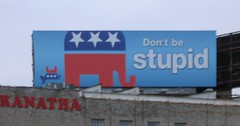
Here's a peculiar billboard, visible just south of the High-Rise Bridge from northbound I-94/I-43:
It would appear to be a pro-Republican billboard, at least upon examination: the upside-down Democratic donkey (oh-so-cleverly placed directly beneath the Republican elephant's asshole, as if to say that Republicans crap Democrats) suggests the point is that one should not be "stupid" but should instead be (as the dominant graphic has it) Republican. And of course the style - personal attack in lieu of substance, with a tasty soupçon of adolescent scatalogy - is all too Rovean. (Not that the Dems are immune to sleaze, and not that they have all that great a record of accomplishment to point to lately - but the Republicans have the Democrats completely outdone in fiascoes, malfeasance, idiocy, bigotry, and outrageous disregard for human decency.)
The really funny thing, though, is that roaring by the billboard on the freeway at 60 miles per hour, it's pretty easy to miss the donkey. Without the donkey, the billboard presents quite a different message: here's the Republican elephant, and here's an admonition not to be stupid. Clearly, the two ideas go together: "Don't be stupid and be a Republican."
Someone's graphic skills need a bit of work.
It would appear to be a pro-Republican billboard, at least upon examination: the upside-down Democratic donkey (oh-so-cleverly placed directly beneath the Republican elephant's asshole, as if to say that Republicans crap Democrats) suggests the point is that one should not be "stupid" but should instead be (as the dominant graphic has it) Republican. And of course the style - personal attack in lieu of substance, with a tasty soupçon of adolescent scatalogy - is all too Rovean. (Not that the Dems are immune to sleaze, and not that they have all that great a record of accomplishment to point to lately - but the Republicans have the Democrats completely outdone in fiascoes, malfeasance, idiocy, bigotry, and outrageous disregard for human decency.)
The really funny thing, though, is that roaring by the billboard on the freeway at 60 miles per hour, it's pretty easy to miss the donkey. Without the donkey, the billboard presents quite a different message: here's the Republican elephant, and here's an admonition not to be stupid. Clearly, the two ideas go together: "Don't be stupid and be a Republican."
Someone's graphic skills need a bit of work.
10.16.2006
my time is wasting
Had a rather frustrating weekend dealing with a well-known Swedish-based household-goods retailer. Here are some ideas on how to run a business (which are collectively available for purchase under the name "Snårki"):
1. If you sell furnishings (such as bookshelves) that are modular, have a website that lists them in various configurations - but make it very difficult to find out any useful information about individual units. By no means should you list the dimensions of the items as packaged. This will prohibit your customer from doing something silly like figuring out what sort of vehicle will accommodate purchases.
2. Structure shipping charges by item, not by weight. Customers sometimes have the unreasonable expectation that, given that most of the cost of shipping an item comes with the first item (someone has to drive a truck), subsequent items might cost less, on the grounds that each item is not, in fact, coming in its own separate truck with individual driver. Frustrate this inane notion: after all, it's simpler just to multiply numbers (even when the resulting shipping charge would be more expensive than the items purchased) than to have complex calculations that might save a customer money and encourage them to reduce profits by ordering lots of stuff at once.
3. Do not allow customers to purchase items in advance for pick-up at any particular store. Customers should demonstrate their loyalty by driving several hours in a rented vehicle on the off-chance that the particular set of items they're looking for might just might happen to be in stock.
4. Maintain only a vague and offhandedly accurate record of inventory. "Three or four" is a number.
5. Have a very loose definition of "in stock." Example: instruct your sales personnel to tell customers, yes, we have 20 of that item "in stock." Even if only 1 of this item is actually available for purchase (and that item, opened and beat-up: see below).
6. If a customer, having been told that there are 20 of a particular item "in stock," then discovers that of that 20 (of which the customer wishes to purchase 2), 20 of them are on warehouse shelves fifteen feet off the floor, wrapped in plastic on a palette, tell the customer that a manager will be with them "shortly." ("Shortly" means: before the store closes, but not necessarily sooner.)
7. Inform the customer that even though the 20 items are "in stock," they cannot be sold - because the store cannot operate a forklift during open hours, even though big-box retailers like Home Depot do so all the time. Refuse any suggestions that the aisle might be closed off temporarily for safety issues. Do not immediately acknowledge that this policy is not "law" but only store policy.
8. If the customer suggests that there's no need for a forklift - that someone on a ladder with a boxcutter could cut the plastic and bring down a package - return to the rules and regulations regarding forklifts and safety, irrelevantly. (At this point, keep a close watch on the customer, who is eyeing the kitchen supplies area looking for a small, sharp knife with a Swedish name and thinking of monkeying up onto the scaffolding and cutting the plastic himself.)
9. Claim that, even though the store's been open only two hours that day and that it's the busiest sales day of the week, the store isn't in the least to blame for lazy failure to stock (note: in this instance, by "stock" we mean "make available for actual sale by not hiding the item in an inaccessible location") an item you've already informed the customer is "very popular." Claim that all ten or twenty or so of the item that would fit in the glaringly empty space set aside for the item must have sold that morning - even though there's also no empty pallet there, as if an unfussy customer decided the pallet would do as well as the item of furniture, at least if given a charmingly Swedish name.
10. Neglect to mention until the customer is apoplectic with rage that, oh, there's another, newly-opened branch of the store only twenty miles away that has the desired item in stock (in this case, actually sellable).
Pavement "A Date with Ikea"
John Vanderslice "My Old Flame"
Jonathan Coulton "Ikea"
* If the Coulton track doesn't download, go here and right-click on the "Download Song" link.
1. If you sell furnishings (such as bookshelves) that are modular, have a website that lists them in various configurations - but make it very difficult to find out any useful information about individual units. By no means should you list the dimensions of the items as packaged. This will prohibit your customer from doing something silly like figuring out what sort of vehicle will accommodate purchases.
2. Structure shipping charges by item, not by weight. Customers sometimes have the unreasonable expectation that, given that most of the cost of shipping an item comes with the first item (someone has to drive a truck), subsequent items might cost less, on the grounds that each item is not, in fact, coming in its own separate truck with individual driver. Frustrate this inane notion: after all, it's simpler just to multiply numbers (even when the resulting shipping charge would be more expensive than the items purchased) than to have complex calculations that might save a customer money and encourage them to reduce profits by ordering lots of stuff at once.
3. Do not allow customers to purchase items in advance for pick-up at any particular store. Customers should demonstrate their loyalty by driving several hours in a rented vehicle on the off-chance that the particular set of items they're looking for might just might happen to be in stock.
4. Maintain only a vague and offhandedly accurate record of inventory. "Three or four" is a number.
5. Have a very loose definition of "in stock." Example: instruct your sales personnel to tell customers, yes, we have 20 of that item "in stock." Even if only 1 of this item is actually available for purchase (and that item, opened and beat-up: see below).
6. If a customer, having been told that there are 20 of a particular item "in stock," then discovers that of that 20 (of which the customer wishes to purchase 2), 20 of them are on warehouse shelves fifteen feet off the floor, wrapped in plastic on a palette, tell the customer that a manager will be with them "shortly." ("Shortly" means: before the store closes, but not necessarily sooner.)
7. Inform the customer that even though the 20 items are "in stock," they cannot be sold - because the store cannot operate a forklift during open hours, even though big-box retailers like Home Depot do so all the time. Refuse any suggestions that the aisle might be closed off temporarily for safety issues. Do not immediately acknowledge that this policy is not "law" but only store policy.
8. If the customer suggests that there's no need for a forklift - that someone on a ladder with a boxcutter could cut the plastic and bring down a package - return to the rules and regulations regarding forklifts and safety, irrelevantly. (At this point, keep a close watch on the customer, who is eyeing the kitchen supplies area looking for a small, sharp knife with a Swedish name and thinking of monkeying up onto the scaffolding and cutting the plastic himself.)
9. Claim that, even though the store's been open only two hours that day and that it's the busiest sales day of the week, the store isn't in the least to blame for lazy failure to stock (note: in this instance, by "stock" we mean "make available for actual sale by not hiding the item in an inaccessible location") an item you've already informed the customer is "very popular." Claim that all ten or twenty or so of the item that would fit in the glaringly empty space set aside for the item must have sold that morning - even though there's also no empty pallet there, as if an unfussy customer decided the pallet would do as well as the item of furniture, at least if given a charmingly Swedish name.
10. Neglect to mention until the customer is apoplectic with rage that, oh, there's another, newly-opened branch of the store only twenty miles away that has the desired item in stock (in this case, actually sellable).
Pavement "A Date with Ikea"
John Vanderslice "My Old Flame"
Jonathan Coulton "Ikea"
* If the Coulton track doesn't download, go here and right-click on the "Download Song" link.
10.10.2006
eight and seventeen
Just acquired a bunch of new CDs and thought I'd post a track from each. But hey: that would be a lot of writing, if I were to actually describe all of them in any kind of detail. Solution: eight haiku, of course. (Tracks chosen quasi-randomly from the middle of the CDs.)
Bruford One of a Kind (used) "The Abingdon Chasp":
bass impersonates
elegant sumo wrestlers;
keys a whiff of cheese
Iggy Pop Blah-Blah-Blah (used) "Cry for Love":
iguana smothered
in neon big-drum coked-out
glossy trash traffic
Baxter Dury Len Parrot's Memorial Lift (used) "Bachelor":
not his father's block
heads for the beach, boys filtered
through smoky glamour
Lansing-Dreiden The Dividing Island (used) "Our Next Breath":
this firm produces
ads for abstract glass buildings
glimpsed through shrouding fog
Matthew Friedberger Winter Women / Holy Ghost Language School "Don't You Remember?":
Dear Sir or Madam:
Please find telegram, enclosed:
my heart, in crayon
Now It's Overhead Dark Light Daybreak "Dark Light Daybreak":
who drowned this water,
burnt this fire, and scattered
dried-leaf paragraphs?
Pere Ubu Why I Hate Women "Mona":
Cartoon sestinas,
leather-jacket circuses,
why can't I hold sand?
TV On the Radio Return to Cookie Mountain "Wolf Like Me":
Bells ring underground,
quill from claw I write life in
hell's erasing ink
Bruford One of a Kind (used) "The Abingdon Chasp":
bass impersonates
elegant sumo wrestlers;
keys a whiff of cheese
Iggy Pop Blah-Blah-Blah (used) "Cry for Love":
iguana smothered
in neon big-drum coked-out
glossy trash traffic
Baxter Dury Len Parrot's Memorial Lift (used) "Bachelor":
not his father's block
heads for the beach, boys filtered
through smoky glamour
Lansing-Dreiden The Dividing Island (used) "Our Next Breath":
this firm produces
ads for abstract glass buildings
glimpsed through shrouding fog
Matthew Friedberger Winter Women / Holy Ghost Language School "Don't You Remember?":
Dear Sir or Madam:
Please find telegram, enclosed:
my heart, in crayon
Now It's Overhead Dark Light Daybreak "Dark Light Daybreak":
who drowned this water,
burnt this fire, and scattered
dried-leaf paragraphs?
Pere Ubu Why I Hate Women "Mona":
Cartoon sestinas,
leather-jacket circuses,
why can't I hold sand?
TV On the Radio Return to Cookie Mountain "Wolf Like Me":
Bells ring underground,
quill from claw I write life in
hell's erasing ink
10.07.2006
Floohg! Uft! Buhd! Grint!
Look, I know it's been forty or fifty years that bands have had to give themselves names more intriguing than "John Thomas and the Stank-o-tones," but it seems recent acts are resorting to apparently random nonsense syllables.
There's a Canadian act called the Duhks (pronounced like the fowl). There's a local act called the Mahp (pronounced I have no idea: mop? map? ma-aa-aap?). And perhaps that's fitting - since the (recently re-formed) '80s Milwaukee act called the Gufs might be said to have started all this. (That band has some goofy explanation involving some obscure movie...but c'mon, guys, face it: to the rest of the world, it's a nonsense syllable, or a misspelling of "guff" - but why would you call your band that?)
There's a Canadian act called the Duhks (pronounced like the fowl). There's a local act called the Mahp (pronounced I have no idea: mop? map? ma-aa-aap?). And perhaps that's fitting - since the (recently re-formed) '80s Milwaukee act called the Gufs might be said to have started all this. (That band has some goofy explanation involving some obscure movie...but c'mon, guys, face it: to the rest of the world, it's a nonsense syllable, or a misspelling of "guff" - but why would you call your band that?)
10.03.2006
of curdled milk
Here's a fairly common musical strategy: take one idea, one that manifests itself as a steady, regular, and consonant musical flow, and set against it a more irregular, dissonant, contrasting piece of music; overall, of course, the resulting piece expresses tension, frustration, disagreement, etc. For whatever reason, composers will often use melodic and harmonic figures characteristic of the Baroque to express that first quality - probably because such music is often described as being "pure" music, free of programmatic content and expressive of elegant, even mathematical, relations among the notes.
What's curious is the way nominally emotionally-neutral can come to be powerfully emotionally expressive, in such a context. Four examples to illustrate:
In "Jane Fakes a Hug," the Wrens take a Bach-like chordal sequence and set against it an increasingly agitated series of countervailing gestures, culminating in a complete breakdown of the sequence into random noise. (Cleverly, though, they've prepared us for that noise by having a blurping, not-quite-rhythmic noise in the background throughout the song.) The lyrics, of course, are about the breakup of a marriage in suburbia (as, it would seem, is most of the Secaucus album). In that context, the Baroque figure reads as a sort of inevitably, a progress that has an impetus of its own, much as the narrator imagines his frustration and desperation leading him first to flirtation, then into an affair, driving the breakup of a failing marriage.
In many ways, the Wrens track is a translation into personal, everyday life of the high-minded (and rather heavy-handed) philosophical issues Charles Ives explored in his well-known piece "The Unanswered Question." Here, the strings play an imperturbable, tonic sequence (reminiscent of the well-known Pachelbel canon in D), against which the trumpet "asks" its repeated "question," in response to which the flute quartet becomes increasingly agitated (and discordant). (One route from Ives' ostensibly philosophic milieu to the Wrens' emotional and sexual realm might look at the bizarre, macho way Ives approached discord: he once infamously rebuked an audience for their reaction to one of his pieces, challenging them to "stand up and take dissonance like a man." This isn't the space to analyze that sort of peculiar and projected anxiety...)
Speaking of that Pachelbel canon, Brian Eno and Gavin Bryars notoriously deconstructed that piece by taking bits and pieces of the score and altering it in various ways. The third and final movement (entitled "Brutal Ardour": the titles, Eno's notes inform us, come from "the charmingly inaccurate translation of the French cover notes for the Erato recording of the piece made by the orchestra of Jean Francois Pailliard") is altered by having "each player [play] a sequence of notes related to those of the other players, but [whose] sequences are of different lengths so that the original relationships [among the notes] break down." Curious that even though Eno's piece is more cerebral and less expresses tension among different parts than simply manifesting the tension through its alteration of the original piece, the notion of "relationships break[ing] down" is present here, too. (In this context, it's worth noting that the mistranslated titles may have seemed "charming" to Eno in their inaccuracy in part because of their sexual and scatalogical implications: the other two movements are called "Fullness of Wind" and "French Catalogues.")
Finally, a rather more obscure piece than any of these: "In the Autumn of My Madness," the third section of Procol Harum's "In Held 'Twas in I" (one of the first side-long prog-rock epics - originally from their second album, 1968's Shine On Brightly, although I've excerpted the orchestrated version from their 1972 recording with the Edmonton Symphony Orchestra and Chorus), in which a harmonically and rhythmically restless verse (along with the band's typically Baroque-influenced bass lines) appears to resolve its tension in a very Baroque organ figure between verses. That resolution, however, is illusory: the organ modulates upward, step by step, seemingly without end, as trumpets play sirens and random noises erupt from the orchestra. (I used the orchestral version for two reasons: I like Gary Brooker's vocal much better than the studio recording's vocal - Matthew Fisher? - and the imitation trumpet-based sirens are less cheesy than the field-recording sirens on the original.) Once again, the juxtaposition of an orderly Baroque figure is contrasted with chaotic material, the chaos being magnified by the contrast - and in this case, with the added complication that even the apparent order spirals into chaos, modulating and modulating in an Escher-like series that has no obvious endpoint (in fact, the band rises through more than an octave before the figure is abruptly cut off).
The Wrens "Jane Fakes a Hug"
Charles Ives "The Unanswered Question" (Orpheus Chamber Orchestra)
Brian Eno "Three Variations on the Canon in D Major by Johann Pachelbel: (iii) Brutal Ardour" (Gavin Bryars, the Cockpit Ensemble)
Procol Harum "In the Autumn of My Madness" from "In Held 'Twas in I" (with the Edmonton Symphony Orchestra and Chorus)
What's curious is the way nominally emotionally-neutral can come to be powerfully emotionally expressive, in such a context. Four examples to illustrate:
In "Jane Fakes a Hug," the Wrens take a Bach-like chordal sequence and set against it an increasingly agitated series of countervailing gestures, culminating in a complete breakdown of the sequence into random noise. (Cleverly, though, they've prepared us for that noise by having a blurping, not-quite-rhythmic noise in the background throughout the song.) The lyrics, of course, are about the breakup of a marriage in suburbia (as, it would seem, is most of the Secaucus album). In that context, the Baroque figure reads as a sort of inevitably, a progress that has an impetus of its own, much as the narrator imagines his frustration and desperation leading him first to flirtation, then into an affair, driving the breakup of a failing marriage.
In many ways, the Wrens track is a translation into personal, everyday life of the high-minded (and rather heavy-handed) philosophical issues Charles Ives explored in his well-known piece "The Unanswered Question." Here, the strings play an imperturbable, tonic sequence (reminiscent of the well-known Pachelbel canon in D), against which the trumpet "asks" its repeated "question," in response to which the flute quartet becomes increasingly agitated (and discordant). (One route from Ives' ostensibly philosophic milieu to the Wrens' emotional and sexual realm might look at the bizarre, macho way Ives approached discord: he once infamously rebuked an audience for their reaction to one of his pieces, challenging them to "stand up and take dissonance like a man." This isn't the space to analyze that sort of peculiar and projected anxiety...)
Speaking of that Pachelbel canon, Brian Eno and Gavin Bryars notoriously deconstructed that piece by taking bits and pieces of the score and altering it in various ways. The third and final movement (entitled "Brutal Ardour": the titles, Eno's notes inform us, come from "the charmingly inaccurate translation of the French cover notes for the Erato recording of the piece made by the orchestra of Jean Francois Pailliard") is altered by having "each player [play] a sequence of notes related to those of the other players, but [whose] sequences are of different lengths so that the original relationships [among the notes] break down." Curious that even though Eno's piece is more cerebral and less expresses tension among different parts than simply manifesting the tension through its alteration of the original piece, the notion of "relationships break[ing] down" is present here, too. (In this context, it's worth noting that the mistranslated titles may have seemed "charming" to Eno in their inaccuracy in part because of their sexual and scatalogical implications: the other two movements are called "Fullness of Wind" and "French Catalogues.")
Finally, a rather more obscure piece than any of these: "In the Autumn of My Madness," the third section of Procol Harum's "In Held 'Twas in I" (one of the first side-long prog-rock epics - originally from their second album, 1968's Shine On Brightly, although I've excerpted the orchestrated version from their 1972 recording with the Edmonton Symphony Orchestra and Chorus), in which a harmonically and rhythmically restless verse (along with the band's typically Baroque-influenced bass lines) appears to resolve its tension in a very Baroque organ figure between verses. That resolution, however, is illusory: the organ modulates upward, step by step, seemingly without end, as trumpets play sirens and random noises erupt from the orchestra. (I used the orchestral version for two reasons: I like Gary Brooker's vocal much better than the studio recording's vocal - Matthew Fisher? - and the imitation trumpet-based sirens are less cheesy than the field-recording sirens on the original.) Once again, the juxtaposition of an orderly Baroque figure is contrasted with chaotic material, the chaos being magnified by the contrast - and in this case, with the added complication that even the apparent order spirals into chaos, modulating and modulating in an Escher-like series that has no obvious endpoint (in fact, the band rises through more than an octave before the figure is abruptly cut off).
The Wrens "Jane Fakes a Hug"
Charles Ives "The Unanswered Question" (Orpheus Chamber Orchestra)
Brian Eno "Three Variations on the Canon in D Major by Johann Pachelbel: (iii) Brutal Ardour" (Gavin Bryars, the Cockpit Ensemble)
Procol Harum "In the Autumn of My Madness" from "In Held 'Twas in I" (with the Edmonton Symphony Orchestra and Chorus)
Subscribe to:
Posts (Atom)

