Does the "Irish" stereotyping of the Lucky Charms leprechaun bother you as much as it bothers me? I guess the lack of outcry is just more proof that the Irish Anti-Defamation League is drunk again. (Ha. Blatantly stolen from yellojkt...)
Anyway, before he rose to semi-fame as engineer for Interpol, Peter Katis was in the Philistines Jr. with his brother Tarquin. This song - more or less the title track from their album Analog vs. Digital (the song and album have different subtitles: the song's is "Peter vs. Tarquin," the album's is, uh, very long and in the ID3 tag) - is one of the better self-referential recordings I know of.
Katis is, of course, not the only musician who went on to greater fame behind the boards. I offer you "Decline and Fall" by Sneakers - which featured a disturbingly young-looking Mitch Easter (who, of course, went on to produce the first few R.E.M. and Game Theory albums, and whose sadly underheralded band Let's Active released a handful of fine, slightly tweaked '80s-style guitar-rock records: I avoid the "j*ngle" word). Sneakers was a bit of a pre-all-star band: Easter's songwriting foil was Chris Stamey, eventually of the dB's. (Speaking of which: Stamey has reunited with the original dB's lineup, including Peter Holsapple, to record a new album due out, I believe, early next year. Two tracks are available for download at the dB's website: one for free, one for a charitable donation to a fund to help musicians rendered homeless by Katrina.)
The Philistines Jr. "Analog vs. Digital, or Peter vs. Tarquin"
Sneakers "Decline and Fall"


9.27.2005
Who's the DJ for MC Escher?
Normally I have no problem hearing various instances of rhythmic trickiness. Do your whole song in 13/8, and I'll get it. Toss in a bar of 3/4, and I won't be sitting there clapping on the wrong beats like a Republican for three and half measures. This is probably a product of my prog-rock teens, such that even the truly devilish metrical tricks going on in, say, the middle section of Yes' "Gates of Delirium" (the repeating riff is one bar of a very fast 11/8, alternating with a bar of 10/8; the staggery bit that goes bam-bam, bam-bam, bam-bam-bam is a bar each of 5/8, 6/8, and 9/8) give me little pause.
However, every once in a while a song comes along that, although simple on the surface, I just plain get confused by. Basically, it seems that I hear the "one" in the wrong place in the verses, and then get set straight by the chorus. I can think of three songs I hear this way: Cream's "Sunshine of Your Love," XTC's "That Is the Way," and Dali's Car's "Dali's Car" (speaking of songs with the same names as bands). It's possible, I suppose, that in fact the songs drop in a bar of 7/8 before the chorus and one of 9/8 afterwards - but pretty unlikely.
It's like one of those Necker cubes, although in this case I have a hard time switching back and forth, probably because I've heard these songs "wrong" for so long. The XTC track, for instance, sounds rather square and four-to-the-floor putting the one on the last note of the bass riff - a rhythmic scheme suggested both by the disco thump of the chorus and the variation on the dum-dum-dummmm rhythm in the bits between the choruses and verses. In that arrangement, Terry Chambers' drum accent provides about the only rhythmic variety, falling in between beats two and three. But damned if I hear it that way: I hear it falling squarely on two, with the one falling on the blank space immediately after that dum-dum-dummmm - as if it's some sort of mutant reggae rhythm (something XTC were no strangers to, of course), or a distant cousin of the push-pull feel of Led Zeppelin's "Dancing Days." I suppose one could argue that the square, plodding feel generated by putting heavy accents on one and three would fit the song's lyrics about stultifying conformity - but my ears just can't hear it.
Dalis Car (they spell it sans apostrophe, although I suspect that's more graphic design than some secret, occult preference) is a bit trickier, if only because the whole shape of the arrangement seems designed to throw off cozy assumptions, both rhythmically and texturally. Mick Karn's bass is made entirely of rubber, I'm sure, and he madly bounces between octaves - while the instrumental texture presents duelling bass clarinets, one per stereo channel, and a synth flute line that builds in a microtonal dip at the end as key melodic information. So yeah, these guys may well have written it with odd-metered bars bracing the chorus. Or I just have weird ears.
Perhaps some day medical science will find a cure for this debilitating illness. Until then, I simply won't be receiving any job offers from James Brown.
XTC "That Is the Way"
Dalis Car "Dalis Car"
However, every once in a while a song comes along that, although simple on the surface, I just plain get confused by. Basically, it seems that I hear the "one" in the wrong place in the verses, and then get set straight by the chorus. I can think of three songs I hear this way: Cream's "Sunshine of Your Love," XTC's "That Is the Way," and Dali's Car's "Dali's Car" (speaking of songs with the same names as bands). It's possible, I suppose, that in fact the songs drop in a bar of 7/8 before the chorus and one of 9/8 afterwards - but pretty unlikely.
It's like one of those Necker cubes, although in this case I have a hard time switching back and forth, probably because I've heard these songs "wrong" for so long. The XTC track, for instance, sounds rather square and four-to-the-floor putting the one on the last note of the bass riff - a rhythmic scheme suggested both by the disco thump of the chorus and the variation on the dum-dum-dummmm rhythm in the bits between the choruses and verses. In that arrangement, Terry Chambers' drum accent provides about the only rhythmic variety, falling in between beats two and three. But damned if I hear it that way: I hear it falling squarely on two, with the one falling on the blank space immediately after that dum-dum-dummmm - as if it's some sort of mutant reggae rhythm (something XTC were no strangers to, of course), or a distant cousin of the push-pull feel of Led Zeppelin's "Dancing Days." I suppose one could argue that the square, plodding feel generated by putting heavy accents on one and three would fit the song's lyrics about stultifying conformity - but my ears just can't hear it.
Dalis Car (they spell it sans apostrophe, although I suspect that's more graphic design than some secret, occult preference) is a bit trickier, if only because the whole shape of the arrangement seems designed to throw off cozy assumptions, both rhythmically and texturally. Mick Karn's bass is made entirely of rubber, I'm sure, and he madly bounces between octaves - while the instrumental texture presents duelling bass clarinets, one per stereo channel, and a synth flute line that builds in a microtonal dip at the end as key melodic information. So yeah, these guys may well have written it with odd-metered bars bracing the chorus. Or I just have weird ears.
Perhaps some day medical science will find a cure for this debilitating illness. Until then, I simply won't be receiving any job offers from James Brown.
XTC "That Is the Way"
Dalis Car "Dalis Car"
9.26.2005
Life in These United States
U.S. soldiers trade photos of horribly mutilated war dead for access to porn. Our heroes: so much for our moral superiority. (This link is not to the photos, although the article linked thereto contains two small versions of those photos, off to the right of the page, if you care to ignore them as best you can. The article itself links to the website in question; I personally have not gone there, and have no wish to do so.)
9.25.2005
O! What a Life of Luxury!
Stand back: I've recorded another song. This is a song about not quite getting things right. (Excuse-makers take note: such a subject offers an excellent situation for insouciantly disavowing any apparent flaws as being illustrative and on purpose. Foolproof!) It's also a song that fulfills a sadly overlooked function, that of having there be more songs whose titles are the same as the name of the act that recorded them.
Here's one of my favorite album covers of all time, which rather illustrates much of what's going on here:

Without further ado, here's Monkey Typing Pool with their smash-hit waxing called (wait for it) "Monkey Typing Pool."
Those who wish to armor themselves with information before listening to the track are advised that some information is available at the link clickable hereon. Those who'd rather let the song be the song without any of that pesky background may ignore that link, until later (a vaguely defined period of time not exclusive of "never").
Addendum 9/25 10:30 pm: I've put up a remixed version that corrects a few problems in the original version. And hey - you get four more seconds of fade out, during which you can clearly hear the ghost of John Lennon say "cranberry grubs I picked from Paul's hair."
Monkey Typing Pool "Monkey Typing Pool"
Here's one of my favorite album covers of all time, which rather illustrates much of what's going on here:
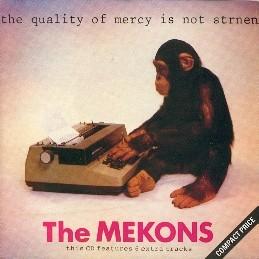
Without further ado, here's Monkey Typing Pool with their smash-hit waxing called (wait for it) "Monkey Typing Pool."
Those who wish to armor themselves with information before listening to the track are advised that some information is available at the link clickable hereon. Those who'd rather let the song be the song without any of that pesky background may ignore that link, until later (a vaguely defined period of time not exclusive of "never").
Addendum 9/25 10:30 pm: I've put up a remixed version that corrects a few problems in the original version. And hey - you get four more seconds of fade out, during which you can clearly hear the ghost of John Lennon say "cranberry grubs I picked from Paul's hair."
Monkey Typing Pool "Monkey Typing Pool"
9.24.2005
minor observations
1. Dead Guy Derby
It might be entertaining to set myself a project this semester of seeing which dead rock guy's face is on more students' t-shirts: Garcia, Hendrix, Marley, or Morrison.
2. Yo-Ho-Ho
I just realized that pirates are hip-hop Santas.
It might be entertaining to set myself a project this semester of seeing which dead rock guy's face is on more students' t-shirts: Garcia, Hendrix, Marley, or Morrison.
2. Yo-Ho-Ho
I just realized that pirates are hip-hop Santas.
9.22.2005
image du jour
A very nice piece of writing, from Sean over at Said the Gramophone:
"Okay, imagine you have a twig, a good brown twig the breadth of your thumb. And you snap it in half. And you throw the two pieces of twig to either side of a forest. And then a lonely person comes along and picks up one of the pieces of twig. He thinks life's meaningless and lame. He wanders. At the other side of the wood he idly picks up the other piece of twig. And look! Lo! They fit together! Just. Like. That. And for a long moment he's in awe of the way the world can just make things come together in the rightest way.
"Michael Lau's [of Page France, STG's featured artist today] rhymes are like that."
"Okay, imagine you have a twig, a good brown twig the breadth of your thumb. And you snap it in half. And you throw the two pieces of twig to either side of a forest. And then a lonely person comes along and picks up one of the pieces of twig. He thinks life's meaningless and lame. He wanders. At the other side of the wood he idly picks up the other piece of twig. And look! Lo! They fit together! Just. Like. That. And for a long moment he's in awe of the way the world can just make things come together in the rightest way.
"Michael Lau's [of Page France, STG's featured artist today] rhymes are like that."
9.21.2005
loneliness and dreams
One measure of the depth and strength of the Robyn Hitchcock catalog is that he has several excellent songs which have never seen official release. Often, such songs just don't fit with the mood of a given album, and sometimes it seems time simply passes such songs by. I suppose it might seem odd as a musician to release as new a song written ten years ago. Still, it's a real shame that "Surfer Ghost" has never seen official release. It is, of course, an unwritten bylaw of the pop-geek guild that no song with the word "surf" in the title can avoid being compared, at some level, to the work of Brian Wilson - and I suppose the opening vocal lines, interweaving as they do, might be regarded as Wilsonesque. But Hitchcock's cleverer than that - and the real Wilson influence here is this song's suite-like structure, moving through three distinct sections without tying the whole thing back up in a symmetrical little bow. This track was apparently recorded (by Hitchcock and Andy Metcalfe) in 1995, and at one point it was slated to be the title track of Hitchcock's then-forthcoming album, which eventually turned into Moss Elixir (and its originally LP-only companion, Mossy Liquor) - neither of which featured "Surfer Ghost," however. I actually think it would have fit quite well on that album - but it seems I am not the deity that rules the decisions made by Robyn Hitchcock. I will refrain from detailed comment on the lyrics - except that this seems a relatively early entry in Hitchcock's move toward slightly more direct and emotionally open, less overtly surreal lyrics. Of course, he's still Robyn - and trying to parse out every line literally, as if the song is really a slice-of-life (or slice-of-death) short story, is a mug's game.
Coincidentally, around the same time, Milwaukee's Blow Pops made one of their final recordings, a cover of the Psychedelic Furs' "The Ghost in You," which appeared on a compilation winningly entitled Gag Me with a Spoon: Don't Records Celebrate the Eighties. (That's not a question: "Don't" was the name of the label.) Okay: those facts are "coincidental" at all - what is is that in my mind, the feel of the Blow Pops' arrangement of this song is fairly close to something I could imagine a full-dress studio version of "Surfer Ghost" wearing for the Moss Elixir CD. Less electric guitar, probably - and Deni Bonet's violin - but that sorta reverby acoustic rhythm would definitely fit, I think. (This song also proves, unexpectedly, that the Blow Pops did listen to music recorded after 1976 or so.) Uh-and there's the word "Ghost" in the title, because apparently I'm celebrating Halloween early. All things are connected - oh yes they are.
Robyn Hitchcock "Surfer Ghost"
The Blow Pops "The Ghost in You"
Coincidentally, around the same time, Milwaukee's Blow Pops made one of their final recordings, a cover of the Psychedelic Furs' "The Ghost in You," which appeared on a compilation winningly entitled Gag Me with a Spoon: Don't Records Celebrate the Eighties. (That's not a question: "Don't" was the name of the label.) Okay: those facts are "coincidental" at all - what is is that in my mind, the feel of the Blow Pops' arrangement of this song is fairly close to something I could imagine a full-dress studio version of "Surfer Ghost" wearing for the Moss Elixir CD. Less electric guitar, probably - and Deni Bonet's violin - but that sorta reverby acoustic rhythm would definitely fit, I think. (This song also proves, unexpectedly, that the Blow Pops did listen to music recorded after 1976 or so.) Uh-and there's the word "Ghost" in the title, because apparently I'm celebrating Halloween early. All things are connected - oh yes they are.
Robyn Hitchcock "Surfer Ghost"
The Blow Pops "The Ghost in You"
9.20.2005
aaarrgghhh!
This week in The Onion: What's Bush's first official act after Katrina? Why, making sure reconstruction workers get paid less, of course. And, feeling that disastrous leaks are something his appointee is completely familiar with, Bush puts Karl Rove in charge of reconstruction. Finally, to counter charges of incompetence and encourage his beloved bootstrapping philosophy, Bush says that more authority and power are needed for the federal government and the military. Presumably, such power and authority will be used to overcome their own demonstrated incompetence. (As Josh Marshall says, "show me the instance where the federal government was prevented from doing anything that needed to be done because it lacked the requisite authority.")
Oh wait - all of that is real news, not from The Onion.
Oh wait - all of that is real news, not from The Onion.
9.18.2005
missing by half what we wanted
The music industry, presumably, wants us to buy its products, such as CDs. I purchased an actual, physical copy of the wonderful new CD by the New Pornographers, Twin Cinema, the day after it came out (I was traveling the day it came out).
The music industry, presumably, would prefer that if downloading files must continue, consumers at least pay for such downloaded file, so that the usual flow of monies might continue to their designated (notice I don't say "appropriate") recipients. I've paid for several tracks I've downloaded from a couple of legitimate online purveyors of MP3 files.
Here is a song by the New Pornographers called "High Art, Local News." It was given away on a promotional 7-inch single to fanatics who lined up early in the morning on the day of release to be at selected record stores early enough to acquire a copy of the CD that included the single. I was not among that number, and so I thought my chances of legitimately obtaining a copy of that song were limited - at least until such point as it (inevitably) shows up on a compilation or something (see A.C. Newman's "Homemade Bombs in the Afternoon").
Then I heard that one of those legitimate MP3 downloading services was making this track available. However, it was not available to people who had bought the actual, physical CD. It was not available to people who, having bought the actual physical CD, wanted to pay only for this particular track. (Most tracks at this service are available for single purchase, for around a buck.) It was available only to people who purchased the (artwork- and packaging-free, low-resolution) online version of the Twin Cinema album, at this site's full price. (That full price, I will note, is only a couple of bucks less than the real copy costs - even though paying that much for a 128 kbps copy of an album is foolish. You probably know which service still encodes its files at the scuzzy lo-fi rate I'm talking about: c'mon, get with it, and offer at least 192 kbps.)
Thus, my only legitimate choice in acquiring this track is to pay an additional $10, for one, 128 kbps track.
Perhaps, given this situation, the music industry might understand why even people who once supported it in its battles against downloading (I can name two prominent bloggers who formerly sermonized against free filesharing, both of whom have since recanted and, in fact, post MP3s or other-formatted downloadable music at their sites) feel thwarted in their desires to play nice, and feel that defying the industry is a better choice, in publicizing good music, than is being robbed by paying ten bucks for a single low-resolution track.
Of course (as you'll hear) this is not that track. It's from the single, and its ID3 tags reveal its source. (Probably not a viable e-mail - but then, I haven't tried.)
Addendum: An Allegory for the Music Industry's Relation to its "Content Providers" - With the Additional Bonus of Being a Kick in the Crotch to Those Religious People Who Imagine That It Is Only Humans' Sinfulness That Leads to "Perversions"
The music industry, presumably, would prefer that if downloading files must continue, consumers at least pay for such downloaded file, so that the usual flow of monies might continue to their designated (notice I don't say "appropriate") recipients. I've paid for several tracks I've downloaded from a couple of legitimate online purveyors of MP3 files.
Here is a song by the New Pornographers called "High Art, Local News." It was given away on a promotional 7-inch single to fanatics who lined up early in the morning on the day of release to be at selected record stores early enough to acquire a copy of the CD that included the single. I was not among that number, and so I thought my chances of legitimately obtaining a copy of that song were limited - at least until such point as it (inevitably) shows up on a compilation or something (see A.C. Newman's "Homemade Bombs in the Afternoon").
Then I heard that one of those legitimate MP3 downloading services was making this track available. However, it was not available to people who had bought the actual, physical CD. It was not available to people who, having bought the actual physical CD, wanted to pay only for this particular track. (Most tracks at this service are available for single purchase, for around a buck.) It was available only to people who purchased the (artwork- and packaging-free, low-resolution) online version of the Twin Cinema album, at this site's full price. (That full price, I will note, is only a couple of bucks less than the real copy costs - even though paying that much for a 128 kbps copy of an album is foolish. You probably know which service still encodes its files at the scuzzy lo-fi rate I'm talking about: c'mon, get with it, and offer at least 192 kbps.)
Thus, my only legitimate choice in acquiring this track is to pay an additional $10, for one, 128 kbps track.
Perhaps, given this situation, the music industry might understand why even people who once supported it in its battles against downloading (I can name two prominent bloggers who formerly sermonized against free filesharing, both of whom have since recanted and, in fact, post MP3s or other-formatted downloadable music at their sites) feel thwarted in their desires to play nice, and feel that defying the industry is a better choice, in publicizing good music, than is being robbed by paying ten bucks for a single low-resolution track.
Of course (as you'll hear) this is not that track. It's from the single, and its ID3 tags reveal its source. (Probably not a viable e-mail - but then, I haven't tried.)
Addendum: An Allegory for the Music Industry's Relation to its "Content Providers" - With the Additional Bonus of Being a Kick in the Crotch to Those Religious People Who Imagine That It Is Only Humans' Sinfulness That Leads to "Perversions"
9.12.2005
"God destroyed a wicked city"...
One disturbing possibility regarding the moseying pace of federal response to Katrina was brought to my attention by a friend of mine (who can identify himself if he wants - but just in case he doesn't want to be targeted by the enraged, I'll leave him nameless for now). And that is that in the minds of many right-wing religious types, New Orleans was Babylon of the West, Sin City without the legitimating flow of corporatized money and Wayne Newton - and Katrina represented God's wrathful judgment upon its residents' and visitors' sinful, breast-flashing ways. And sure enough, at least some fundies are saying exactly that - even if they're trying to be a bit circumspect in not directly chortling with glee.
Consider that not only is the Bush administration chockfull of small-government apologists and riddled with incompetence and cronyism, but it's also a bin full of fringe religionists, including the Ass-Hat-in-Chief himself. So I don't doubt that at some level, at least some officials figured the floods were God's way of Just Saying No to licentiousness.
Consider that not only is the Bush administration chockfull of small-government apologists and riddled with incompetence and cronyism, but it's also a bin full of fringe religionists, including the Ass-Hat-in-Chief himself. So I don't doubt that at some level, at least some officials figured the floods were God's way of Just Saying No to licentiousness.
over and over
I think it's difficult for people now to understand much of the 1960s simply because our whole prevailing mindset has changed dramatically. Specifically, that a lot of '60s ideas seem impossibly earnest might suggest that it's very difficult for us to conceive of those ideas now as having been genuine or uninflected by irony, cynicism, etc. While the naivete (as we see it now) of some '60s ideas has led to problems ranging from misunderstood to outright chilling (I'm thinking of the way ideas of the nobility and innocence of, say, third-world peoples ultimately colluded in their oppression), more often it's just rendered it difficult to approach a lot of cultural material in the spirit it was intended. And part of that spirit, I think, was suspending disbelief, willing hope and earnestness into being, on the grounds that, hey, it just might work - and certainly, your grim '50s rationality didn't seem to work very fulfillingly.
I think it's no accident, for example, that we seem to imagine the '50s in black and white, while the stereotypical '60s image not only is in color but in supersaturated, wildly pulsating color. It's as if people were working all day in a dim building, then left work expecting the gray of late evening and were surprised to find it still full, near-blinding daylight.
Still, some folks at the time seemed aware of some of the problems, and managed to speak in a way that's less dated. One example, one of my favorite songs from the era, is the Mamas & the Papas' "12:30 (Young Girls Are Coming to the Canyon)." The narrator, who seems to be a bit older than the women he describes (he calls them "young," after all), both feels renewed and inspirited by the new sense of joy, openness, and love he sees and experienced - but also a bit saddened, worried that, already, he's too old, that the moment has already passed him by. And that it will eventually pass us all by, and quite possibly before we can adequately remember it.
Judging by the difficulty with which the '60s is shorthanded as mere fashion, as trendy (but outdated) politics for some, or as hopeless, even dangerous naivete, maybe the song's narrator was correct. I'm reminded - despite this song's sadness and autumnal air - how much more difficult it is in music to convey joy, without succumbing to saccharine, than it is to convey darkness.
The other '60s track I'm posting is here as a sort of delayed follow-up to a comment I made over at Said the Gramophone when Sean & Co. posted it. Tommy James & the Shondells' "Crimson and Clover" was one of my favorite songs as a grade-schooler, and like a surprising number of those songs, I still enjoy it, and not only as an exercise in nostalgia. At the time, I wrote in STG's comments board that, contrary to some commentors, I preferred the long version (even though the short one is a fine pop single). In particular, the omitted section is three very different guitar solos: first, a pedal steel (or something like it) playing a pretty straight little lick, then a wah-wah guitar soloing rather more agitatedly, and finally a distorted, snarling little number which (in contrast with its tone) plays in a very regulated little manner (with wah-wah in counterpoint)...until at 3:47, it erupts in a little frenzy of notes, as if forgetting itself, before returning briefly to its settled state, and then there's the big build-up back to the coda (a version of the chorus), with a big chromatic wah-wah guitar part.
What's striking about this song is its deliberateness: we imagine the '60s somehow as being big on abandon, as if everyone just freaked out all at once... Yet, lassitude is well-known as an effect of pot, for instance - and there's definitely that sort of air to this song's deliberate tempo, its refusal to get overexcited. Yet at the same time (and that guitar eruption is key) there's quite a bit of emotion and tension underneath the song, a tension that that deliberation only heightens. (I could ramble on here about key differences between US and British psychedelia, by the way: British tended to work within the context of a pop song, even if it expanded it, whereas Americans often felt the need to completely dispense with such structure, in favor of extended freeform ramblings. A generalization, to be sure, with many exceptions - including this song.)
But the real reason I'm posting this version of the song: Rhino "fixed" this on the reissue I have - but when I first heard this song as a kid, the guitar solo section was a little flat in pitch relative to the rest of the song - which meant that when the circular rhythm riff underlying the chorus comes back after the solos, not only was it modulated upward a half-step as intended, it was in a whole different pitch-ballpark entirely. It just about lifted you out of your chair is what it did. The way Rhino should have fixed it was to fix the flattening at the entry of the guitar solo (the steel), but leave the microtone rise afterwards - in other words, raise the pitch of the ending part just a hair. Thanks to Audacity, that's exactly what I did: the last part of the track is raised a quarter-tone in pitch, to reproduce the effect the original version of the track had (on me, at least). Curiously, because I didn't correspondingly flatten the pitch during the solos (because that, for some reason, always grated against my ears), I'm not entirely sure the effect is the same. Then again, I don't have the original version anymore - so I'm not sure exactly how much the pitch was altered. It may have been that the particular amount of the pitch-change was key to the effect - sounds are tricky that way (as Thurston Moore knows...).
But to connect this back to my musings at the beginning of the post: this song is usually presented nowadays somewhat cynically: chart-lusting musicians jump on the psychedelic bandwagon, cute but campy artifact of a highly marketable era, etc. But it's a fine song, not only in its guise as a pop song but also as an artfully arranged but colorful expression of longing and frustrated joy, yet calm and accepting in a way as well.
The Mamas & the Papas "12:30 (Young Girls Are Coming to the Canyon)"
Tommy James & the Shondells "Crimson and Clover" (altered version)
I think it's no accident, for example, that we seem to imagine the '50s in black and white, while the stereotypical '60s image not only is in color but in supersaturated, wildly pulsating color. It's as if people were working all day in a dim building, then left work expecting the gray of late evening and were surprised to find it still full, near-blinding daylight.
Still, some folks at the time seemed aware of some of the problems, and managed to speak in a way that's less dated. One example, one of my favorite songs from the era, is the Mamas & the Papas' "12:30 (Young Girls Are Coming to the Canyon)." The narrator, who seems to be a bit older than the women he describes (he calls them "young," after all), both feels renewed and inspirited by the new sense of joy, openness, and love he sees and experienced - but also a bit saddened, worried that, already, he's too old, that the moment has already passed him by. And that it will eventually pass us all by, and quite possibly before we can adequately remember it.
Judging by the difficulty with which the '60s is shorthanded as mere fashion, as trendy (but outdated) politics for some, or as hopeless, even dangerous naivete, maybe the song's narrator was correct. I'm reminded - despite this song's sadness and autumnal air - how much more difficult it is in music to convey joy, without succumbing to saccharine, than it is to convey darkness.
The other '60s track I'm posting is here as a sort of delayed follow-up to a comment I made over at Said the Gramophone when Sean & Co. posted it. Tommy James & the Shondells' "Crimson and Clover" was one of my favorite songs as a grade-schooler, and like a surprising number of those songs, I still enjoy it, and not only as an exercise in nostalgia. At the time, I wrote in STG's comments board that, contrary to some commentors, I preferred the long version (even though the short one is a fine pop single). In particular, the omitted section is three very different guitar solos: first, a pedal steel (or something like it) playing a pretty straight little lick, then a wah-wah guitar soloing rather more agitatedly, and finally a distorted, snarling little number which (in contrast with its tone) plays in a very regulated little manner (with wah-wah in counterpoint)...until at 3:47, it erupts in a little frenzy of notes, as if forgetting itself, before returning briefly to its settled state, and then there's the big build-up back to the coda (a version of the chorus), with a big chromatic wah-wah guitar part.
What's striking about this song is its deliberateness: we imagine the '60s somehow as being big on abandon, as if everyone just freaked out all at once... Yet, lassitude is well-known as an effect of pot, for instance - and there's definitely that sort of air to this song's deliberate tempo, its refusal to get overexcited. Yet at the same time (and that guitar eruption is key) there's quite a bit of emotion and tension underneath the song, a tension that that deliberation only heightens. (I could ramble on here about key differences between US and British psychedelia, by the way: British tended to work within the context of a pop song, even if it expanded it, whereas Americans often felt the need to completely dispense with such structure, in favor of extended freeform ramblings. A generalization, to be sure, with many exceptions - including this song.)
But the real reason I'm posting this version of the song: Rhino "fixed" this on the reissue I have - but when I first heard this song as a kid, the guitar solo section was a little flat in pitch relative to the rest of the song - which meant that when the circular rhythm riff underlying the chorus comes back after the solos, not only was it modulated upward a half-step as intended, it was in a whole different pitch-ballpark entirely. It just about lifted you out of your chair is what it did. The way Rhino should have fixed it was to fix the flattening at the entry of the guitar solo (the steel), but leave the microtone rise afterwards - in other words, raise the pitch of the ending part just a hair. Thanks to Audacity, that's exactly what I did: the last part of the track is raised a quarter-tone in pitch, to reproduce the effect the original version of the track had (on me, at least). Curiously, because I didn't correspondingly flatten the pitch during the solos (because that, for some reason, always grated against my ears), I'm not entirely sure the effect is the same. Then again, I don't have the original version anymore - so I'm not sure exactly how much the pitch was altered. It may have been that the particular amount of the pitch-change was key to the effect - sounds are tricky that way (as Thurston Moore knows...).
But to connect this back to my musings at the beginning of the post: this song is usually presented nowadays somewhat cynically: chart-lusting musicians jump on the psychedelic bandwagon, cute but campy artifact of a highly marketable era, etc. But it's a fine song, not only in its guise as a pop song but also as an artfully arranged but colorful expression of longing and frustrated joy, yet calm and accepting in a way as well.
The Mamas & the Papas "12:30 (Young Girls Are Coming to the Canyon)"
Tommy James & the Shondells "Crimson and Clover" (altered version)
9.11.2005
The Return of Peeve Man!
Note: please do not whistle along with Otis in public. You are not, yourself, watching the tide roll away. Thank you.
And: in the ever-expanding category of What the Hell Are They Thinking? - may I add: fake bullet-hole stickers for one's car. (The folks who maintain that link also sell fake "bull's balls" for one's truck. I do believe any comment from me on this product is utterly unnecessary.) Now, if you look up the phrase "fake bullet holes," you will discover that many of the manufacturers pretend that these are "prank" stickers, easily removable (they say), that you might put on a friend's car - say, at a bar, while pretending to visit the restroom, so that upon wobbling out of the place at bartime, you can point to your friend's car and say, "Whoa, dude - looks like someone shot up your ride har har har." While the humor content of this scenario is measurable if negligible, I just can't fathom who'd want to put these on their own car. My neighbor, though, for one - my neighbor who obsessively washes his little red Toyota Matrix or Ford Echo or whatever it is several times a week (fake bullet-holes, good; the merest suggestion of dust, bad), my neighbor who mows his lawn wearing shorts and wading boots, my neighbor with the NRA stickers on his garage, the garage that he doesn't park in (it's filled with god knows what) because he parks next to the garage on a patch of gravel he's laid down. I think I'm afraid to talk to him.
I'm theorizing that this is perhaps another case of that weird phenomenon of suburbanites having gangsta envy - what, your life's so boring you need to imagine being shot at? I should mention that my neighbor is a white guy in his mid- to late forties, not some young dude entranced by the captivating masculinity of MTV gangsta rappers. (Okay, so maybe he's a middle-aged dude entranced by the captivating masculinity etc.) Obviously these folks have never actually been shot at, and I'm one of those boringly practical people who just can't conceive the cachet of being thought of having been shot at, so it's a complete mystery to me.
And: in the ever-expanding category of What the Hell Are They Thinking? - may I add: fake bullet-hole stickers for one's car. (The folks who maintain that link also sell fake "bull's balls" for one's truck. I do believe any comment from me on this product is utterly unnecessary.) Now, if you look up the phrase "fake bullet holes," you will discover that many of the manufacturers pretend that these are "prank" stickers, easily removable (they say), that you might put on a friend's car - say, at a bar, while pretending to visit the restroom, so that upon wobbling out of the place at bartime, you can point to your friend's car and say, "Whoa, dude - looks like someone shot up your ride har har har." While the humor content of this scenario is measurable if negligible, I just can't fathom who'd want to put these on their own car. My neighbor, though, for one - my neighbor who obsessively washes his little red Toyota Matrix or Ford Echo or whatever it is several times a week (fake bullet-holes, good; the merest suggestion of dust, bad), my neighbor who mows his lawn wearing shorts and wading boots, my neighbor with the NRA stickers on his garage, the garage that he doesn't park in (it's filled with god knows what) because he parks next to the garage on a patch of gravel he's laid down. I think I'm afraid to talk to him.
I'm theorizing that this is perhaps another case of that weird phenomenon of suburbanites having gangsta envy - what, your life's so boring you need to imagine being shot at? I should mention that my neighbor is a white guy in his mid- to late forties, not some young dude entranced by the captivating masculinity of MTV gangsta rappers. (Okay, so maybe he's a middle-aged dude entranced by the captivating masculinity etc.) Obviously these folks have never actually been shot at, and I'm one of those boringly practical people who just can't conceive the cachet of being thought of having been shot at, so it's a complete mystery to me.
9.08.2005
timely (sort of), for once
I Am A Media Whore dept.: Yes, a fine and upstanding publicist from Touch & Go Records e-mailed me a link to this track this very morning, and here it is not even midnight and I'm dutifully posting it here, just as God and T&G intended! But that's because it's a good song, not least because it speaks to the anger and frustration I feel at the condescension, arrogance, and incompetence of the powers that be and their imperial corps of hangers-on, lackeys, and rectum groomers. And yes, that frustration and anger is also, I'm sure, a transmutation of my powerlessness to actually do much of anything for the victims (victims, not co-instigators) of this disaster.
Anyway, here's TV on the Radio with a brand-new song, called "Dry Drunk Emperor," whose title should be self-explanatory. Lyrics are at online here.
In a different vein, both musically and lyrically, Steve Goodman's classic "City of New Orleans" is, of course, nominally about a train of that name. But in its elegiac delineation of things whose time has passed, it is perhaps sadly relevant to the train's namesake city. Whatever form it takes - if it takes one - the new New Orleans will have a hard time living its laissez les bon temps rouler without looking back, and the "Big Easy" sobriquet will rest a bit less easily.
TV on the Radio "Dry Drunk Emperor"
Steve Goodman "The City of New Orleans"
Anyway, here's TV on the Radio with a brand-new song, called "Dry Drunk Emperor," whose title should be self-explanatory. Lyrics are at online here.
In a different vein, both musically and lyrically, Steve Goodman's classic "City of New Orleans" is, of course, nominally about a train of that name. But in its elegiac delineation of things whose time has passed, it is perhaps sadly relevant to the train's namesake city. Whatever form it takes - if it takes one - the new New Orleans will have a hard time living its laissez les bon temps rouler without looking back, and the "Big Easy" sobriquet will rest a bit less easily.
TV on the Radio "Dry Drunk Emperor"
Steve Goodman "The City of New Orleans"
9.06.2005
SCLM
My theory, which I'd mentioned to a few folks the other day, is that Bush's strategy in nominating the grossly underqualified John Roberts for Chief Justice is simply that even if the Democrats actually grow a spine and oppose him for that office, they'll be unlikely to oppose Bush's second nominee for the position (I mean, they wouldn't want to be perceived as an actual opposition party or anything), who'd be someone like Scalia.
It looks as if the mainstream media is reading it the same way. Here are some excerpts from the terribly objective AP article:
"No Democrat has yet publicly opposed Roberts' nomination to the Supreme Court, with several actually praising the federal appeals court judge when he was set to be O'Connor's replacement. Assuming no more than a handful of Republicans would fail to vote for Roberts, the only way Democrats might stop Roberts' confirmation would be through a politically bruising filibuster fight, which might weaken them just as President Bush makes a new nomination to replace O'Connor." Right: actually having principles might "weaken" the Democrats.
And I love this language (from elsewhere in the same article): "After turning twice to Roberts, Bush faces increasing pressure to name a woman or a minority, and to replace O'Connor's swing vote with a more reliable conservative." A little of this, a little of that: no mention that those pressures are coming from rather opposite directions, because that would require, you know, some degree of thought and analysis rather than just the blind, automatic gesture of being "fair and balanced," as if it doesn't matter where political forces flow from. Plus there's the lovely final phrase. "More reliable conservative"? So conservatives just are more reliable than "swing voters" (the possibility that one might actually hold principles which cause one sometimes to agree with Bush and other times disagree apparently is inconceivable here). Oh I'm sure the gloss is supposed to "more reliably conservative," with no implication that conservatives are actually any more reliable than anyone else - but the poor phrasing just happens to tilt things the Bushies' way.
Finally, the first sentence of the next paragraph: "Liberal groups are trying to drum up support to fight Roberts' ascension to chief justice anyway..." That's right, those nutty quixotic liberals, clearly with no hope, are going to oppose the nomination "anyway" even though clearly, we objective journalists can see they haven't the chance of an icecube addressed by a blowtorch.
There's your So-Called Liberal Media in action for today.
It looks as if the mainstream media is reading it the same way. Here are some excerpts from the terribly objective AP article:
"No Democrat has yet publicly opposed Roberts' nomination to the Supreme Court, with several actually praising the federal appeals court judge when he was set to be O'Connor's replacement. Assuming no more than a handful of Republicans would fail to vote for Roberts, the only way Democrats might stop Roberts' confirmation would be through a politically bruising filibuster fight, which might weaken them just as President Bush makes a new nomination to replace O'Connor." Right: actually having principles might "weaken" the Democrats.
And I love this language (from elsewhere in the same article): "After turning twice to Roberts, Bush faces increasing pressure to name a woman or a minority, and to replace O'Connor's swing vote with a more reliable conservative." A little of this, a little of that: no mention that those pressures are coming from rather opposite directions, because that would require, you know, some degree of thought and analysis rather than just the blind, automatic gesture of being "fair and balanced," as if it doesn't matter where political forces flow from. Plus there's the lovely final phrase. "More reliable conservative"? So conservatives just are more reliable than "swing voters" (the possibility that one might actually hold principles which cause one sometimes to agree with Bush and other times disagree apparently is inconceivable here). Oh I'm sure the gloss is supposed to "more reliably conservative," with no implication that conservatives are actually any more reliable than anyone else - but the poor phrasing just happens to tilt things the Bushies' way.
Finally, the first sentence of the next paragraph: "Liberal groups are trying to drum up support to fight Roberts' ascension to chief justice anyway..." That's right, those nutty quixotic liberals, clearly with no hope, are going to oppose the nomination "anyway" even though clearly, we objective journalists can see they haven't the chance of an icecube addressed by a blowtorch.
There's your So-Called Liberal Media in action for today.
9.03.2005
marketing people are different from you or me
1.) Apparently, no product is too mundane to be flung at hyperenergetic, desperately-trying-to-be-hip teens: presenting, "X-treme White Bread." I saw a loaf of this in a display at the grocery store - I couldn't find any more info on it other than the photo I've linked to (thank you, apparently very tall Flickr subscriber...). The photo doesn't quite convey the shiny silveriness of the packaging - which, I imagine, is supposed to look all sleek and cool but in fact looks cheap, as if it will tear at the slightest stress. Oh - and it's been a while since I've bought a loaf of pre-sliced generic white bread, but...do they all say "do not place package in microwave" now? I mean, what sort of bozo tries to mic an entire loaf of bread at once?
2.) Who knew that a several-thousand year-old religious system's most intricate, mysterious symbology would wind up as an overpriced can of jacked-up sugar water? Presenting: Kabbalah Energy Drink (warning: annoyingly loud, Flash-intensive site). As ridiculous as the very concept is, it gets better: according to this site, who did its manufacturers tap as the drink's spokesperson? The noted rabbinical authority Ashton Kutcher, that's who. (It also gets even more ridiculous when you realize that - how to put this - these folks are serious about the mystical powers of their Red Bull imitating product.)
2.) Who knew that a several-thousand year-old religious system's most intricate, mysterious symbology would wind up as an overpriced can of jacked-up sugar water? Presenting: Kabbalah Energy Drink (warning: annoyingly loud, Flash-intensive site). As ridiculous as the very concept is, it gets better: according to this site, who did its manufacturers tap as the drink's spokesperson? The noted rabbinical authority Ashton Kutcher, that's who. (It also gets even more ridiculous when you realize that - how to put this - these folks are serious about the mystical powers of their Red Bull imitating product.)
9.02.2005
2nd Anniversary Quasi-Clip Show
This golb began about two years ago. For this year's anniversary, no found poetry...instead, I offer you a quiz! With a prize! (See below)
I often borrow the subject lines of my entries from song lyrics, titles, and other cultural productions. Match the entry title in the first list with the correct source in the second list, lather, rinse, and repeat, and you'll win!
Yes, that's right: get all the answers correct, and you'll win $20!*
Here's the list of subject lines and the date of the entry:
1. the advantage of noise (12/31/04)
2. more Beethoven mule! (4/28/05)
3. hello Dunsinane? My name's Birnam Wood (4/19/05)
4. color appreciation (10/2/04)
5. ...vanishes like a dream (4/23/05)
6. sleeping is a gateway drug to being awake (11/12/04)
7. it's just like sreeping gas - it's oh so ethereal (6/10/05)
8. as long as you're not dumb enough to actually try it (2/10/05)
9. which way Michael? (5/18/05)
10. it doesn't matter - someone else will come along and move it (3/17/05)
11. silence please! poets at work (2/16/05)
12. point that thing somewhere else (8/16/05)
13. the poppies are in the fields (11/11/04)
14. spot the setup (1/5/05)
15. look! he's shallow, like us! (3/2/05)
16. here is your throat back - thanks for the loan (1/10/05)
17. cutting off the soles of my shoes, climbing a tree, and learning to play the flute (3/22/05)
18. can you read the signs yet? can you read the signs? (8/23/05)
19. I feel mysterious today (3/28/05)
20. it's only words, and words are all a heh-heh-heh (3/31/05)
And, their sources:
A. Magoo (song and album title)
B. a line from Xander on Buffy the Vampire Slayer
C. Wire "Life in the Manscape
D. The Teardrop Explodes "Sleeping Gas" (altered)
E. Bee Gees
F. reference to Shakespeare
G. They Might Be Giants "Wearing a Raincoat"
H. Shriekback
I. Wire "Pieta"
J. The Firesign Theatre Don't Crush That Dwarf, Hand Me the Pliers
K. The Clash "Know Your Rights"
L. Plasticland (song and album title)
M. The Teardrop Explodes (song title)
N. Josh Reads (website)
O. The Loud Family (song title)
P. Gryphius (German poet) via Jon Langford
Q. comment on album cover art relevant to the post
R. XTC "Complicated Game"
S. Bob Dylan "Ballad of a Thin Man"
T. Wire (song title)
* In order to qualify for $20** prize, winning entries must be received on prime-numbered calendar dates and must be notarized and accompanied by a $20 bill
** Less postage
I often borrow the subject lines of my entries from song lyrics, titles, and other cultural productions. Match the entry title in the first list with the correct source in the second list, lather, rinse, and repeat, and you'll win!
Yes, that's right: get all the answers correct, and you'll win $20!*
Here's the list of subject lines and the date of the entry:
1. the advantage of noise (12/31/04)
2. more Beethoven mule! (4/28/05)
3. hello Dunsinane? My name's Birnam Wood (4/19/05)
4. color appreciation (10/2/04)
5. ...vanishes like a dream (4/23/05)
6. sleeping is a gateway drug to being awake (11/12/04)
7. it's just like sreeping gas - it's oh so ethereal (6/10/05)
8. as long as you're not dumb enough to actually try it (2/10/05)
9. which way Michael? (5/18/05)
10. it doesn't matter - someone else will come along and move it (3/17/05)
11. silence please! poets at work (2/16/05)
12. point that thing somewhere else (8/16/05)
13. the poppies are in the fields (11/11/04)
14. spot the setup (1/5/05)
15. look! he's shallow, like us! (3/2/05)
16. here is your throat back - thanks for the loan (1/10/05)
17. cutting off the soles of my shoes, climbing a tree, and learning to play the flute (3/22/05)
18. can you read the signs yet? can you read the signs? (8/23/05)
19. I feel mysterious today (3/28/05)
20. it's only words, and words are all a heh-heh-heh (3/31/05)
And, their sources:
A. Magoo (song and album title)
B. a line from Xander on Buffy the Vampire Slayer
C. Wire "Life in the Manscape
D. The Teardrop Explodes "Sleeping Gas" (altered)
E. Bee Gees
F. reference to Shakespeare
G. They Might Be Giants "Wearing a Raincoat"
H. Shriekback
I. Wire "Pieta"
J. The Firesign Theatre Don't Crush That Dwarf, Hand Me the Pliers
K. The Clash "Know Your Rights"
L. Plasticland (song and album title)
M. The Teardrop Explodes (song title)
N. Josh Reads (website)
O. The Loud Family (song title)
P. Gryphius (German poet) via Jon Langford
Q. comment on album cover art relevant to the post
R. XTC "Complicated Game"
S. Bob Dylan "Ballad of a Thin Man"
T. Wire (song title)
* In order to qualify for $20** prize, winning entries must be received on prime-numbered calendar dates and must be notarized and accompanied by a $20 bill
** Less postage
Subscribe to:
Posts (Atom)

