On Scott Walker's extraordinary, truly sui generis new CD The Drift, one of the most powerful tracks is "Jesse" (subtitled "September Song"), concerning which an epigram notes that "In times of loneliness and despair, Elvis Presley would talk to his stillborn twin brother Jesse Garon Presley."
The lyrics of the song are apparently sung by a dreaming Elvis. Of course, in our world, Elvis is himself as dead as Jesse - and even while alive Elvis had attained a curiously twin-like status, as in the famous postage stamp poll soliciting favor for either the young Elvis or the older Elvis (popularly called merely "fat Elvis"). Dream-Elvis here might almost be talking to himself, to his now-dead, once-youthful twin self.
Walker's subtitle, of course, alludes to the famous Kurt Weill/Maxwell Anderson song, whose lyric glancingly mentions the proverbial May-December romance and is therefore another sort of dialogue between age and youth. More directly (as played out in his song's lyric), Walker means a particular September: that of 2001.
In his dream, Elvis sees a "tall tall tower" in ruins, figuratively casting its shadow as far as Memphis. Later, the dream-Elvis sees himself "crawling around on [his] hands and knees/smoothing out the prairie/All the dents and gouges..." It's not clear (not least to Elvis) why he's doing this: in desperation? in hopes of eliminating difficult, rough patches and creating a smooth conformity? in expiation? Walker ends the song in a wintry, sepulchral a capella, its tone and vocal production reminiscent of a withered Elvis: "I'm the only one left alive."
At first glance, the only common trope visible between Elvis and the events of September 11 is that of twin-ness: Elvis and Jesse, the Twin Towers. But the lyrics (and aspects of the Elvis myth in our culture) suggest a few more (which are also twins of a sort): age and dissipation vs. youth and vigor (crawling across the flat, horizontal prairie vs. the "tall tall tower"), present vs. past, sleeping vs. wakefulness, death vs. life. The phrase "six feet of foetus" serves to conflate the identities of the living, grown Elvis with his stillborn twin: in the half-death of dreaming, Elvis confronts his dead, other self. Of course, insofar as the notion of twins contrast the young Elvis, the lively Elvis, the energetic Elvis with the bloated self-parody dying on the toilet, there is no twin, no other - only a mythic projection. There's only one Elvis. "Jesse" is a phantom, Elvis is the only one left alive.
And I think this may be the bluntest, most painful and relevant parallel Walker sees between his twin images. The twin towers were self-identical: America might think its image in the eyes of the terrorist, as variously exploiter, bully, culture-killer, and hypocrite, is some sort of phantasmic evil twin, a mere projection; and that the heroic, tall-standing, shining beacon of freedom is its true, real self. But there is no twin, there is only America. And as the towers fell, and we too fell to the ground, weeping, praying, raging, mourning, desperately smoothing the gaps and covering the gouges, perhaps we realized we were one: there was no dead, zombie-like evil twin shadowing us. We are both: the shining, youthful and creative promise and the pathetic, isolated grotesque, compulsively stuffing ourselves until we pass out in a pile of our own shit. Good thing that we, along with Elvis, are only dreaming, and that soon we'll wake and discover it was only a nightmare, right?
Incidentally, you might recognize that "Jesse" is built around a ghostly transfiguration of the "Jailhouse Rock" guitar riff. Curiously, another Scott with a new CD out (Scott Miller, whose new album What If It Works? is billed as a collaboration between Miller's band The Loud Family and Anton Barbeau) somewhat tongue-in-cheek calls that song "history's most perfect paradisal vision" in that album's liner notes: "Angel wardens arrange kicks for the willingly penitent. The outcast criminal element now neighbor, peer - tolerated, loved. The cutest jailbird I ever. Blessed are those who can't find a partner. Use a wooden chair! This is how it will be in the Kingdom of God." One of that record's standout tracks is called "Mavis of Maybelline Towers." It would seem to be about a couple who've enjoyed the good life for some time, one of whom is beginning to realize the falseness, instability, and danger of that life. ("Maybelline" is both the cosmetics company and one of Chuck Berry's reckless drivers.) "Mavis of make-believe hours, slow lullabyes showed us that almost-unnoticed, known through new eyes," Miller sings in the chorus. Elsewhere, the song's narrator seems to lash out at the loss of his carefree freedom, deciding to "chuck it" (Miller's said this is a euphemism, in fact) while flying into, of all places, the home of Puff the Magic Dragon, Honalei - whose inhabitants, far from being the carefree denizens of the older song, now screen travelers for fear they might be bearing contraband "fruit that would displace the native life."
After posting my transcription of these lyrics (accuracy not guaranteed) to the Loud Family mailing list, another list-member mentioned that he thought the imagery and themes of the song might also aptly describe some aspects of America post-9/11. I certainly hadn't thought of that possibility - but there's nothing in the lyric to deny that possibility, and the song's main lyrical tropes (false or deceptive appearance, self-obliviousness, recklessness) certainly resonate with those events.
If nothing else, it's curious that two songs in 2006 make use of two different iconic '50s rockers - and look back with a wary, irony-shaded nostalgia to see things rather more darkly than those figures ever did.
Scott Walker "Jesse (September Song)"
The Loud Family with Anton Barbeau "Mavis of Maybelline Towers"


6.23.2006
make a man out of a mouse!
Please note: this link is NOT MANDATORY.
Addendum: Yes, having seen the charity screening of Serenity last night, I'm on a bit of a Whedon kick... Found one of those damned quizzes - this one is "Which Firefly Character Are You?" No surprise at all: I'm Wash.
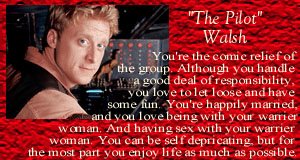
Guess I'd better watch out for very large pointed things... (And somebody needs a spell-checker...)
Addendum: Yes, having seen the charity screening of Serenity last night, I'm on a bit of a Whedon kick... Found one of those damned quizzes - this one is "Which Firefly Character Are You?" No surprise at all: I'm Wash.

Guess I'd better watch out for very large pointed things... (And somebody needs a spell-checker...)
6.21.2006
a Santa Claus world!
Some time ago, I ran into a couple of albums by Biff Rose. Rose (if you recognize the name at all) is best known as the writer of the not-exactly-best-loved Bowie song "Fill Your Heart" (on Hunky Dory). Rose is sort of an eccentric hippie (that's not redundant: I mean he's more eccentric than your average hippie) but with a bit more sarcasm and sheer bizarritude than you might expect. In fact, he's still around - although he mainly seems to be interested in painting on women's breasts these days. Anyway.
Turns out he's a key influence on Bowie in those days. Every critic of the early Bowie feels compelled to mention Anthony Newley - true enough - but "Kooks" (also from Hunky Dory) is pretty much a big fat sloppy wet kiss on Biff's lips, and a lot of Bowie's vocal phrasing at the time is similar to Rose's.
For someone as seemingly of-his-era as Rose, a couple of his songs are almost presciently relevant these days: witness "American Waltz," about consumerism and the plague of fat, and "Evolution" (sort of about the same...and a record that I suspect Daniel Smith of Danielson (Famile) might have heard. You've been warned...). No one is going to accuse Rose of having a powerful singing voice, and for me, his rinky-tink pianner playing is just this side of the annoying end of camp...but there's just enough of an edge to his lyrics that he's still interesting to me. I doubt I'll listen to him that often - but a song like "Son in Moon" is downright pretty. Certainly, someone should have covered it.
All three of these tracks are from his 1969 release Children of Light. Note also some very early synthesizer playing, programmed (as seemingly every early synth was) by Beaver & Krause and played (or so AMG says) by Van Dyke Parks.
Biff Rose "American Waltz"
Biff Rose "Evolution"
Biff Rose "Son in Moon"
Turns out he's a key influence on Bowie in those days. Every critic of the early Bowie feels compelled to mention Anthony Newley - true enough - but "Kooks" (also from Hunky Dory) is pretty much a big fat sloppy wet kiss on Biff's lips, and a lot of Bowie's vocal phrasing at the time is similar to Rose's.
For someone as seemingly of-his-era as Rose, a couple of his songs are almost presciently relevant these days: witness "American Waltz," about consumerism and the plague of fat, and "Evolution" (sort of about the same...and a record that I suspect Daniel Smith of Danielson (Famile) might have heard. You've been warned...). No one is going to accuse Rose of having a powerful singing voice, and for me, his rinky-tink pianner playing is just this side of the annoying end of camp...but there's just enough of an edge to his lyrics that he's still interesting to me. I doubt I'll listen to him that often - but a song like "Son in Moon" is downright pretty. Certainly, someone should have covered it.
All three of these tracks are from his 1969 release Children of Light. Note also some very early synthesizer playing, programmed (as seemingly every early synth was) by Beaver & Krause and played (or so AMG says) by Van Dyke Parks.
Biff Rose "American Waltz"
Biff Rose "Evolution"
Biff Rose "Son in Moon"
6.20.2006
meta...
So apparently, if one uses certain words in one's blog, certain purveyors of certain devices send unsolicited e-mails assuming that one is interested in the devices represented by said words. I should've guessed that would happen...
6.19.2006
Heads Up! (a/k/a another episode of "Blogrolling in Our Time")
A month or so back, I got an e-mail from a guy named Sean who's running an mp3-and-article website (there seems to be an awful lot of that sort of thing from people named Sean, doncha think?) called Daytrotter. There's a picture of a pony.
Anyway, aside from seeing the picture of the pony (stay with me here: I'm trying to build up my teen-girl demographic), you can also download live-in-studio versions of a bunch of fine songs from folks like The M's, Casey Dienel, Impossible Shapes, Sunset Rubdown, and Casiotone for the Painfully Alone.
Good stuff - I like it.
Anyway, aside from seeing the picture of the pony (stay with me here: I'm trying to build up my teen-girl demographic), you can also download live-in-studio versions of a bunch of fine songs from folks like The M's, Casey Dienel, Impossible Shapes, Sunset Rubdown, and Casiotone for the Painfully Alone.
Good stuff - I like it.
6.17.2006
Because apparently there's nothing in the Constitution about the right to bear dildos
Sometimes, I just want to slap myself in the forehead over and over again, hoping that something I've read just isn't true, and we don't live in such a ridiculous nation. For example: apparently the latest right-wing trend is banning sex toys. Yep: the most important thing some state legislators feel the need to address is the notion that (to paraphrase the famous line about Puritans) someone, somewhere, is getting off with no one else present (such as the legislator) to assist.
The proposed bill would make it "illegal to sell devices used for sexual stimulation." In related news, teenage boys will no longer be allowed to ride buses or motorcycles (or, indeed, be unaccompanied by a parent or open their eyes), and washing machines will be banned within the state, lest anyone sit upon them for purposes of illicitly benefiting from their vibrations.
It occurs to me (because apparently I'm a sicko) that gun-control advocates ought to take advantage of such legislation, and claim that, clearly, a gun is a phallic substitute that someone might possibly use as a sex toy, and therefore, they ought to be banned as illegal under such legislation.
Alternately, those in favor of sex toys might try another well-used right-wing tactic, and agitate to have sex toys declared "persons." Arguably, they possess more attributes of personhood than either fetuses or corporations. (No word on what would happen if someone somehow used a corporation for sexual stimulation.)
Buzzcocks "Orgasm Addict"
Flipper "Sex Bomb"
(Thanks to the proprietors of the mysterious Horn Farm Paste Mob for pointing me to this link.)
The proposed bill would make it "illegal to sell devices used for sexual stimulation." In related news, teenage boys will no longer be allowed to ride buses or motorcycles (or, indeed, be unaccompanied by a parent or open their eyes), and washing machines will be banned within the state, lest anyone sit upon them for purposes of illicitly benefiting from their vibrations.
It occurs to me (because apparently I'm a sicko) that gun-control advocates ought to take advantage of such legislation, and claim that, clearly, a gun is a phallic substitute that someone might possibly use as a sex toy, and therefore, they ought to be banned as illegal under such legislation.
Alternately, those in favor of sex toys might try another well-used right-wing tactic, and agitate to have sex toys declared "persons." Arguably, they possess more attributes of personhood than either fetuses or corporations. (No word on what would happen if someone somehow used a corporation for sexual stimulation.)
Buzzcocks "Orgasm Addict"
Flipper "Sex Bomb"
(Thanks to the proprietors of the mysterious Horn Farm Paste Mob for pointing me to this link.)
6.16.2006
an apt distance
After reading J. Niimi's entry in the "33 1/3" series on Murmur, which discussed the influential role of Walker Percy's essay "Metaphor as Mistake" on Michael Stipe's lyric-writing ideas, I followed up by reading that essay. Not only because I'm a geek, but also because I'm intrigued by the way language works, by its insistent metaphoricity. Okay, because I'm a geek. Anyway:
Percy refers frequently to what old-school critic R.P. Blackmur called a "heightened sense of being" created in the presence of striking metaphor. (Incidentally, a separate essay could be written on the productive re-exploration of outmoded critical thought - rather similar to the way it's always worth re-exploring outmoded musical genres...) Percy explicates Blackmur's phrase in part by pointing out the most striking metaphor is often difficult to parse literally, whereas boring, mundane (and hence not striking) metaphors are quite readily mappable from tenor to vehicle. (The "tenor" is the named object upon which attributes of the "vehicle" are mapped: in "her eyes were a blue million miles" (Captain Beefheart), "her eyes" is the tenor, while "a blue million miles" is the vehicle. I read once that the Greek subway system is called the Metaphoroi - literally, the word means to carry from place to place.)
Returning to Percy: "clouds were fleece" is a coherent metaphor (the visual similarities between clouds and fleece are apparent to anyone), but it falls utterly flat in sparking thought. Its literality is too confined, too pinned down, in a harsh, shadowless, and unambiguous light. Poetry and art are not like a legal document, wherein everything must be distinguished in its specificity from every other similar but non-identical something else; it needs that space of play and uncertainty in order to breathe.
The example Niimi draws from Percy is that of the "blue-dollar hawk": Percy describes a young boy, seeing a particular bird's striking flight, "its very great speed, the effect of alternation of the wings, its sudden plummeting into the woods," who asks "what is that bird?" That's an odd question, Percy points out, in that the boy "has already apprehended the hawk in the vividest, most plenary way.... What more will he know by having the bird named?"
And though Percy doesn't directly say so, I suspect the answer has much to do with the artistic instinct generally - and perhaps why those with less developed such instincts are puzzled by artists. "That painting looks nothing like its subject" - well of course not: the subject's already there, what could be more redundant than attempting to duplicate its presence in paint? Elsewhere, Percy notes that poetic naming, though it cannot merely describe what's already literally there, also can't be merely random (as in surrealism) and still sustain itself. (A bit unfair to surrealism: in fact, surrealism claimed seemingly random correspondences were the key to unlocking the unconscious - in which, of course, apt but previously unthought similarities dwelled beyond the realm of cliche.) Words randomly smashed together may produce sparks, but ultimately what's lacking is the notion of an apt distance: neither too close and literal nor arbitrarily distant, but some middle figure that illuminates, that reflects some aspect of the object and the namer's experience of the object. Percy writes that "poetry validates that which has already been privately apprehended but has gone unformulated" for both the poet and reader.
Percy notes the curious fact that although conventional theories of language deny any but an arbitrary relationship between the word and what it designates (with the exception of onomatopoeia), it would seem that language itself argues otherwise. His example is the cluster of words in Indo-European languages around the syllable sta (which relates to the notion of "standing") and plu (which suggests "flow"). Analyzing the obscure metaphor "a white shire of clouds," Percy observes that a class of words connoting "segmented or sectioned or roughly oblong flattened objects" coheres around the sound /sh/, for example shape, sheath, shard, sheet, shelf, shield, shire, shoal, shovel, shroud. Thus, "a white shire of clouds" seems more apt than, say, "a white dictum of clouds" (to choose a word semi-randomly from elsewhere in Percy's book - although having chosen it, naturally I now try to figure out a context in which that phrase might make sense...).
In the final sentence of his essay, Percy uses a figure that's personally striking to me - because it's very close to one I've used for years to describe some aspects of my tastes. He writes that humans "must know one thing through the mirror of another." (This idea connects to a larger theme of Percy's, an interrogation into the ways language is constitutive of humanness, and the strangeness of language's endless indirection.) I rarely like the pure anything - I like instead the slightly scuffed, the mixed-up, the next-door-to, the slightly off-center. I don't like pure genres, I like bastardizations. I like the distorted, askew reflections of things more than the things themselves. I visualized a field of mirrors set at various angles, so within any one of them you'd see bits of the field itself but more often further reflections, reflections of reflections, etc. (This is sort of an installation-art version of Indra's net, I suppose...)
What might constitute such an "apt distance" (my phrase, not Percy's): how, for example, does "blue-dollar hawk" (which is really the prosaically named "blue darter hawk") dwell at an apt, illuminating distance from an experience of the actual bird, given the characteristics of the bird? Well, with "blue" I think of "talk a blue streak," "blue in the face"...the idea of excess or plenitude. And there's the homophone with "blew": quickness, past-tense. There's something compressed, condensed about "blue" - as if it's a lighter, more distributed color crammed into a small space. Darkness seems closer, less distant, than bright daylight, for instance. Even when we imagine the night stars in their infinite distance, the darkness between compresses, as if we could almost touch them. A small, high plane passing near the sun's position in the sky in high daylight seems much further away than the moon or stars. As for "dollar": I imagine the wry folk humor that imputes quickness (in disappearing) to money - and a blue dollar would be even quicker than a green or silver one, given the qualities of plenitude and compression "blue" connotes.
Niimi quotes Stipe as saying that if people wanted to "understand" his lyrics, they should read Percy's essay. Does Percy help illuminate Stipe's lyrics? Maybe the best example, writ large, of how it might do so, is the story behind "Perfect Circle". In an interview (quoted in Niimi), Peter Buck said this about that song:
The most moving moment I've had in the last couple of years was at the end of one of our tours. I hadn't slept in days.... I was standing in the City Gardens in Trenton, New Jersey, at the back door, and it was just getting dark. These kids were playing touch football, the last game before dark came, and for some reason I was so moved I cried for twenty minutes.... I told Michael to try and capture that feeling. There's no football in there, no kids, no twilight, but it's all there.
Stipe, I think, recognized that literally describing Buck's experience probably wouldn't have worked - the scene, in itself, is prosaic, verging on cliched (childhood, twilight) - but the emotion was genuine, germane to Buck's exhaustion but seemingly unconnected with the scene that brought it on. I'm guessing Percy would argue that the unconscious correspondence Buck formulated (in the way the experience played itself out in his emotional reaction to it) itself worked in the way a striking metaphor does: not logically explicable, but making a hitherto unformulated connection. Rather than literally describe the experience, I think Stipe tried to recreate it in his own terms, with enough space and distance to allow for that play and uncertainty. And I suspect it's not only the words themselves, but their setting as part of the music of the song, and the song's setting as part of Murmur, that allow the whole to do its work.
More generally, I think Stipe took Percy's ideas to heart by allowing or encouraging a number of devices to keep the semiotic structure of his lyrics open. Some possibilities, some of which he's known to have done, others of which I'm only speculating about: leaving out words whose presence is implied, changing words based on others' mishearings, using homophones, changing lyrics as the song evolves in successive performances, layering multiple lyrical and musical lines atop one another so ghost words and meanings might be created by the interplay (hypothetical example: if one line sings "ease" overlapping the second syllable of the phrase "all evening" in a second line, the listener might hear the word "leaves" - even though no one person is actually singing that word), allowing homophonic meaning to suggest alternative interpretations (actual example, although from Brian Eno's "Burning Airlines Give You So Much More": "Sweet Regina's on the plane, a Newsweek on her knees": suggesting airsickness through the conjunction of "on the plane" and the homophonic "weak on her knees"), not informing Mills or Berry what the actual lyrics were (so they were forced to interpret the lyrics themselves in singing backing vocals, adding more texture or "wrong" lyrics to the mix) - and, of course, being reluctant to confirm or deny what the actual lyrics are for the audience, allowing them always to remain interpretable.
I said earlier that one reason Niimi's book resonated for me was that it resonated in so many ways with the way I've reacted to Murmur (and R.E.M. generally) over the years, particularly in terms of the band's aesthetic on its early albums. So it's no surprise, really, that well before reading Percy's essay, some stratagems I've used several times in writing lyrics or making images bear some similarity to these ideas: taking an arbitrary phrase that's striking in some way (sometimes my own phrase, sometimes one "sampled" from elsewhere, such as spam, or something I've read or overheard) and then teasing meaning from it by placing it in a particular context, often allowing that meaning to evolve semi-consciously by withholding the authorial censoring function ("that doesn't make sense: get rid of it") till fairly late in the game. Of course, one difference is that, lacking an audience, I have no idea whether my metaphors seem apt to anyone but myself. (Or more accurately, I do have an audience, of one: my later self, looking at the work of my earlier self.) Ultimately, so what: the pleasure of creating needn't be externally driven or validated. If you like dancing in your room, it hardly matters if you're a good dancer or a bad one in others' eyes.
Speaking of bad dancing, and cutting the rug out from under this recent series of R.E.M.-based entries (and citing myself for mixing metaphors...), one thing R.E.M. is not is a blues band. And Warren Zevon was a fabulous songwriter, and a fine vocal interpreter of his own lyrics...but one thing he was not was a blues singer. Which is why their combined forces, recorded one drunken evening and eventually released (doubtless for entirely commercial reasons) under the name Hindu Love Gods, was nearly a complete waste of time. If I didn't recognize Zevon's voice, I'd say this was a competent garage band, benefiting from someone's access to quality recording equipment and personnel. Utterly anonymous. A couple-three songs are worth rescuing, though: their off-the-cuff runthrough of Prince's "Raspberry Beret" (one of the few songs on the album that isn't a grizzled blues number) foremost among them. Three other tracks have their moments, though I really can't call any of them all that wonderful. Regardless, here are all three, for your edification: "Battleship Chains," "I'm a One-Woman Man," and "Vigilante Man." There - I've saved you the fifty cents it'd cost you to pick this up from the used CD bin.
Hindu Love Gods "Raspberry Beret"
Hindu Love Gods "Battleship Chains"
Hindu Love Gods "I'm a One-Woman Man"
Hindu Love Gods "Vigilante Man"
Percy refers frequently to what old-school critic R.P. Blackmur called a "heightened sense of being" created in the presence of striking metaphor. (Incidentally, a separate essay could be written on the productive re-exploration of outmoded critical thought - rather similar to the way it's always worth re-exploring outmoded musical genres...) Percy explicates Blackmur's phrase in part by pointing out the most striking metaphor is often difficult to parse literally, whereas boring, mundane (and hence not striking) metaphors are quite readily mappable from tenor to vehicle. (The "tenor" is the named object upon which attributes of the "vehicle" are mapped: in "her eyes were a blue million miles" (Captain Beefheart), "her eyes" is the tenor, while "a blue million miles" is the vehicle. I read once that the Greek subway system is called the Metaphoroi - literally, the word means to carry from place to place.)
Returning to Percy: "clouds were fleece" is a coherent metaphor (the visual similarities between clouds and fleece are apparent to anyone), but it falls utterly flat in sparking thought. Its literality is too confined, too pinned down, in a harsh, shadowless, and unambiguous light. Poetry and art are not like a legal document, wherein everything must be distinguished in its specificity from every other similar but non-identical something else; it needs that space of play and uncertainty in order to breathe.
The example Niimi draws from Percy is that of the "blue-dollar hawk": Percy describes a young boy, seeing a particular bird's striking flight, "its very great speed, the effect of alternation of the wings, its sudden plummeting into the woods," who asks "what is that bird?" That's an odd question, Percy points out, in that the boy "has already apprehended the hawk in the vividest, most plenary way.... What more will he know by having the bird named?"
And though Percy doesn't directly say so, I suspect the answer has much to do with the artistic instinct generally - and perhaps why those with less developed such instincts are puzzled by artists. "That painting looks nothing like its subject" - well of course not: the subject's already there, what could be more redundant than attempting to duplicate its presence in paint? Elsewhere, Percy notes that poetic naming, though it cannot merely describe what's already literally there, also can't be merely random (as in surrealism) and still sustain itself. (A bit unfair to surrealism: in fact, surrealism claimed seemingly random correspondences were the key to unlocking the unconscious - in which, of course, apt but previously unthought similarities dwelled beyond the realm of cliche.) Words randomly smashed together may produce sparks, but ultimately what's lacking is the notion of an apt distance: neither too close and literal nor arbitrarily distant, but some middle figure that illuminates, that reflects some aspect of the object and the namer's experience of the object. Percy writes that "poetry validates that which has already been privately apprehended but has gone unformulated" for both the poet and reader.
Percy notes the curious fact that although conventional theories of language deny any but an arbitrary relationship between the word and what it designates (with the exception of onomatopoeia), it would seem that language itself argues otherwise. His example is the cluster of words in Indo-European languages around the syllable sta (which relates to the notion of "standing") and plu (which suggests "flow"). Analyzing the obscure metaphor "a white shire of clouds," Percy observes that a class of words connoting "segmented or sectioned or roughly oblong flattened objects" coheres around the sound /sh/, for example shape, sheath, shard, sheet, shelf, shield, shire, shoal, shovel, shroud. Thus, "a white shire of clouds" seems more apt than, say, "a white dictum of clouds" (to choose a word semi-randomly from elsewhere in Percy's book - although having chosen it, naturally I now try to figure out a context in which that phrase might make sense...).
In the final sentence of his essay, Percy uses a figure that's personally striking to me - because it's very close to one I've used for years to describe some aspects of my tastes. He writes that humans "must know one thing through the mirror of another." (This idea connects to a larger theme of Percy's, an interrogation into the ways language is constitutive of humanness, and the strangeness of language's endless indirection.) I rarely like the pure anything - I like instead the slightly scuffed, the mixed-up, the next-door-to, the slightly off-center. I don't like pure genres, I like bastardizations. I like the distorted, askew reflections of things more than the things themselves. I visualized a field of mirrors set at various angles, so within any one of them you'd see bits of the field itself but more often further reflections, reflections of reflections, etc. (This is sort of an installation-art version of Indra's net, I suppose...)
What might constitute such an "apt distance" (my phrase, not Percy's): how, for example, does "blue-dollar hawk" (which is really the prosaically named "blue darter hawk") dwell at an apt, illuminating distance from an experience of the actual bird, given the characteristics of the bird? Well, with "blue" I think of "talk a blue streak," "blue in the face"...the idea of excess or plenitude. And there's the homophone with "blew": quickness, past-tense. There's something compressed, condensed about "blue" - as if it's a lighter, more distributed color crammed into a small space. Darkness seems closer, less distant, than bright daylight, for instance. Even when we imagine the night stars in their infinite distance, the darkness between compresses, as if we could almost touch them. A small, high plane passing near the sun's position in the sky in high daylight seems much further away than the moon or stars. As for "dollar": I imagine the wry folk humor that imputes quickness (in disappearing) to money - and a blue dollar would be even quicker than a green or silver one, given the qualities of plenitude and compression "blue" connotes.
Niimi quotes Stipe as saying that if people wanted to "understand" his lyrics, they should read Percy's essay. Does Percy help illuminate Stipe's lyrics? Maybe the best example, writ large, of how it might do so, is the story behind "Perfect Circle". In an interview (quoted in Niimi), Peter Buck said this about that song:
The most moving moment I've had in the last couple of years was at the end of one of our tours. I hadn't slept in days.... I was standing in the City Gardens in Trenton, New Jersey, at the back door, and it was just getting dark. These kids were playing touch football, the last game before dark came, and for some reason I was so moved I cried for twenty minutes.... I told Michael to try and capture that feeling. There's no football in there, no kids, no twilight, but it's all there.
Stipe, I think, recognized that literally describing Buck's experience probably wouldn't have worked - the scene, in itself, is prosaic, verging on cliched (childhood, twilight) - but the emotion was genuine, germane to Buck's exhaustion but seemingly unconnected with the scene that brought it on. I'm guessing Percy would argue that the unconscious correspondence Buck formulated (in the way the experience played itself out in his emotional reaction to it) itself worked in the way a striking metaphor does: not logically explicable, but making a hitherto unformulated connection. Rather than literally describe the experience, I think Stipe tried to recreate it in his own terms, with enough space and distance to allow for that play and uncertainty. And I suspect it's not only the words themselves, but their setting as part of the music of the song, and the song's setting as part of Murmur, that allow the whole to do its work.
More generally, I think Stipe took Percy's ideas to heart by allowing or encouraging a number of devices to keep the semiotic structure of his lyrics open. Some possibilities, some of which he's known to have done, others of which I'm only speculating about: leaving out words whose presence is implied, changing words based on others' mishearings, using homophones, changing lyrics as the song evolves in successive performances, layering multiple lyrical and musical lines atop one another so ghost words and meanings might be created by the interplay (hypothetical example: if one line sings "ease" overlapping the second syllable of the phrase "all evening" in a second line, the listener might hear the word "leaves" - even though no one person is actually singing that word), allowing homophonic meaning to suggest alternative interpretations (actual example, although from Brian Eno's "Burning Airlines Give You So Much More": "Sweet Regina's on the plane, a Newsweek on her knees": suggesting airsickness through the conjunction of "on the plane" and the homophonic "weak on her knees"), not informing Mills or Berry what the actual lyrics were (so they were forced to interpret the lyrics themselves in singing backing vocals, adding more texture or "wrong" lyrics to the mix) - and, of course, being reluctant to confirm or deny what the actual lyrics are for the audience, allowing them always to remain interpretable.
I said earlier that one reason Niimi's book resonated for me was that it resonated in so many ways with the way I've reacted to Murmur (and R.E.M. generally) over the years, particularly in terms of the band's aesthetic on its early albums. So it's no surprise, really, that well before reading Percy's essay, some stratagems I've used several times in writing lyrics or making images bear some similarity to these ideas: taking an arbitrary phrase that's striking in some way (sometimes my own phrase, sometimes one "sampled" from elsewhere, such as spam, or something I've read or overheard) and then teasing meaning from it by placing it in a particular context, often allowing that meaning to evolve semi-consciously by withholding the authorial censoring function ("that doesn't make sense: get rid of it") till fairly late in the game. Of course, one difference is that, lacking an audience, I have no idea whether my metaphors seem apt to anyone but myself. (Or more accurately, I do have an audience, of one: my later self, looking at the work of my earlier self.) Ultimately, so what: the pleasure of creating needn't be externally driven or validated. If you like dancing in your room, it hardly matters if you're a good dancer or a bad one in others' eyes.
Speaking of bad dancing, and cutting the rug out from under this recent series of R.E.M.-based entries (and citing myself for mixing metaphors...), one thing R.E.M. is not is a blues band. And Warren Zevon was a fabulous songwriter, and a fine vocal interpreter of his own lyrics...but one thing he was not was a blues singer. Which is why their combined forces, recorded one drunken evening and eventually released (doubtless for entirely commercial reasons) under the name Hindu Love Gods, was nearly a complete waste of time. If I didn't recognize Zevon's voice, I'd say this was a competent garage band, benefiting from someone's access to quality recording equipment and personnel. Utterly anonymous. A couple-three songs are worth rescuing, though: their off-the-cuff runthrough of Prince's "Raspberry Beret" (one of the few songs on the album that isn't a grizzled blues number) foremost among them. Three other tracks have their moments, though I really can't call any of them all that wonderful. Regardless, here are all three, for your edification: "Battleship Chains," "I'm a One-Woman Man," and "Vigilante Man." There - I've saved you the fifty cents it'd cost you to pick this up from the used CD bin.
Hindu Love Gods "Raspberry Beret"
Hindu Love Gods "Battleship Chains"
Hindu Love Gods "I'm a One-Woman Man"
Hindu Love Gods "Vigilante Man"
6.13.2006
ding-dong...
Apparently, a number of people now think more highly of Bush and his war because Abu Musab al-Zarqawi has been killed. What an absurd conclusion: one guy's dead, so now everything's all better? Well: if it was that simple, why didn't they save all the trouble and effort of the war and just try to kill him in the first place?
Seriously: while I certainly don't countenance assassination, I truly do not understand the moral calculus that condones the terrors of war, with its inevitable killings of innocent civilians who play no role in whatever offense drives the war, but which prohibits the targeted killing of a leader who actually bears some responsibility for that offense. That makes no sense. Perhaps someone can explain it to me.
Seriously: while I certainly don't countenance assassination, I truly do not understand the moral calculus that condones the terrors of war, with its inevitable killings of innocent civilians who play no role in whatever offense drives the war, but which prohibits the targeted killing of a leader who actually bears some responsibility for that offense. That makes no sense. Perhaps someone can explain it to me.
6.11.2006
I had a dream last night, in which I met an old friend of mine whom I haven't seen in years. The main thing I remember is picking up a large book (about five or six hundred pages, in a large, coffee-table type format about 12x10 inches) which proved to be primarily published versions of my friend's blog (which I hadn't known existed). The pages were even laid out like a blog (like, in fact, a commonly used Blogger template - though I can't recall if it was an actual one or just looked like one). The earlier parts of the book were a collection of his other writings: letters, photos, etc., more or less like a scrapbook. I thought it peculiar that an actual publisher had thought his blog worth printing - but I also thought it was kinda cool, and I was a bit envious.
The peculiar thing was the name of his blog. It was "Seal of Seals." That was striking enough that it was one of the main things I remembered about the dream when I woke up. So, naturally, I googled the phrase. Other than more or less incidental references, most referred to metaphorical seals, as in verification - but one result referred to the translated title of a work by Giordano Bruno (Sigillus Sigillorum) which itself turned out to be about "noetic ascent." I've read nothing of Bruno's.
Curious enough...but what's weirder is some months ago, a phrase popped into my head for no apparent reason. The phrase was "it begins with itself" - and a search on that phrase brought up only one result: something on the "Grammar of Ascent" by John Henry Cardinal Newman. Odd enough that phrases rarely found outside religious/philosophical works (neither of which I've read) should find themselves lodged in my head, but reading a bit into both of them, they're not entirely dissimilar in subject either. Both bear some relation to what we'd now call the psychology of faith. I haven't read either text closely (and probably won't), but I do find that accidents and coincidences are often most useful (similar to the Oblique Strategy "honor thy error as a hidden intention"), and that even apparently random or nonsensical bursts of language often reveal if not hidden intentions at least hidden patterns, or latent patterns, which can then be teased out and elaborated upon.
Another example would be the fact that from my more-or-less nonsense lyric a week or so back ("Lance Crocker, Almanac Cracker"), the character of Lance has sort of forced himself into my mind: he wears peculiar goggles, kind of a cross between Russell Mills' illustration for Brian Eno's "Blank Frank" and Maniwa from Paranoia Agent in his "Radar Man" guise...with a bit of Thomas Dolby mixed in. (It's the fetishy eyegear.) The most unusual aspect of his appearance is that he's wound bands of leather, about six inches wide, several times around the knees of both of his trousers (he has some sort of issue with his knees), creating a loose band of leather midway up each of his trouser legs. He is, essentially, someone who believes that secret information is being kept from us, information that will harm us if it's kept hidden, and his mission is to find and reveal that information. Or, as a now-famous quote from the Gnostic Gospel of Thomas has it: "If you bring forth what is within you, what you have will save you. If you do not bring it forth, what you do not have within you will kill you." Whether there's anything to his ideas, or whether he's merely a delusional if colorful character, well, I don't know.
The peculiar thing was the name of his blog. It was "Seal of Seals." That was striking enough that it was one of the main things I remembered about the dream when I woke up. So, naturally, I googled the phrase. Other than more or less incidental references, most referred to metaphorical seals, as in verification - but one result referred to the translated title of a work by Giordano Bruno (Sigillus Sigillorum) which itself turned out to be about "noetic ascent." I've read nothing of Bruno's.
Curious enough...but what's weirder is some months ago, a phrase popped into my head for no apparent reason. The phrase was "it begins with itself" - and a search on that phrase brought up only one result: something on the "Grammar of Ascent" by John Henry Cardinal Newman. Odd enough that phrases rarely found outside religious/philosophical works (neither of which I've read) should find themselves lodged in my head, but reading a bit into both of them, they're not entirely dissimilar in subject either. Both bear some relation to what we'd now call the psychology of faith. I haven't read either text closely (and probably won't), but I do find that accidents and coincidences are often most useful (similar to the Oblique Strategy "honor thy error as a hidden intention"), and that even apparently random or nonsensical bursts of language often reveal if not hidden intentions at least hidden patterns, or latent patterns, which can then be teased out and elaborated upon.
Another example would be the fact that from my more-or-less nonsense lyric a week or so back ("Lance Crocker, Almanac Cracker"), the character of Lance has sort of forced himself into my mind: he wears peculiar goggles, kind of a cross between Russell Mills' illustration for Brian Eno's "Blank Frank" and Maniwa from Paranoia Agent in his "Radar Man" guise...with a bit of Thomas Dolby mixed in. (It's the fetishy eyegear.) The most unusual aspect of his appearance is that he's wound bands of leather, about six inches wide, several times around the knees of both of his trousers (he has some sort of issue with his knees), creating a loose band of leather midway up each of his trouser legs. He is, essentially, someone who believes that secret information is being kept from us, information that will harm us if it's kept hidden, and his mission is to find and reveal that information. Or, as a now-famous quote from the Gnostic Gospel of Thomas has it: "If you bring forth what is within you, what you have will save you. If you do not bring it forth, what you do not have within you will kill you." Whether there's anything to his ideas, or whether he's merely a delusional if colorful character, well, I don't know.
6.09.2006
Pixar knows!
Or you'd think they would... Saw an ad for the new Pixar feature Cars - and why on earth did they put the cars' "eyes" on the windshield, when everyone knows that cars' "faces" are formed by the grille and headlights - the latter of which are cars' "eyes"? Car designers surely know this: just contrast the cute, round-eyed look of something like the Neon (introduced with that annoying "Hi." campaign) vs. your average sports car, with its narrow-eyed, "mean"-look, much like cartoon sports logoes conveying aggressiveness and intensity.
6.07.2006
There Is More Past Than You Thought!
I'm halfway through reading John Hodgman's The Areas of My Expertise, aptly described by Tom Perrotta in a blurb as resembling what would result if "Benjamin Franklin and Borges got drunk and decided to write a book together." Hodgman's become suddenly quite visible, appearing on This American Life (wait - that's radio: strike "visible"), writing for The Daily Show, and appearing in a Mac ad (which, amusingly, garnered him accusations of "selling out" five minutes after anyone outside of Brooklyn had even heard of him). He's the PC - ill-fitting suit, horn-rim glasses, nerdy haircut. Of course, that's also exactly what he always looks like, judging from available publicity photos.
One of the book's more peculiar and charming features is its obsession with hoboes - a meme which has taken on a life of its own, judging from the several hundred efforts to illustrate Hodgman's "Seven Hundred Hobo Names," which began as a Flickr group and has since migrated to its own website. (Side note: You will note that few of these images appear to be photographs, which apparently caused some trouble for some contributors with Flickr. Of course, a scanner is a kind of camera, and since the illustrations in some cases are scanned, I think they should technically count as photographs. Alas, the images created entirely in Illustrator and the like are not photos. Unless you printed them out and photographed them...which some people apparently did, to get around the "photo" requirement...)
Anyway, as if obsessive fans illustrating bizarre names like "Undertaker Robert, the Lint-Coffin Weaver" (#691), "49-State Apthorp, the Alaska-Phobe" (#411), and "William Carlos Williams" (#505) weren't enough, Hodgman himself has read the entire list in the form of a spoken word piece, accompanied by Jonathan Coulton on guitar and bleeding fingers. (Warning: it's nearly an hour long. And no, I haven't listened to it.)
Here is an actual hit, one which doubtless would have been covered by contestants on Hobo Idol if there had been such a show in the 1930s, if there had been television, if hoboes cared about such things: Harry McClintock's version of "Big Rock Candy Mountain" (from the big ol' Smithsonian folk-music box). And here is the song "Hobo Chang Ba" by Captain Beefheart, who himself has rather a hoboesque mien (and name to match). I have no idea what "chang ba" is meant to designate.
Harry McClintock "Big Rock Candy Mountain"
Captain Beefheart & the Magic Band "Hobo Chang Ba"
One of the book's more peculiar and charming features is its obsession with hoboes - a meme which has taken on a life of its own, judging from the several hundred efforts to illustrate Hodgman's "Seven Hundred Hobo Names," which began as a Flickr group and has since migrated to its own website. (Side note: You will note that few of these images appear to be photographs, which apparently caused some trouble for some contributors with Flickr. Of course, a scanner is a kind of camera, and since the illustrations in some cases are scanned, I think they should technically count as photographs. Alas, the images created entirely in Illustrator and the like are not photos. Unless you printed them out and photographed them...which some people apparently did, to get around the "photo" requirement...)
Anyway, as if obsessive fans illustrating bizarre names like "Undertaker Robert, the Lint-Coffin Weaver" (#691), "49-State Apthorp, the Alaska-Phobe" (#411), and "William Carlos Williams" (#505) weren't enough, Hodgman himself has read the entire list in the form of a spoken word piece, accompanied by Jonathan Coulton on guitar and bleeding fingers. (Warning: it's nearly an hour long. And no, I haven't listened to it.)
Here is an actual hit, one which doubtless would have been covered by contestants on Hobo Idol if there had been such a show in the 1930s, if there had been television, if hoboes cared about such things: Harry McClintock's version of "Big Rock Candy Mountain" (from the big ol' Smithsonian folk-music box). And here is the song "Hobo Chang Ba" by Captain Beefheart, who himself has rather a hoboesque mien (and name to match). I have no idea what "chang ba" is meant to designate.
Harry McClintock "Big Rock Candy Mountain"
Captain Beefheart & the Magic Band "Hobo Chang Ba"
6.01.2006
clouds, balloons, cauldrons, etc.
I recently picked up a copy of the curious self-titled 1968 release from the United States of America. As founder Joseph Byrd's informative notes point out, no one in the band came from a rock background; most were avant-garde classical musicians, entranced with John Cage, Fluxus, and the like. The band's instrumental lineup was unusual: no guitar, but harpsichord and organ, violin, bass, and drums - all of which were frequently treated electronically, as were the vocals. The band is best-known for the song "Garden of Earthly Delights" - but what struck me on listening to the CD was the band's clear influence on one of my favorite contemporary groups, Broadcast. Not only do both bands' female vocalists have somewhat similar approaches, the electronics are (or are made to sound) homemade, raw, a bit less domesticated than synthesizers have become: less musical instruments than sound sources. The United States of America's "Cloud Song" in particular reminded me of Broadcast in that band's quieter moments, such as "You Can Fall" (from 2000's The Noise Made by People). Broadcast's more poppy moments are rather different stylistically (drawing from a well of influences rather near the one Stereolab's staked out), but the sonic textures bear comparison, as in the evanescent "Lunch Hour Pops."
Despite not having experience in rock bands (a factor probably a lot more important in 1967 when the album was recorded than it would be now, in that I think more people are willing just to listen to music without regard to genre), the United States of America clearly picked up a few things from its 1967 cohort - such as the fuzz bass that drives "Coming Down." I think the repetitive electric violin figure in the background is an indication of the contemporary proto-minimalist musics the band members were listening to.
Almost exactly contemporary with the United States of America, San Francisco's Fifty Foot Hose was experimenting with a similar mix of patchbay electronics and altered rock instrumentation. Its sole album Cauldron consisted of more or less conventional songs dressed in electronic gear interspersed with short, completely electronic instrumental pieces (the opening track "And After" rises from a low, murmuring series of blurps into a wildly howling, oscillating set of screams: simple but effective). Some of the tracks weren't all that great compositionally, but "If Not This Time" (with its longish delay on the vocal echoed in stereo channels) is one of the best: the main riff is played, if my ears aren't completely out to lunch, in stacked parallel fifths which, along with its chromaticism, pretty well unsettles one's harmonic sense until the verse itself comes in. Speaking of unsettling, the title track is a collage of electronics, treated spoken voice, and creepy low-level screams and cries. Great Halloween music, if nothing else.
The United States of America "Cloud Song"
Broadcast "You Can Fall"
Broadcast "Lunch Hour Pops"
The United States of America "Coming Down"
Fifty Foot Hose "If Not This Time"
Fifty Foot Hose "Cauldron"
Despite not having experience in rock bands (a factor probably a lot more important in 1967 when the album was recorded than it would be now, in that I think more people are willing just to listen to music without regard to genre), the United States of America clearly picked up a few things from its 1967 cohort - such as the fuzz bass that drives "Coming Down." I think the repetitive electric violin figure in the background is an indication of the contemporary proto-minimalist musics the band members were listening to.
Almost exactly contemporary with the United States of America, San Francisco's Fifty Foot Hose was experimenting with a similar mix of patchbay electronics and altered rock instrumentation. Its sole album Cauldron consisted of more or less conventional songs dressed in electronic gear interspersed with short, completely electronic instrumental pieces (the opening track "And After" rises from a low, murmuring series of blurps into a wildly howling, oscillating set of screams: simple but effective). Some of the tracks weren't all that great compositionally, but "If Not This Time" (with its longish delay on the vocal echoed in stereo channels) is one of the best: the main riff is played, if my ears aren't completely out to lunch, in stacked parallel fifths which, along with its chromaticism, pretty well unsettles one's harmonic sense until the verse itself comes in. Speaking of unsettling, the title track is a collage of electronics, treated spoken voice, and creepy low-level screams and cries. Great Halloween music, if nothing else.
The United States of America "Cloud Song"
Broadcast "You Can Fall"
Broadcast "Lunch Hour Pops"
The United States of America "Coming Down"
Fifty Foot Hose "If Not This Time"
Fifty Foot Hose "Cauldron"
Subscribe to:
Posts (Atom)

