* Arizona Diamondbacks player Craig Counsell, who went to high school in Milwaukee suburb Whitefish Bay, and Hold Steady drummer P. Judd Counsell, formerly of Milwaukee-to-Minneapolis band Punchdrunk.
Here's Punchdrunk's single b-side "Lyman Bostock," named after another ballplayer (and incidentally recorded on my 31st birthday). The drum hits here sound like they're played by the guy who does the foley effects in movies where some guy gets hit hard in the face.
*Cartoonist Darby Conley (of "Get Fuzzy" fame), born in Concord, Massachusetts, currently resident in Carlisle, Massachusetts (according to Wikipedia anyway), and Boston-based musician Clint Conley, of Mission of Burma and Consonant.
Here's Consonant's "Dumb Joy," which is probably Satchel Pooch's favorite song (or it least, a most apt one).
* The Thought Gang, the 1994 novel by Tibor Fischer about philosophical bank-robbers (or bank-robbing philosophers) and many obscure words beginning with the letter "z," and Thought Gang, David Lynch's "band" that performed a couple of pieces on the soundtrack to his 1992 Twin Peaks prequel, Fire Walk with Me.
To maintain the dog theme, I'm featuring the mysterious and murky track "The Black Dog Runs at Night." (How, you might ask, does the first entry have a dog theme? Uh...doesn't "Bostock" sound like a good name for a dog? Sure it does, of course, that's it!)
Punchdrunk "Lyman Bostock"
Consonant "Dumb Joy"
Thought Gang "The Black Dog Runs at Night"


4.25.2006
chihuahuas, whips, and setting dolls on fire
Until a few days ago, I wouldn't have thought there was a movie featuring both the Zombies and Noel Coward. I refer, of course, to Otto Preminger's Bunny Lake Is Missing. Coward (in a wonderfully over-the-top performance) plays a chihuahua-clutching lothario, a man persuaded (or simply having fun trying to persuade himself) that his honeyed voice, particularly as modulated by the BBC's transmissions, is the very soul of seduction. He also has a priceless scene in which he attempts to sell a couple of policemen on the joy of his collection of whips, including one owned (he says) by none other than the Marquis de Sade.
As for the Zombies: if you thought egregious soundtrack-placement was a recent phenomenon, you haven't seen this movie. The band appears on a television (apparently, in 1965 Britain, a 23-inch screen was a marvel) in a pub, and implausibly draws the attention of a crowd of besotted middle-aged regulars. (The same song is later heard on a radio, being listened to by a rather oblivious janitor.)
The film itself is quite good: beautifully shot, artfully plotted such that we're always kept a bit off-balance, with nearly every character in turn made iffy of motive, character, or stability. As for the premise: a woman's young daughter goes missing...or does she? Without including any spoilers, I'll say that the climactic scene of the movie is excruciating: if the movie hasn't grabbed you, because it seems to last forever, and if it has, for the very same reason. Carol Lynley, who plays the female lead, has a peculiarly contemporary face: that sounds odd, but some people just have faces that seem right for particular eras. Lynley's doesn't jar or anything (unlike some actors whose faces read as too contemporary for historical features); in fact I think it makes the movie a little less dated (some of its psychology places it pretty firmly in the mid-sixties). And Keir Dullea (pre-2001) manages to be simultaneously obnoxious, creepy, and compelling.
The DVD unwisely includes a preview for the recent movie The Forgotten - unwisely for the sake of the advertised film since, as far as I can tell, the plot of that movie is the plot of Bunny Lake as run through the Implausiblizer. I love watching Julianne Moore - but please, give her something better to do. The Forgotten also appears to participate in the regrettable recent trend to visualize everything just because you can. Sometimes, subtlety, or letting viewers imagine things, is more effective. I saw an ad on TV the other day for the movie of The Da Vinci Code: apparently, at one point a 2D-looking cutout of a figure goes sliding around within The Last Supper. That would have been funny on South Park: in an ostensible thriller, I suspect it will be laughable - as laughable (at least in the regard of the audience I saw its previews with) as the letters flying around the head of the young female character in whatever that movie was last year about spelling bees and kabbalah or whatever that was. Even more sadly, a remake of Bunny Lake Is Missing is in the works...starring Reese Witherspoon. Nothing against Witherspoon - but we are reaching a point where, within a few years, all movies will have been remade, and so floundering Hollywood moguls will resort to making movies adapting cereal boxes, assembly instructions, and bathroom graffiti.
As for the Zombies: if you thought egregious soundtrack-placement was a recent phenomenon, you haven't seen this movie. The band appears on a television (apparently, in 1965 Britain, a 23-inch screen was a marvel) in a pub, and implausibly draws the attention of a crowd of besotted middle-aged regulars. (The same song is later heard on a radio, being listened to by a rather oblivious janitor.)
The film itself is quite good: beautifully shot, artfully plotted such that we're always kept a bit off-balance, with nearly every character in turn made iffy of motive, character, or stability. As for the premise: a woman's young daughter goes missing...or does she? Without including any spoilers, I'll say that the climactic scene of the movie is excruciating: if the movie hasn't grabbed you, because it seems to last forever, and if it has, for the very same reason. Carol Lynley, who plays the female lead, has a peculiarly contemporary face: that sounds odd, but some people just have faces that seem right for particular eras. Lynley's doesn't jar or anything (unlike some actors whose faces read as too contemporary for historical features); in fact I think it makes the movie a little less dated (some of its psychology places it pretty firmly in the mid-sixties). And Keir Dullea (pre-2001) manages to be simultaneously obnoxious, creepy, and compelling.
The DVD unwisely includes a preview for the recent movie The Forgotten - unwisely for the sake of the advertised film since, as far as I can tell, the plot of that movie is the plot of Bunny Lake as run through the Implausiblizer. I love watching Julianne Moore - but please, give her something better to do. The Forgotten also appears to participate in the regrettable recent trend to visualize everything just because you can. Sometimes, subtlety, or letting viewers imagine things, is more effective. I saw an ad on TV the other day for the movie of The Da Vinci Code: apparently, at one point a 2D-looking cutout of a figure goes sliding around within The Last Supper. That would have been funny on South Park: in an ostensible thriller, I suspect it will be laughable - as laughable (at least in the regard of the audience I saw its previews with) as the letters flying around the head of the young female character in whatever that movie was last year about spelling bees and kabbalah or whatever that was. Even more sadly, a remake of Bunny Lake Is Missing is in the works...starring Reese Witherspoon. Nothing against Witherspoon - but we are reaching a point where, within a few years, all movies will have been remade, and so floundering Hollywood moguls will resort to making movies adapting cereal boxes, assembly instructions, and bathroom graffiti.
4.22.2006
you've got to trust me on this!
It's the week after Easter, and that can mean only one thing: massively discounted Peeps. A friend discovered the (rather tedious, because a series of single shots) Peeps-based Lord of the Rings parody, and so we were brainstorming ideas. Rose came up with a Peeps-based 24. The below scenario, however, can be blamed solely on me:
[The usual ticking clock and tink-tink. Cut to shot of Peep with miniature cellphone; gradually pull back to reveal that Peep is inside a microwave oven, along with several other peeps sitting on fashionably postmodern furnishings, with computer monitors etc. We hear a few beeps, then a whirring noise as the mic is started up.]
[v/o]: Counter-Terrorist agent Chick Bauer has 24 seconds to prevent anti-Peep terrorists from destroying CTU with microwave radiation! Will he be able to turn off the doomsday device in time, or will he and his fellow Peeps...oops, too late!
[The usual ticking clock and tink-tink. Cut to shot of Peep with miniature cellphone; gradually pull back to reveal that Peep is inside a microwave oven, along with several other peeps sitting on fashionably postmodern furnishings, with computer monitors etc. We hear a few beeps, then a whirring noise as the mic is started up.]
[v/o]: Counter-Terrorist agent Chick Bauer has 24 seconds to prevent anti-Peep terrorists from destroying CTU with microwave radiation! Will he be able to turn off the doomsday device in time, or will he and his fellow Peeps...oops, too late!
4.21.2006
three songs
Michael Penn has not been the most prolific artist. Even taking into account his label disputes, he's released only five full-length CDs since 1989 - that's more than three years between each recording on average. But as sometimes happens when gaps between releases get large, other musicians sometimes step up with astonishing facsimiles (prog rockers might remember Starcastle a/k/a Maybe (not quite Yes) and Triumvirat a/k/a Emerson Fake & Palmer). Shortly before Resigned broke Penn's five-year silence since Free-For-All, a Minneapolis musician calling himself Willie Wisely released a song called Raincan. Producer John Strawberry Fields (yes, that's how he's billed) cannily apes the sort of compressed sound Penn favors.
About a year ago, I ran into an acquaintance of mine and a former fixture on Milwaukee's music scene, Dan Franke (who's since moved to Austin). He'd run into my website, and had some nice things to say about it, and eventually offered to burn me a CD of a whole mess of Milwaukee bands' music, mostly from the late eighties and early nineties. It's rather a drag that so much was going on here just before the ability to make cheap CDs, since much of this material was documented only on self-released cassettes or unreleased tapes. One of the more interesting (and inconsistent) characters then was a guy named Ward Wiesenthal, who billed himself simply as Ward. He was in a band called Simpleton with several future members of the Blow Pops and the Lackloves, but mostly recorded solo. In 1991 he got together with an all-star collection of local musicians (including past and future members of Die Kreuzen, Yipes!, E*I*E*I*O, Plasticland, and Maki) and released a cassette called simply Four by Ward. This was his most elaborate production, with tons of vintage keyboards courtesy Bill Dempsey - but in this case the production served the songs. Too bad there weren't more recordings like this from Ward. Anyway, the opening track, and my favorite song of his, is "Dream." The song takes us through several different sections, and I'm particularly fond of the recurring Townshend-like thundercrack guitar, followed by low-register wobbly piano.
On a completely different note, the other day a song, I think by St. Etienne, came up in my car, with a sample of an obscure '50s doo-wop record with a bass voice saying "I am the Japanese Sandman." Now I knew I'd heard it before, but I couldn't place it...so of course I had to go digging around online to find it. Turns out to be a 1957 track by a band called The Cellos, with the somewhat unwieldy title "Rang Tang Ding Dong (I Am the Japanese Sandman)." (The one part of that linked summary that I doubt is the bit about the title and copyright: there are, of course, many many songs that share titles with pre-existing songs, so I suspect the title change was motivated more by commercial considerations than strictly legal ones.) It's a completely goofy record, its faux-oriental guitar opening interrupted by slap-echoed falsetto "who are you?" - and then that bass response. The song itself is pretty straightforward doo-wop, but I like the part where the one singer interrupts to complain that everyone else gets all the cool parts. (The song is about "Japanese" in pretty much exactly the way that Jonathan Richman's "Here Come the Martian Martians" is about actual Martians: that is, not at all.)
Willie Wisely "Raincan"
Ward "Dream"
The Cellos "Rang Tang Ding Dong (I Am the Japanese Sandman)"
About a year ago, I ran into an acquaintance of mine and a former fixture on Milwaukee's music scene, Dan Franke (who's since moved to Austin). He'd run into my website, and had some nice things to say about it, and eventually offered to burn me a CD of a whole mess of Milwaukee bands' music, mostly from the late eighties and early nineties. It's rather a drag that so much was going on here just before the ability to make cheap CDs, since much of this material was documented only on self-released cassettes or unreleased tapes. One of the more interesting (and inconsistent) characters then was a guy named Ward Wiesenthal, who billed himself simply as Ward. He was in a band called Simpleton with several future members of the Blow Pops and the Lackloves, but mostly recorded solo. In 1991 he got together with an all-star collection of local musicians (including past and future members of Die Kreuzen, Yipes!, E*I*E*I*O, Plasticland, and Maki) and released a cassette called simply Four by Ward. This was his most elaborate production, with tons of vintage keyboards courtesy Bill Dempsey - but in this case the production served the songs. Too bad there weren't more recordings like this from Ward. Anyway, the opening track, and my favorite song of his, is "Dream." The song takes us through several different sections, and I'm particularly fond of the recurring Townshend-like thundercrack guitar, followed by low-register wobbly piano.
On a completely different note, the other day a song, I think by St. Etienne, came up in my car, with a sample of an obscure '50s doo-wop record with a bass voice saying "I am the Japanese Sandman." Now I knew I'd heard it before, but I couldn't place it...so of course I had to go digging around online to find it. Turns out to be a 1957 track by a band called The Cellos, with the somewhat unwieldy title "Rang Tang Ding Dong (I Am the Japanese Sandman)." (The one part of that linked summary that I doubt is the bit about the title and copyright: there are, of course, many many songs that share titles with pre-existing songs, so I suspect the title change was motivated more by commercial considerations than strictly legal ones.) It's a completely goofy record, its faux-oriental guitar opening interrupted by slap-echoed falsetto "who are you?" - and then that bass response. The song itself is pretty straightforward doo-wop, but I like the part where the one singer interrupts to complain that everyone else gets all the cool parts. (The song is about "Japanese" in pretty much exactly the way that Jonathan Richman's "Here Come the Martian Martians" is about actual Martians: that is, not at all.)
Willie Wisely "Raincan"
Ward "Dream"
The Cellos "Rang Tang Ding Dong (I Am the Japanese Sandman)"
4.20.2006
draw back your bow
Some more wonderful writing this week over at Said the Gramophone...the Sam Cooke piece is particularly nice. (And of course the Sam Cooke song is wonderful as well.)
failed experiments
Because I am lame, it's taken me a couple of years to even begin familiarizing myself with various features of my digital camera. For instance, I never had bothered to figure out how the "movie" feature worked. (Very simply, as it turns out - though not foolproof*...) Just for the hell of it, one day as I was driving along I just randomly filmed out the window of the car. I'd also forgotten it records sound...so you can hear ambient background, turn signals...and (what was playing on the car CD player at the time) an excerpt from Iannis Xenakis's Kraanerg. Actually, there are some amusingly traffic-jam-esque sounds in the Xenakis piece. I like it better played at half-speed, however - the blurriness is more apparent, and suggestive, at that playback rate. Oh - and if I were Brian Eno, I'd insist you turn your monitor on its side to view this. Luckily for you, I'm not.
* How not foolproof? "On" and "off" are just depressing the shutter button. But if you're a dope and (to be fair) concentrating more on actually driving, you might not notice that you've turned it off when you thought you'd turned it on, and vice versa. So my intended sequel - a more colorful, suburban version of the same, shot on a sunnier day - didn't turn out: instead, I got about five minutes of the camera sitting on the car seat while Cornelius' Point played. I think I will not pursue my filmmaking career...
* How not foolproof? "On" and "off" are just depressing the shutter button. But if you're a dope and (to be fair) concentrating more on actually driving, you might not notice that you've turned it off when you thought you'd turned it on, and vice versa. So my intended sequel - a more colorful, suburban version of the same, shot on a sunnier day - didn't turn out: instead, I got about five minutes of the camera sitting on the car seat while Cornelius' Point played. I think I will not pursue my filmmaking career...
4.16.2006
"sax swing solo"?
I'm the kind of guy who will, once you get him going, go on and on about the incredible genius of Andy Partridge, about the range, depth, cleverness, and unceasing creativity of even many of his unreleased sketches and demos...but even I will admit that his inspiration sometimes runs...well, sideways.
Perhaps an example or two will suffice. Conveniently, the two selections will also double as Sesame Street type illustrations of the opposing concepts of LARGE and SMALL.
Illustrating LARGE, we have "Bags of Fun with Buster." What's this song about? Well, it's billed to "Johnny Japes and His Jesticles" if that's a clue. (It also features loony Brit John Otway.)
On the SMALL side of our continuum, we have the primarily instrumental outtake "Do the Dwarf." Recorded during the sessions for Mummer, this is one of the rare rock songs in the key of Q-flat minor.
Really, though: flip the goofiness of those two tracks around, take their good humor, their sense of tonal adventurousness and apt sound-painting, and put them to something Partridge truly cares about, and he comes up with something like "Easter Theatre," in my opinion one of the grandest and most powerful songs of the past thirty years. Sick to death of pastel cuteness and gooey sentiment - or solemn religiosity - surrounding the holiday of the season? "Easter Theatre" is an anecdote to both, a pagan celebration of Spring in its joyful glory. Happy holiday.
(As a bonus, here's an interview wherein Partridge explains the origins of this song's chord sequence - an illustration of the way the physical act of playing the guitar, and the images the sounds evoke, can drive composition.)
Johnny Japes and His Jesticles (XTC ft. John Otway) "Bags of Fun with Buster"
XTC "Do the Dwarf"
XTC "Easter Theatre"
Andy Partridge "How 'Easter Theatre' Came to Be"
Perhaps an example or two will suffice. Conveniently, the two selections will also double as Sesame Street type illustrations of the opposing concepts of LARGE and SMALL.
Illustrating LARGE, we have "Bags of Fun with Buster." What's this song about? Well, it's billed to "Johnny Japes and His Jesticles" if that's a clue. (It also features loony Brit John Otway.)
On the SMALL side of our continuum, we have the primarily instrumental outtake "Do the Dwarf." Recorded during the sessions for Mummer, this is one of the rare rock songs in the key of Q-flat minor.
Really, though: flip the goofiness of those two tracks around, take their good humor, their sense of tonal adventurousness and apt sound-painting, and put them to something Partridge truly cares about, and he comes up with something like "Easter Theatre," in my opinion one of the grandest and most powerful songs of the past thirty years. Sick to death of pastel cuteness and gooey sentiment - or solemn religiosity - surrounding the holiday of the season? "Easter Theatre" is an anecdote to both, a pagan celebration of Spring in its joyful glory. Happy holiday.
(As a bonus, here's an interview wherein Partridge explains the origins of this song's chord sequence - an illustration of the way the physical act of playing the guitar, and the images the sounds evoke, can drive composition.)
Johnny Japes and His Jesticles (XTC ft. John Otway) "Bags of Fun with Buster"
XTC "Do the Dwarf"
XTC "Easter Theatre"
Andy Partridge "How 'Easter Theatre' Came to Be"
4.15.2006
agony!
Some time back (inspired by yellojkt) I submitted this site for review by the heartless yet sexy cartoons over at italk2much.com. So the actual review itself was sorta nothingy: to paraphrase, "there are many words, and I am too tired to read them." Fair call: I do like the words.
I was somewhat more amused at the amateur reviewers in the cheap seats (a/k/a the comments section), several of whom took issue with my terrifying background color - which is either yellow, green, or vomit. What's amusing is that at least one of those background haters has a website decorated with the wallpaper from my grandmother's bathroom...so I guess I shouldn't feel too bad.
And wouldn't you know: the italk2much folks would come calling the week I suddenly immersed myself in my R.*.M. collection, earning one of those commenters the right to diss me for being hopelessly outdated in my "obsession." Hey - are you folks forgetting that I am old? And get the hell offa my nice puke-green lawn!
I was somewhat more amused at the amateur reviewers in the cheap seats (a/k/a the comments section), several of whom took issue with my terrifying background color - which is either yellow, green, or vomit. What's amusing is that at least one of those background haters has a website decorated with the wallpaper from my grandmother's bathroom...so I guess I shouldn't feel too bad.
And wouldn't you know: the italk2much folks would come calling the week I suddenly immersed myself in my R.*.M. collection, earning one of those commenters the right to diss me for being hopelessly outdated in my "obsession." Hey - are you folks forgetting that I am old? And get the hell offa my nice puke-green lawn!
4.13.2006
Sorry Jon - kill the whales!
Unlike most art - which people voluntarily view or experience, and which they can therefore take or leave, a situation which should allow the artist pretty much free reign - public art presents a problem of sorts, in that it is imposed on viewers regardless of their opinion of it. Too often, of course, this results in generic, boring, art-by-committee. Perhaps a solution is to place the art in a public place, but not one that everyone more or less has to see every day.
I'm thinking of this because, about ten years ago, Milwaukee County chose to commission a mural for the rather ugly concrete wall of a municipal parking garage overhanging a downtown freeway, directly north of the Marquette interchange where I-94 and I-43 meet. Before the mural went up, I was thinking, well, that's good - anything's an improvement over that wall.
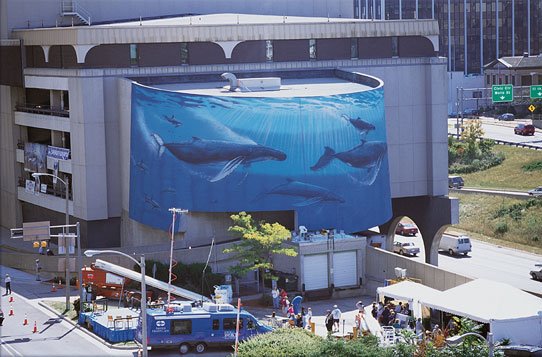
I was wrong. The county chose to put up one of rampant self-promoter Wyland's whale murals.

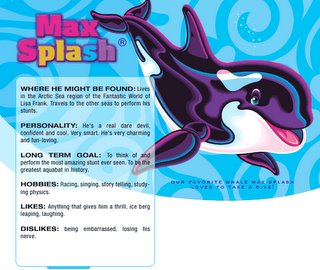
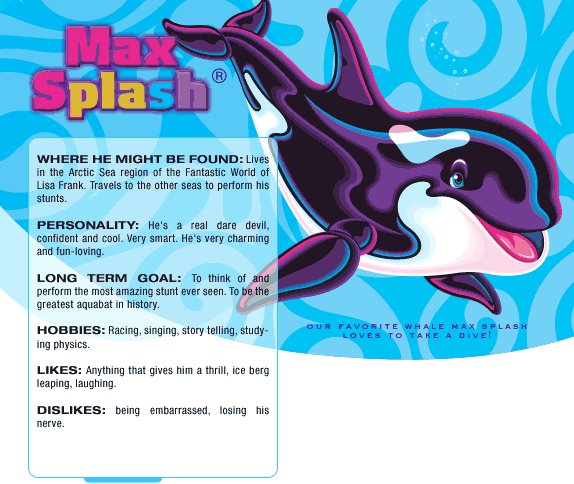
Because, as everyone knows, Milwaukee is all about the whales, what with our being a major oceanic seaport and located along a major whale migration route, as well as having been founded by whalers back in the nineteenth century. (Note to the geography-challenged: the preceding is sarcasm.) Wyland - who underlines his ridiculousness by preeningly insisting on being known only by his surname (his mother calls him Robert, or perhaps Bobby, or perhaps she just sighs exasperatedly, I don't know) - is one of those who make me question my usual annoyance at the way certain words, like "art," get transformed from simple descriptives into honorifics. So let us not argue that Wyland's whale murals aren't art; let us merely claim that they're lousy art. Hell, Lisa Frank's whales are more visually interesting and creative - and at least she doesn't pretend to be doing anything other than trying to make lots of money by selling her images to preteen girls.
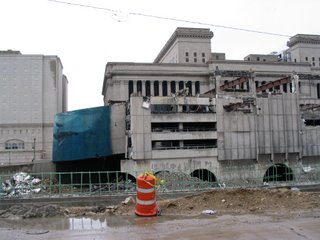
Anyway, after a bit of controversy (Wyland threatened legal action, pretending any building with his art on it had to be preserved in perpetuity...even though in fact, the contract explicitly waived Wyland's rights and granted Milwaukee County the right to remodel or demolish the building, including the whale mural, if need be), the mural is going to be coming down as part of the rebuilding of the Marquette interchange.
Other than the hamhanded literalism of Wyland's image-making, the absurdity of featuring whales over a freeway in Milwaukee was a key reason that almost no one around here ever warmed to the mural. So what sort of image might be more appropriate to Milwaukee?
Well, as everyone knows, Milwaukee is famous for beer - and despite endless attempts on the part of chambers of commerce and other interested parties to transcend Milwaukee's "beer and brats" image (which rarely work - if only because they always end up reinforcing that image in mentioning how much they want to transcend it), there's still a bar on nearly every other corner of the city. Many people don't know it, but Milwaukee is also home to the International Clown Hall of Fame (or as its URL would have it, the "Clown Museum"). Some of our older, more conservative residents, particularly on the southwest side where every other house is owned by a cop, firefighter, or someone related to one, are big supporters of the NRA.
At the same time (as I alluded to above), Milwaukee has considerably updated its image in the past decade, to the point where we're actually attracting young, smart, artistic types to the city - in a word, we're finally figuring out how to do the sexy.
So, what's the perfect image for Milwaukee? Combine the above, and you get...
Drunken Horny Clowns with Guns
Now who could argue with that?
It so happens that artist Bruce Nauman (who grew up in Milwaukee) has already done half the image:


(from his neon work Mean Clown Welcome)
Just put a bottle in one hand and a shotgun in the other, and we're done.
I'm thinking of this because, about ten years ago, Milwaukee County chose to commission a mural for the rather ugly concrete wall of a municipal parking garage overhanging a downtown freeway, directly north of the Marquette interchange where I-94 and I-43 meet. Before the mural went up, I was thinking, well, that's good - anything's an improvement over that wall.
I was wrong. The county chose to put up one of rampant self-promoter Wyland's whale murals.
Because, as everyone knows, Milwaukee is all about the whales, what with our being a major oceanic seaport and located along a major whale migration route, as well as having been founded by whalers back in the nineteenth century. (Note to the geography-challenged: the preceding is sarcasm.) Wyland - who underlines his ridiculousness by preeningly insisting on being known only by his surname (his mother calls him Robert, or perhaps Bobby, or perhaps she just sighs exasperatedly, I don't know) - is one of those who make me question my usual annoyance at the way certain words, like "art," get transformed from simple descriptives into honorifics. So let us not argue that Wyland's whale murals aren't art; let us merely claim that they're lousy art. Hell, Lisa Frank's whales are more visually interesting and creative - and at least she doesn't pretend to be doing anything other than trying to make lots of money by selling her images to preteen girls.
Anyway, after a bit of controversy (Wyland threatened legal action, pretending any building with his art on it had to be preserved in perpetuity...even though in fact, the contract explicitly waived Wyland's rights and granted Milwaukee County the right to remodel or demolish the building, including the whale mural, if need be), the mural is going to be coming down as part of the rebuilding of the Marquette interchange.
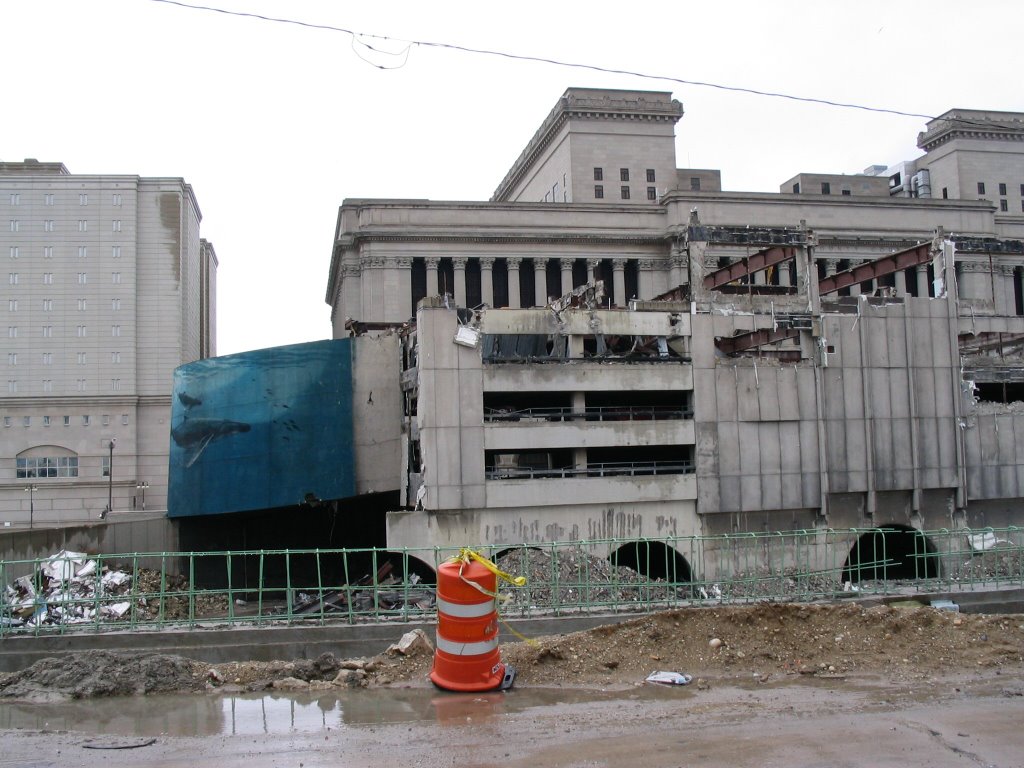
Other than the hamhanded literalism of Wyland's image-making, the absurdity of featuring whales over a freeway in Milwaukee was a key reason that almost no one around here ever warmed to the mural. So what sort of image might be more appropriate to Milwaukee?
Well, as everyone knows, Milwaukee is famous for beer - and despite endless attempts on the part of chambers of commerce and other interested parties to transcend Milwaukee's "beer and brats" image (which rarely work - if only because they always end up reinforcing that image in mentioning how much they want to transcend it), there's still a bar on nearly every other corner of the city. Many people don't know it, but Milwaukee is also home to the International Clown Hall of Fame (or as its URL would have it, the "Clown Museum"). Some of our older, more conservative residents, particularly on the southwest side where every other house is owned by a cop, firefighter, or someone related to one, are big supporters of the NRA.
At the same time (as I alluded to above), Milwaukee has considerably updated its image in the past decade, to the point where we're actually attracting young, smart, artistic types to the city - in a word, we're finally figuring out how to do the sexy.
So, what's the perfect image for Milwaukee? Combine the above, and you get...
Drunken Horny Clowns with Guns
Now who could argue with that?
It so happens that artist Bruce Nauman (who grew up in Milwaukee) has already done half the image:


(from his neon work Mean Clown Welcome)
Just put a bottle in one hand and a shotgun in the other, and we're done.
4.09.2006
some are more equal than others
On the scale of things, it may be extremely petty, or worse, to be irked at the Red Cross' "Katrina: An Equal Opportunity Destroyer" campaign - something I've been feeling since the ads first appeared several months ago. But in fact, the slogan is dubious in several ways.
Obviously Katrina, the storm itself, certainly didn't "care" who its victims were: no one would claim otherwise (except perhaps for Pat Robertson and his ilk). But as with most disasters, collateral damage from flooding, fire, lack of services, and disease ultimately kills, injures, or displaces more people than the initial disaster - and it is at that level that Katrina is anything but an equal-opportunity destroyer. Wealthy people, presented with an onrushing hurricane, have many different options, including getting out of town - and probably have excellent insurance, and certainly have more resources to use in recovering from whatever destruction they might suffer from (such as W. talking about his good ol' friend Trent Lott's sparkling newly to-be-rebuilt hacienda). The point isn't to minimize such suffering, but to compare it with that felt by the poor, who have far fewer options: they may not own a vehicle, are likely to lack insurance, may live in structurally less sound dwellings (which are not their own but rentals), and once displaced from their job (if they have one) are far more likely to find themselves replaced, or the job itself eliminated. The federal government can, when it wants to, mobilize many thousands, send them halfway across the world, and overthrow another nation's government. But take care of its own citizens? Its competence to do so, under this administration, seems extremely limited. (See Mike Davis's article on the situation.) I will make the bright-side assumption that it is a question of competence.
Even if you argue that I'm wrong, that the destruction was evenly distributed among different types of population, there's still the question of what's implied by the Red Cross slogan, what sort of appeal it's making, as an advertisement. "Equal opportunity destroyer" is, of course, a pun on "equal opportunity employer." That phrase is normally used to reassure non-whites, non-males, etc., that an employer will not discriminate against them. Yet New Orleans, as nearly all the media coverage of Katrina points out, is a majority-black city. While some surrounding suburbs are majority-white (and interestingly enough, googling "katrina 'equal opportunity destroyer'" brings up a lot of what look like Republican talking-points pages using this very point to establish Katrina's equal-opportunity-destroyer bona fides), they have smaller populations than New Orleans proper, and in any event generally suffered less (for the reasons I describe above, as well as geography, in most cases). So "equal opportunity destroyer" is certainly not an appeal to, say, African-Americans to recognize (as if they didn't know) that blacks were harmed by Katrina, too (an appeal that would be offensive in its assumptions that blacks don't care about non-blacks.) No, in fact, the clear implication (and what those Republican pages inadvertently point out) is that white people should remember that not only black people were harmed by Katrina.
And that is rather grotesque. I mean, what difference should it make who was harmed? If one-hundred percent of the people harmed by Katrina were black, should that make a damned bit of difference whether people make charitable donations? Of course it shouldn't - yet the Red Cross apparently feels compelled to remind people of the racial makeup (or the diversity of racial makeup) of the victims of Katrina.
Given the overwhelming media coverage emphasizing the blackness of New Orleans, I can only conclude that these ads tacitly acknowledge its audience's racism - in hopes to remind them that their donations will also be supporting nice friendly white people as well, not just those glowering black looters and alleged rapists portrayed in early, and dubiously accurate, news reports.
It's also quite interesting to contrast the frequency and volume of victim-blaming surrounding Katrina - why didn't these people leave town; why didn't New Orleans do more, Louisiana do more, etc. - with the usual free pass given a rather different kind of disaster victim: the folks who keep building and rebuilding multi-million dollar homes in landslide areas on the Pacific coast. Unlike residents of an entire city whose site cannot be moved (see this article contrasting New Orleans' "site" with its "situation"), these homeowners knowingly chose a disaster-prone setting for their entirely optional (and in many cases, uninsurable) location of their homes. I'll leave you to fill in the distinguishing variables that led to the rash of victim-blaming in New Orleans but far less of the same in California.
Obviously Katrina, the storm itself, certainly didn't "care" who its victims were: no one would claim otherwise (except perhaps for Pat Robertson and his ilk). But as with most disasters, collateral damage from flooding, fire, lack of services, and disease ultimately kills, injures, or displaces more people than the initial disaster - and it is at that level that Katrina is anything but an equal-opportunity destroyer. Wealthy people, presented with an onrushing hurricane, have many different options, including getting out of town - and probably have excellent insurance, and certainly have more resources to use in recovering from whatever destruction they might suffer from (such as W. talking about his good ol' friend Trent Lott's sparkling newly to-be-rebuilt hacienda). The point isn't to minimize such suffering, but to compare it with that felt by the poor, who have far fewer options: they may not own a vehicle, are likely to lack insurance, may live in structurally less sound dwellings (which are not their own but rentals), and once displaced from their job (if they have one) are far more likely to find themselves replaced, or the job itself eliminated. The federal government can, when it wants to, mobilize many thousands, send them halfway across the world, and overthrow another nation's government. But take care of its own citizens? Its competence to do so, under this administration, seems extremely limited. (See Mike Davis's article on the situation.) I will make the bright-side assumption that it is a question of competence.
Even if you argue that I'm wrong, that the destruction was evenly distributed among different types of population, there's still the question of what's implied by the Red Cross slogan, what sort of appeal it's making, as an advertisement. "Equal opportunity destroyer" is, of course, a pun on "equal opportunity employer." That phrase is normally used to reassure non-whites, non-males, etc., that an employer will not discriminate against them. Yet New Orleans, as nearly all the media coverage of Katrina points out, is a majority-black city. While some surrounding suburbs are majority-white (and interestingly enough, googling "katrina 'equal opportunity destroyer'" brings up a lot of what look like Republican talking-points pages using this very point to establish Katrina's equal-opportunity-destroyer bona fides), they have smaller populations than New Orleans proper, and in any event generally suffered less (for the reasons I describe above, as well as geography, in most cases). So "equal opportunity destroyer" is certainly not an appeal to, say, African-Americans to recognize (as if they didn't know) that blacks were harmed by Katrina, too (an appeal that would be offensive in its assumptions that blacks don't care about non-blacks.) No, in fact, the clear implication (and what those Republican pages inadvertently point out) is that white people should remember that not only black people were harmed by Katrina.
And that is rather grotesque. I mean, what difference should it make who was harmed? If one-hundred percent of the people harmed by Katrina were black, should that make a damned bit of difference whether people make charitable donations? Of course it shouldn't - yet the Red Cross apparently feels compelled to remind people of the racial makeup (or the diversity of racial makeup) of the victims of Katrina.
Given the overwhelming media coverage emphasizing the blackness of New Orleans, I can only conclude that these ads tacitly acknowledge its audience's racism - in hopes to remind them that their donations will also be supporting nice friendly white people as well, not just those glowering black looters and alleged rapists portrayed in early, and dubiously accurate, news reports.
It's also quite interesting to contrast the frequency and volume of victim-blaming surrounding Katrina - why didn't these people leave town; why didn't New Orleans do more, Louisiana do more, etc. - with the usual free pass given a rather different kind of disaster victim: the folks who keep building and rebuilding multi-million dollar homes in landslide areas on the Pacific coast. Unlike residents of an entire city whose site cannot be moved (see this article contrasting New Orleans' "site" with its "situation"), these homeowners knowingly chose a disaster-prone setting for their entirely optional (and in many cases, uninsurable) location of their homes. I'll leave you to fill in the distinguishing variables that led to the rash of victim-blaming in New Orleans but far less of the same in California.
4.07.2006
souvenirs
I found some good music downloads elsewhere - V-Fib Recordings has a whole raft of good, semi-obscure music. I noticed that a good number of these bands had Milwaukee connections (even though the active musicians featured are currently based in locales as various as New York, Richmond, Minneapolis, and elsewhere) - which turns out to be not too surprising, as the folks who run the site are former Milwaukeeans as well. Or at least names familiar to me, but I might have been drunk at the time.
Anyway, moving way way over to the other side of the whirled wired web, we run headlong into a Bubblegum Machine. In the future, you'll be able to actually get real, chewable bubblegum on the Intarnets - but for now, you'll just have to chew on Britisher Martin Lampen's take on the variety pack of sometimes moldy old records. Remember how mid-sixties soul lyrics often used an extended metaphor - "I Second That Emotion," etc.? So here's Joe Tex with a track called "Buying a Book," which uses one of the more obscurely convoluted romantic-sexual metaphors around. Fun track though - and don't miss the instrumental "Chocolate Cherry," which isn't a metaphor.
The history of the world is legible in the random shufflings of my iTune - or so I sometimes like to believe. This time, though, it amused me by following up "Buying a Book" with John Entwistle's "The Window Shopper" (a song I downloaded from Feed Me Good Tunes) which also mentions books in a, umm, romantic context. And what the hell is that in the background? It sounds like Entwistle poached a sackbut and shawm player from Richard Thompson, in one of Thompson's pointed-floppy-shoe-wearing excursions into funky medievalia. You do know that Entwistle was very well-read, right? So I'm sure this song is actually from Chaucer or something.
Finally, two last comments on the whole R.E.M. thing:
1. I think "the biggest wagon is the empty wagon is the noisiest" (from "Little America") is a great summation of all too much that happens all too often. It sounds like something some wise old toothless guy spitting outside a general store might say - but he'd be right.
2. If I wanted to force the chorus of "Sitting Still" to be semi-parsible into sense, I'd render it "Up to par and Katie bars the kitchen ties that knot me in/Set a trap for lovemaking, a waste of time, sitting still." But it's not that ("bars" rhymes with "ties" as Stipe sings it, and the consonant in "ties" is clearly an "s" - i.e., "size," "sighs," or possibly "signs"): too bad, as the first line would then both allude to the Southern phrase "Katie bar the door" and to the cliche "the ties that bind," with a hint of restrictive apron strings as well. It doesn't matter: the song isn't about what Stipe sings, but how he sings it. You really only need that, and two lines and the way he sings them in particular: "get away from me" and "can you hear me?" The rest of the words are blunt-cut, scissored, failed communication (I read the song as companion to "9-9" - "conversation fear" - and a more frustrated, angry take on the personal distance Stipe would explore more openly in "Good Advices" and the heartbreaking "Kohoutek.")
Anyway, moving way way over to the other side of the whirled wired web, we run headlong into a Bubblegum Machine. In the future, you'll be able to actually get real, chewable bubblegum on the Intarnets - but for now, you'll just have to chew on Britisher Martin Lampen's take on the variety pack of sometimes moldy old records. Remember how mid-sixties soul lyrics often used an extended metaphor - "I Second That Emotion," etc.? So here's Joe Tex with a track called "Buying a Book," which uses one of the more obscurely convoluted romantic-sexual metaphors around. Fun track though - and don't miss the instrumental "Chocolate Cherry," which isn't a metaphor.
The history of the world is legible in the random shufflings of my iTune - or so I sometimes like to believe. This time, though, it amused me by following up "Buying a Book" with John Entwistle's "The Window Shopper" (a song I downloaded from Feed Me Good Tunes) which also mentions books in a, umm, romantic context. And what the hell is that in the background? It sounds like Entwistle poached a sackbut and shawm player from Richard Thompson, in one of Thompson's pointed-floppy-shoe-wearing excursions into funky medievalia. You do know that Entwistle was very well-read, right? So I'm sure this song is actually from Chaucer or something.
Finally, two last comments on the whole R.E.M. thing:
1. I think "the biggest wagon is the empty wagon is the noisiest" (from "Little America") is a great summation of all too much that happens all too often. It sounds like something some wise old toothless guy spitting outside a general store might say - but he'd be right.
2. If I wanted to force the chorus of "Sitting Still" to be semi-parsible into sense, I'd render it "Up to par and Katie bars the kitchen ties that knot me in/Set a trap for lovemaking, a waste of time, sitting still." But it's not that ("bars" rhymes with "ties" as Stipe sings it, and the consonant in "ties" is clearly an "s" - i.e., "size," "sighs," or possibly "signs"): too bad, as the first line would then both allude to the Southern phrase "Katie bar the door" and to the cliche "the ties that bind," with a hint of restrictive apron strings as well. It doesn't matter: the song isn't about what Stipe sings, but how he sings it. You really only need that, and two lines and the way he sings them in particular: "get away from me" and "can you hear me?" The rest of the words are blunt-cut, scissored, failed communication (I read the song as companion to "9-9" - "conversation fear" - and a more frustrated, angry take on the personal distance Stipe would explore more openly in "Good Advices" and the heartbreaking "Kohoutek.")
4.06.2006
4.05.2006
we could arrange a meeting...
I conclude R.E.M. week (on the 26th anniversary of their first gig) by featuring music by bands that aren't quite R.E.M.
It'll make sense: trust me.
Like most small, intense music scenes, that of Athens in the early '80s was fairly incestuous: people knew one another, people played in one another's bands or formed ad hoc bands, and so on. Just around the time R.E.M. was beginning to be sniffed out by people beyond the local scene (and to read about the hygiene of Stipe in particular at that time, that couldn't have been too difficult...), Michael Stipe was also doing time in a band called Tanzplagen, which featured his sister Lynda and, occasionally, singer Linda Hopper. (Hopper and Lynda Stipe would go on to Oh OK, also Matthew Sweet's launching pad, while Stipe would form Hetch Hetchy and Hopper would go on to form Magnapop. That's just for those you into the rock genealogy thing.) The band was led by a musician named William Lee Self, a guitarist and organ player who clearly enjoys his pedals.
Tanzplagen released a single, "Treason" b/w "Meeting," and what's interesting is the way both tracks have some very R.E.M.-ish moments...even though Stipe's the only R.E.M. guy here, and he only co-wrote "Meeting." I'd say that in addition to people playing in one another's bands, they were listening, and learning, from one another's bands. Regardless, this is a pretty great single. Both sides were reissued on a German CD in the early '90s which also featured three live tracks: "Living by the Neck," built on a bass-led guitar riff and tremolo, a version of "Meeting" that expands the studio recording considerably, in a rather spacy direction, and a somewhat annoying (but short) track called "Peter Pan" that all but shouts "we're being avant garde now!"
At one point I found some biographical info on William Lee Self - but I can't seem to find it any more. (He's not the writer Will Self, though...)
From one band that isn't R.E.M., we go to another band that isn't R.E.M. but sort of is. The Minus 5 is a sort of Borg of a band that seems bent on assimilating other bands nearly whole: on its current tour it's also Robyn Hitchcock's backing band (and Hitchcock is apparently recording with them: good - he's much better with a band these days, I think), and since it features Peter Buck as more or less a permanent member (the apparatus is under the control of mad genius Scott McCaughey, who's pretty much the sole constant member), as well as R.E.M. tour drummer Bill Rieflin, plus a Posie or sometimes two...it was only a matter of time until the inevitable happened. So, last week on April 1 (and this time, this isn't a hoax), here's Mike Mills wandering onto the stage of the Georgia Theater in Atlanta, and hey waddaya know let's do a few R.E.M. songs since here's Michael Stipe...and - wow - who's that unibrowed man in a white t-shirt who just picked up the bass guitar? Yep: Bill Berry, temporarily returning from his retirement, to join the Minus 5, or 4.E.M., or something, on a version of "Country Feedback." (In the comments area of my last R.E.M. post, there's a link to a video of this performance on YouTube: lead guitar and vocals are all but inaudible, but you can see what's going on...such as the fact that Michael Stipe is no longer the only member of R.E.M. with a bald spot. If you can play this audio and watch that video, well, that should work pretty well for you!)
Tanzplagen "Treason"
Tanzplagen "Living by the Neck" (live)
Tanzplagen "Meeting" (live)
4.E.M. "Country Feedback" (live)
It'll make sense: trust me.
Like most small, intense music scenes, that of Athens in the early '80s was fairly incestuous: people knew one another, people played in one another's bands or formed ad hoc bands, and so on. Just around the time R.E.M. was beginning to be sniffed out by people beyond the local scene (and to read about the hygiene of Stipe in particular at that time, that couldn't have been too difficult...), Michael Stipe was also doing time in a band called Tanzplagen, which featured his sister Lynda and, occasionally, singer Linda Hopper. (Hopper and Lynda Stipe would go on to Oh OK, also Matthew Sweet's launching pad, while Stipe would form Hetch Hetchy and Hopper would go on to form Magnapop. That's just for those you into the rock genealogy thing.) The band was led by a musician named William Lee Self, a guitarist and organ player who clearly enjoys his pedals.
Tanzplagen released a single, "Treason" b/w "Meeting," and what's interesting is the way both tracks have some very R.E.M.-ish moments...even though Stipe's the only R.E.M. guy here, and he only co-wrote "Meeting." I'd say that in addition to people playing in one another's bands, they were listening, and learning, from one another's bands. Regardless, this is a pretty great single. Both sides were reissued on a German CD in the early '90s which also featured three live tracks: "Living by the Neck," built on a bass-led guitar riff and tremolo, a version of "Meeting" that expands the studio recording considerably, in a rather spacy direction, and a somewhat annoying (but short) track called "Peter Pan" that all but shouts "we're being avant garde now!"
At one point I found some biographical info on William Lee Self - but I can't seem to find it any more. (He's not the writer Will Self, though...)
From one band that isn't R.E.M., we go to another band that isn't R.E.M. but sort of is. The Minus 5 is a sort of Borg of a band that seems bent on assimilating other bands nearly whole: on its current tour it's also Robyn Hitchcock's backing band (and Hitchcock is apparently recording with them: good - he's much better with a band these days, I think), and since it features Peter Buck as more or less a permanent member (the apparatus is under the control of mad genius Scott McCaughey, who's pretty much the sole constant member), as well as R.E.M. tour drummer Bill Rieflin, plus a Posie or sometimes two...it was only a matter of time until the inevitable happened. So, last week on April 1 (and this time, this isn't a hoax), here's Mike Mills wandering onto the stage of the Georgia Theater in Atlanta, and hey waddaya know let's do a few R.E.M. songs since here's Michael Stipe...and - wow - who's that unibrowed man in a white t-shirt who just picked up the bass guitar? Yep: Bill Berry, temporarily returning from his retirement, to join the Minus 5, or 4.E.M., or something, on a version of "Country Feedback." (In the comments area of my last R.E.M. post, there's a link to a video of this performance on YouTube: lead guitar and vocals are all but inaudible, but you can see what's going on...such as the fact that Michael Stipe is no longer the only member of R.E.M. with a bald spot. If you can play this audio and watch that video, well, that should work pretty well for you!)
Tanzplagen "Treason"
Tanzplagen "Living by the Neck" (live)
Tanzplagen "Meeting" (live)
4.E.M. "Country Feedback" (live)
4.04.2006
what Philip Larkin said
Okay. Some people think they come from "interesting" (i.e., difficult, i.e., pain in the ass) families. I challenge you to read this Drink at Work entry (wherein Ces Marciuliano apparently expands his "Conversations with Dad" series to an older generation - you know, sorta like Star Trek did, only in reverse) and still maintain that your family's got anything - anything - on this one.
you don't say!
Amusing headline du jour (from Yahoo)...
You know what else? Jesus could have figure-skated with the best of them. He would have kicked ass at hockey, too. (Cue the King Missile track...)
You know what else? Jesus could have figure-skated with the best of them. He would have kicked ass at hockey, too. (Cue the King Missile track...)
file under water
It's apparently R.E.M. week here at ADS; aptly enough, today's the 26th anniversary of the band's rehearsal for its first concert (Christ but I'm old. But they're even older...). I'm featuring four more songs today. So last time I mentioned that I hadn't run into a studio version of the unreleased song "Theme from Two Steps Onward"; of course, I also hadn't looked for quite some time. Having done so, I found a set of R.E.M. demos: these tracks are from that collection. (And as I'd hoped, cuz I'm a sneaky bastard, a reader responded by offering to send along her copy of a studio recording of "Two Steps Onward"; it turned out to be the same recording.)
Anyway, the version of "Theme from Two Steps Onward" featured here is listed as coming from John Keane Studio in January or March 1986 (i.e., during the Lifes Rich Pageant sessions: sources vary). I hope you all like hiss: it sounds like this one was recorded while someone was grinding coffee beans in the next room. (That reader's version I mentioned above has less hiss, but a lot more swirly distortion resulting from the noise reduction; ultimately, I can more readily filter out the hiss in my head than that tinkly swirly stuff. Efforts to do my own noise reduction met with failure.) Nothing too revelatory in terms of the arrangement: it's almost identical to the concert version I posted a few days ago (which was performed about ten months beforehand). Mills nearly jams out on the bass a bit toward the end; that's about the only significant musical difference.
"That Beat" is a very early R.E.M. track - the demo here is listed as being recorded way back in February of 1981. How early is it? Early enough that Stipe has to ask about mic technique...the reply from the booth is too good for me to spoil here. The demo of "Laughing" is from August 1982 sessions in RCA Studios in NYC. It's a bit more straightforward than the Murmur version; in a way it reminds me of what it might have sounded like with Chronic Town's production.
The curious thing about "Skank" is that although it's never been released and, according to available gigographies, was played at only one of the shows I've been at, it still sounds quite familiar to me. It was the final song of the second encore of that show - maybe for some reason it lodged itself in my memory. Ah well - rather an odd lyric - and for Stipe that's saying something.
R.E.M. "Theme from Two Steps Onward" (demo)
R.E.M. "Laughing" (demo)
R.E.M. "That Beat" (demo)
R.E.M. "Skank" (demo)
Anyway, the version of "Theme from Two Steps Onward" featured here is listed as coming from John Keane Studio in January or March 1986 (i.e., during the Lifes Rich Pageant sessions: sources vary). I hope you all like hiss: it sounds like this one was recorded while someone was grinding coffee beans in the next room. (That reader's version I mentioned above has less hiss, but a lot more swirly distortion resulting from the noise reduction; ultimately, I can more readily filter out the hiss in my head than that tinkly swirly stuff. Efforts to do my own noise reduction met with failure.) Nothing too revelatory in terms of the arrangement: it's almost identical to the concert version I posted a few days ago (which was performed about ten months beforehand). Mills nearly jams out on the bass a bit toward the end; that's about the only significant musical difference.
"That Beat" is a very early R.E.M. track - the demo here is listed as being recorded way back in February of 1981. How early is it? Early enough that Stipe has to ask about mic technique...the reply from the booth is too good for me to spoil here. The demo of "Laughing" is from August 1982 sessions in RCA Studios in NYC. It's a bit more straightforward than the Murmur version; in a way it reminds me of what it might have sounded like with Chronic Town's production.
The curious thing about "Skank" is that although it's never been released and, according to available gigographies, was played at only one of the shows I've been at, it still sounds quite familiar to me. It was the final song of the second encore of that show - maybe for some reason it lodged itself in my memory. Ah well - rather an odd lyric - and for Stipe that's saying something.
R.E.M. "Theme from Two Steps Onward" (demo)
R.E.M. "Laughing" (demo)
R.E.M. "That Beat" (demo)
R.E.M. "Skank" (demo)
4.01.2006
unbelievable!
As many people know, during the recording sessions that completed the two John Lennon tracks that were released on the Anthology series, the surviving Beatles were often at odds with many of Jeff Lynne's production ideas. The "Threetles" felt that Lynne's approach was too safe, too glossy, and they wanted to incorporate more of the experimentation that characterized their peak years together, especially as Lennon had been a key component of that experimentation. Of course, the two Lennon songs ("Free as a Bird" and "Real Love") ultimately reflected Lynne's approach, being fairly conventional (if almost parodically "Beatlesque," particularly "Free as a Bird"'s coda).
However, it's long been rumored that the Beatles would sneak into the studio after hours, free to explore their musical impulses outside of Lynne's more commercial impulses. Any results of such recordings have long been assumed to be lost - but (as you've probably heard) an Egyptian collector discovered a cache of digital tapes left him by an eccentric British cousin who worked as a custodian at The Mill Studio in Sussex, where the two Lennon songs were completed. Most of the tape was unusable - but one track was nearly complete. Labeled "Zebra Ticket," the short excerpt (slightly over one minute long) is a compelling example of the way the Beatles could bridge experimentation with pop melody and appeal. While the loop that underlies the track is clearly a product of the '90s, the rest of the track is truly a Beatles song, featuring the melodicism of Ringo, McCartney's bracing cynicism, and Harrison's newly found instrumental expertise on the rare Javanese treadle-driven water organ (heard in the high-pitched, wavery drone).
So here it is: the Beatles' last-known recording, "Zebra Ticket." It's no "Fool on the Hill," but it is what it is.
However, it's long been rumored that the Beatles would sneak into the studio after hours, free to explore their musical impulses outside of Lynne's more commercial impulses. Any results of such recordings have long been assumed to be lost - but (as you've probably heard) an Egyptian collector discovered a cache of digital tapes left him by an eccentric British cousin who worked as a custodian at The Mill Studio in Sussex, where the two Lennon songs were completed. Most of the tape was unusable - but one track was nearly complete. Labeled "Zebra Ticket," the short excerpt (slightly over one minute long) is a compelling example of the way the Beatles could bridge experimentation with pop melody and appeal. While the loop that underlies the track is clearly a product of the '90s, the rest of the track is truly a Beatles song, featuring the melodicism of Ringo, McCartney's bracing cynicism, and Harrison's newly found instrumental expertise on the rare Javanese treadle-driven water organ (heard in the high-pitched, wavery drone).
So here it is: the Beatles' last-known recording, "Zebra Ticket." It's no "Fool on the Hill," but it is what it is.
Subscribe to:
Posts (Atom)

