This continues the posting of arbitrarily selected songs (the sixth track) from last week's CD purchases. Or disinterment, in one case. This installment focuses on tracks by bands whose names begin with letters in the second half of the alphabet.
The Minus 5 The Minus 5 (The Gun Album) (2006) "Cemetery Row": Why yes, that is Colin Meloy, singing wistfully of lemonade and gin and rhyming "matchsticks" with "halfwits." (Of course, in so doing he's only doing Scott McCaughey's bidding.) This is, I believe, the only song Meloy sings on - so Decemberists fanatics need not rush out to buy this CD on that basis alone (oops - too late - they were all rushing out the door in 19th century frockcoats right after "Colin Meloy, singing..."). So, another album full of melodic but sometimes curiously arranged songs full of decidedly curious lyrics (my favorite bits of nonsense are from "Hotel Senator": "She's a hotel senator from a nightstand fatherland. She's a representative of the broadcast prison band.")
The Ponys Laced with Romance (2003) "Looking Out a Mirror": I really liked the Ponys' Celebration Castle CD from last year, so I picked up this earlier release. More of the same - here their typical garageyness is melded with a sort of drive-in horror-movie sound to fine effect, a sound that suits the singer's voice (rather like Robert Smith's cousin who runs a motorcycle repair shop).
The Soft Boys "Stuck Inside of Mobile with the Memphis Blues Again" live on KEXP Seattle, 10-31-02: Not a new release - not a new purchase either. (Unfortunately, not a release at all.) Back when the Soft Boys reunion was an ongoing thing, I obtained a CD-R full of mp3s from the 2001 tour, along with several radio appearances primarily from 2002 in support of Nextdoorland. I'd begun burning CDs from them (at the time, I could play mp3 discs only in my computer), and had been distracted from trying to arrange and edit about 10 CDs' worth of material. I'd completely forgotten I'd even burned this CD, until last week I was digging through some old CD-Rs full of mp3s to enter them into my mp3 database program, and found this CD. Well hey. My random choice of the sixth track proves fortuitous here (it's the first track from the KEXP show, following five from a BBC-2 show two weeks earlier), since this is the only recording I have of the Soft Boys doing this Dylan track. (They do not appear to have played it on the 2001 tour.) Now you have it too - isn't that neat?
Swords Metropolis (2005) "Land Speed Record": My confession here is that despite what sometimes strikes me as a bit of overwroughtness to Swords' sound, for the most part this band's music is scientifically extracted from a lot of ideas residing in my head about what makes music interesting. They're right down the center of my own personal musical alley, in other words. I'd heard a couple of tracks before (they were previously known by the unwieldy name The Swords Project) but it wasn't until someone posted "Family Photographs" from this album that I was hooked. And that, too, was almost accidental: the mp3 didn't have proper ID3 tags, so it was playing away in iTunes taunting me. So I googled a few key lyrical phrases and found out which song and band it was - and then bought the CD. This track is typical: longish, intricately (if not busily) arranged, emotive, complex.
The Minus 5 "Cemetery Row"
The Ponys "Looking Out a Mirror"
The Soft Boys "Stuck Inside of Mobile with the Memphis Blues Again"
Swords "Land Speed Record"


2.25.2006
incoming!
I picked up a raft of new CDs last week, and I thought I'd make the next two entries brief reports on each of them. Since I've listened to each CD only a couple of times, these are more or less first impressions. And, I'm not very decided on which tracks are the best ones, so I'm simply posting the sixth track from each CD (unless the sixth track is only 19 seconds long or something...). So:
The Books The Lemon of Pink (2003) "There Is No There": I've really been enjoying the Books a lot lately. I suppose I should know better whether anyone else out there sounds like them - but regardless, their mix of frequently acoustic-instrument sound sources with laptop editing, along with a very fine ear for speech rhythms and pitch that make their voice excerpts far more integral than the usual bluntly signifying soundbites that litter too many records, make their records instantly distinctive as their own. (Here's an interesting interview with The Books, including some discussion of the source of the speech sample we hear in the middle of this track.)
Destroyer Destroyer's Rubies (2006) "3000 Flowers": Dan Bejar, of course, once more sounds nothing like his band's previous release (Your Blues) and like nothing so much as himself. Although that last phrase is probably misleading - in that for the first time in several records, Destroyer sounds like a band rather than a thinly disguised Bejar solo project. Several tracks feature saxophones - a new wrinkle, but one that somehow complements Bejar's ongoing interrogation of rock history (as much as I can make sense of his lyrics, that seems to be one of his main subjects: his own work is by no means exempt, as a few prior Destroyer albums get namechecked here, just as the band itself has been mentioned in earlier Destroyer songs).
His Name Is Alive Detrola (2006) "Your Bones": Warren Defever - or Warn, or just War, as he's billed here - is another restless musician whose work sometimes just barely seems to justify being released under a band name rather than under his own name...although HNIA has always featured different female vocalists, so there's always a certain audible element of collaboration. Defever's backed off from the hotted-up R&B of the last couple of HNIA albums, and some of the atmosphere of his 2002 solo albumWhen Flowers Covered the Earth - which sometimes created the impression that the listener was standing midway between a jazz band and the Steve Reich Ensemble - carries over to this release - which also features a saxophone on several tracks, an instrument rarely heard on earlier HNIA recordings. "Your Bones" is one of a handful of tracks with a strong synthesizer presence - again, something Defever has often avoided.
Lilys Everything Wrong Is Imaginary (2006) "The Night Sun over San Juan": Apparently, I'm buying CDs by "bands" that barely qualify as bands: Lilys, of course, is almost exclusively the realization of the vision of one man, Kurt Heasley. His collaborators, though, have always strongly colored the sound of his CDs: this time, he again works with Michael Musmanno, and the sound is somewhat similar to Lilys' last release(s) Precollection/The Lilys (US/British releases, with some different tracks and arrangements and running order). Heasley's sometimes been criticized for being a musical chameleon with no discernible style of his own: to me, such criticism focuses too much on the style and too little on the music itself, which has always been quite distinctively Heasley's in its melodic and structural contours. Regardless, as on the last album Heasley strikes out on no particularly derived path in terms of style and arrangement. There's a sort of semi-dancey, synthy sheen to several tracks here (notably "A Diana's Diana," featured at Fluxblog a couple weeks back) but the results are distinctively Lilys. I'm liking this one a lot so far.
Next: the second half of the alphabet (funny how that works!), including another release by a band whose name ends in "-ys" (no, not the Dead Kennedys: second half of the alphabet...).
The Books "There Is No There"
Destroyer "3000 Flowers"
His Name Is Alive "Your Bones"
Lilys "The Night Sun over San Juan"
The Books The Lemon of Pink (2003) "There Is No There": I've really been enjoying the Books a lot lately. I suppose I should know better whether anyone else out there sounds like them - but regardless, their mix of frequently acoustic-instrument sound sources with laptop editing, along with a very fine ear for speech rhythms and pitch that make their voice excerpts far more integral than the usual bluntly signifying soundbites that litter too many records, make their records instantly distinctive as their own. (Here's an interesting interview with The Books, including some discussion of the source of the speech sample we hear in the middle of this track.)
Destroyer Destroyer's Rubies (2006) "3000 Flowers": Dan Bejar, of course, once more sounds nothing like his band's previous release (Your Blues) and like nothing so much as himself. Although that last phrase is probably misleading - in that for the first time in several records, Destroyer sounds like a band rather than a thinly disguised Bejar solo project. Several tracks feature saxophones - a new wrinkle, but one that somehow complements Bejar's ongoing interrogation of rock history (as much as I can make sense of his lyrics, that seems to be one of his main subjects: his own work is by no means exempt, as a few prior Destroyer albums get namechecked here, just as the band itself has been mentioned in earlier Destroyer songs).
His Name Is Alive Detrola (2006) "Your Bones": Warren Defever - or Warn, or just War, as he's billed here - is another restless musician whose work sometimes just barely seems to justify being released under a band name rather than under his own name...although HNIA has always featured different female vocalists, so there's always a certain audible element of collaboration. Defever's backed off from the hotted-up R&B of the last couple of HNIA albums, and some of the atmosphere of his 2002 solo albumWhen Flowers Covered the Earth - which sometimes created the impression that the listener was standing midway between a jazz band and the Steve Reich Ensemble - carries over to this release - which also features a saxophone on several tracks, an instrument rarely heard on earlier HNIA recordings. "Your Bones" is one of a handful of tracks with a strong synthesizer presence - again, something Defever has often avoided.
Lilys Everything Wrong Is Imaginary (2006) "The Night Sun over San Juan": Apparently, I'm buying CDs by "bands" that barely qualify as bands: Lilys, of course, is almost exclusively the realization of the vision of one man, Kurt Heasley. His collaborators, though, have always strongly colored the sound of his CDs: this time, he again works with Michael Musmanno, and the sound is somewhat similar to Lilys' last release(s) Precollection/The Lilys (US/British releases, with some different tracks and arrangements and running order). Heasley's sometimes been criticized for being a musical chameleon with no discernible style of his own: to me, such criticism focuses too much on the style and too little on the music itself, which has always been quite distinctively Heasley's in its melodic and structural contours. Regardless, as on the last album Heasley strikes out on no particularly derived path in terms of style and arrangement. There's a sort of semi-dancey, synthy sheen to several tracks here (notably "A Diana's Diana," featured at Fluxblog a couple weeks back) but the results are distinctively Lilys. I'm liking this one a lot so far.
Next: the second half of the alphabet (funny how that works!), including another release by a band whose name ends in "-ys" (no, not the Dead Kennedys: second half of the alphabet...).
The Books "There Is No There"
Destroyer "3000 Flowers"
His Name Is Alive "Your Bones"
Lilys "The Night Sun over San Juan"
2.22.2006
excerpts from Dick Cheney's diaries
12/27: As I went to pick up the morning paper, I noticed the cutest little puppy rolling around on my lawn. I picked up the little feller and decapitated him with my bare hands, drinking down the blood from his skull in one draft. Anyway, just then I noticed a young boy in tears. "Mister, why'd you kill my new puppy? My mommy just got it for me for Christmas!" I felt sorry for him, so I said, "Hey kid! Catch!" and hurled the puppy's head at him full-force. It was pretty funny the way he doubled over in pain and fell vomiting into the street. And it's not my fault: I've told the goddamned bus company to slow down on my block so I can see the driver salute as he drives past. It's such a shame when a young life goes to waste. But I'd already eaten breakfast, so I swept the kid's mangled corpse into the sewer.
1/3: You know what my favorite song ever is? "Muskrat Love." That one always makes me cry like a little girl.
1/19: An amusing incident at dinner this evening. Eating my porterhouse, I ran into a particularly tough section of steak. Well, I refused to back down and give in to the damned steak...after all, back in my Wyoming youth I had a reputation for having the toughest teeth around - and in college, when a buddy of mine lost his car keys (let's just say he'd had a bit too much "youthful indiscretion"), I bit the doorhandle off his Maserati so he could get in. Well, anyway, I'm gnawing manfully away at the steak, and finally, after crunching through some bone, I swallowed the ungrateful hunk of meat. It was then I discovered that I'd accidentally bitten off my own thumb. Thankfully, the surgeons available to serve the office of Vice President of the United States of America are the best anywhere. They found a new, real thumb for me right away (ha! I guess my fingerprints won't match anymore), sewed it on, and everything's good as new. Of course, I had to send the surgeons to Gitmo afterwards - otherwise those damned journalists would never shut up about it. "Where'd you get the thumb, Mr. Cheney sir?" Whine, whine, whine.
2/6: W. called me into his office last week, yipping away about Jesus again. I thought I'd have some fun with him, so I told him I'd heard a rumor that Heaven's streets of gold needed repaving, and I knew just the guys who'd do a great job on them, hint hint. Sure enough, he took the bait - and this afternoon, one of my Halliburton buddies told me: $100 billion no-bid contract to repave all the streets in Heaven. Ka-ching!
2/18: Lynne was feeling a bit frisky last night, so instead of our usual game of "Hide the WMD," we played a new game - which I called "ICBM." She was a bit frail though - age will do that to a body - and it's really too bad I broke her hip. I'll miss her - but mercy dictated that she had to be put down. Back of the head, center of the skull. This time, I didn't miss.
1/3: You know what my favorite song ever is? "Muskrat Love." That one always makes me cry like a little girl.
1/19: An amusing incident at dinner this evening. Eating my porterhouse, I ran into a particularly tough section of steak. Well, I refused to back down and give in to the damned steak...after all, back in my Wyoming youth I had a reputation for having the toughest teeth around - and in college, when a buddy of mine lost his car keys (let's just say he'd had a bit too much "youthful indiscretion"), I bit the doorhandle off his Maserati so he could get in. Well, anyway, I'm gnawing manfully away at the steak, and finally, after crunching through some bone, I swallowed the ungrateful hunk of meat. It was then I discovered that I'd accidentally bitten off my own thumb. Thankfully, the surgeons available to serve the office of Vice President of the United States of America are the best anywhere. They found a new, real thumb for me right away (ha! I guess my fingerprints won't match anymore), sewed it on, and everything's good as new. Of course, I had to send the surgeons to Gitmo afterwards - otherwise those damned journalists would never shut up about it. "Where'd you get the thumb, Mr. Cheney sir?" Whine, whine, whine.
2/6: W. called me into his office last week, yipping away about Jesus again. I thought I'd have some fun with him, so I told him I'd heard a rumor that Heaven's streets of gold needed repaving, and I knew just the guys who'd do a great job on them, hint hint. Sure enough, he took the bait - and this afternoon, one of my Halliburton buddies told me: $100 billion no-bid contract to repave all the streets in Heaven. Ka-ching!
2/18: Lynne was feeling a bit frisky last night, so instead of our usual game of "Hide the WMD," we played a new game - which I called "ICBM." She was a bit frail though - age will do that to a body - and it's really too bad I broke her hip. I'll miss her - but mercy dictated that she had to be put down. Back of the head, center of the skull. This time, I didn't miss.
2.20.2006
...and they smile at us!
In my year-end wrap-up for 2005, one track on my "singles" comp was a demo of a song from an Oshkosh (WI) band called The Willis. That song, "Are We Are" (along with a few others, including the two that are linked from the band's page at Doubleplusgood Records), created some pretty high expectations for their then-forthcoming album Bathtub.Lightbulb.Heartattack. And I haven't been disappointed.
Because rock is so often about familiarity - about feeling those same muscles moving again, sweat and the same nerves vibrating - being smart, being interesting, even being creative with arrangements often risks losing the power and intensity of rock. It's (one reason) why the Ramones wrote the same song a hundred times: it was a damned fine song. But somehow, the Willis alchemize brains, brawn, and heart in a manner that sounds nothing like, but seems sparked by similar catalysts, as Mission of Burma (perhaps the number-one champ at pushing all of those qualities as far as they could go while compromising none of them). The two Bathtub songs posted at the label site linked above show some of their range: "Jimmy Fallon: The Plan" is self-referential and clever (almost too) with its musical means, and Stephen McCabe's vocals verge on shoutiness but stay on pitch. "They Have a Theory" is a bit more subdued, static electricity crackling ozone as the band's electronic side plays off a richly recorded acoustic guitar and high-lonesome pedal steel guitar. (Credit at this point should go to the sparkling production courtesy of James Lison, with "premixing" by Alan Weatherhead, who's worked with everyone from Sparklehorse to Mary Timony to Maki and who also plays pedal steel here.)
Just because they can, the band covers "Good Vibrations"...and (as one of the band's duelling Erics, bassist Eric Blumreich, points out in this interview) moves the song's furniture around to the extent that people often take a while to recognize the rather familiar room. "Missiles," perhaps, follows from Wilson's unconventional notions of song structure: that might be a verse that opens the track, or maybe it's a long intro, and then there's the chorus, or maybe that's the verse, but no, the next bit is the chorus I guess, and then there's an instrumental interlude, and - oh hell, it's the next song already. Maybe my favorite thing about this one is the tricky rhythmic thing (in the phrase giving both the song and this entry their titles) which ultimately is just in 4/4 but gives the impression of hopping off-center.
The rest of the record's equally interesting, and just as good, though not in the same way. But I can't post every song, cuz the idea is for people to buy the damned thing. (No Karma, in the list o' links to your right, sells it.) Some nice packaging (too bad the lyrics are nearly illegible), which thematically resonates strongly with the record itself, which seems to be set in a sort of mediated haze (that's "mediated" as in "media"), wherein some guy in a dark room full of outmoded electronic equipment scribbles notes trying to make sense of all the weird data flowing around him. He's not quite in tinfoil hat territory yet - but, well, it could happen. (Coincidentally, the graphic on the CD itself imitates the old "target" TV test pattern, very similar to the graphic on the CD of Michael Penn's latest CD. Penn will probably blame the Knights Templar.)
The Willis "Good Vibrations"
The Willis "Missiles"
Because rock is so often about familiarity - about feeling those same muscles moving again, sweat and the same nerves vibrating - being smart, being interesting, even being creative with arrangements often risks losing the power and intensity of rock. It's (one reason) why the Ramones wrote the same song a hundred times: it was a damned fine song. But somehow, the Willis alchemize brains, brawn, and heart in a manner that sounds nothing like, but seems sparked by similar catalysts, as Mission of Burma (perhaps the number-one champ at pushing all of those qualities as far as they could go while compromising none of them). The two Bathtub songs posted at the label site linked above show some of their range: "Jimmy Fallon: The Plan" is self-referential and clever (almost too) with its musical means, and Stephen McCabe's vocals verge on shoutiness but stay on pitch. "They Have a Theory" is a bit more subdued, static electricity crackling ozone as the band's electronic side plays off a richly recorded acoustic guitar and high-lonesome pedal steel guitar. (Credit at this point should go to the sparkling production courtesy of James Lison, with "premixing" by Alan Weatherhead, who's worked with everyone from Sparklehorse to Mary Timony to Maki and who also plays pedal steel here.)
Just because they can, the band covers "Good Vibrations"...and (as one of the band's duelling Erics, bassist Eric Blumreich, points out in this interview) moves the song's furniture around to the extent that people often take a while to recognize the rather familiar room. "Missiles," perhaps, follows from Wilson's unconventional notions of song structure: that might be a verse that opens the track, or maybe it's a long intro, and then there's the chorus, or maybe that's the verse, but no, the next bit is the chorus I guess, and then there's an instrumental interlude, and - oh hell, it's the next song already. Maybe my favorite thing about this one is the tricky rhythmic thing (in the phrase giving both the song and this entry their titles) which ultimately is just in 4/4 but gives the impression of hopping off-center.
The rest of the record's equally interesting, and just as good, though not in the same way. But I can't post every song, cuz the idea is for people to buy the damned thing. (No Karma, in the list o' links to your right, sells it.) Some nice packaging (too bad the lyrics are nearly illegible), which thematically resonates strongly with the record itself, which seems to be set in a sort of mediated haze (that's "mediated" as in "media"), wherein some guy in a dark room full of outmoded electronic equipment scribbles notes trying to make sense of all the weird data flowing around him. He's not quite in tinfoil hat territory yet - but, well, it could happen. (Coincidentally, the graphic on the CD itself imitates the old "target" TV test pattern, very similar to the graphic on the CD of Michael Penn's latest CD. Penn will probably blame the Knights Templar.)
The Willis "Good Vibrations"
The Willis "Missiles"
2.17.2006
the stripes to be a crowd
One of my favorite bands is Plasticland. I think part of it is they manage a sort of temporal hat-trick, sounding simultaneously like the music they're clearly emulating (psychedelia, particularly the Pretty Things circa S.F. Sorrow and, to a lesser extent, Parachute), of the time they recorded (the early '80s, in the shadow of punkish cynicism), and timeless; or at least for me: I don't listen to their songs nostalgically but as music powerfully performed, wonderfully and colorfully arranged, and witty enough to avoid the cotton-candy gooishness of too many neo-flowerpower acts, but genuine enough in their affection for the era's excess to avoid being a mere pisstake. I'm not sure if anyone else will appreciate the comment in the same way, but a comment Glenn Rehse made onstage at one of their periodic reunions a couple years back sums it up. Glancing at the usual tangle of cables and cords cluttering the stage, Rehse campily frowned, turned to the mic, and said, "Ooh - we're gonna need some conditioner!"
Anyway, another obvious influence on Plasticland is Syd Barrett - so of course, Plasticland had to appear on the Imaginary Records 1987 tribute album (this was, I'm pretty sure, one of the first tribute albums). They cover "Octopus" from The Madcap Laughs - and surprisingly, transform it into an entirely acoustic setting.* (I think they preceded the "unplugged" phenomenon here too.)
Here's a somewhat obscure track "Enchanted Forestry," from the EP Let's Play Pollyanna, released in 1989 on the German Repulsion label. As with nearly every psychedelic waltz-time number ever recorded, there's a trombone solo.
That solo is played by John Frankovic, who played bass for the most part but is capable on a broad range of other instruments. He's released a handful of solo recordings, and last year a bunch of them were compiled on an album unpromisingly titled Space Zombie (which - even more unpromisingly - features an illustration of the titular creature on its cover, which seems borrowed from the Museum of Rejected Pulp Sci-Fi Paperback Illustrations). Titled "I Forgot," it's an amusing illustration of one's tendency to space out. Well, some people's tendencies...for whatever reasons. I like the acoustic instruments filling out the mix on the bridge. Curiously, except for drums, Frankovic plays everything on this track...but the bass, the instrument he's best known for.
* I had two different versions of this song, both digitized from vinyl. One was a forest of pops and clicks, the other was much better...except for a skip in the middle. So I thought I'd compile a version - except the two were slightly different in pitch and tempo (variable turntable speeds, presumably) and of rather different sonic character. (Digression: what the high hell are turntable fetishists ingesting?) A little speeding up, a little equalizing, and a tiny edit eleven eighth-notes long (along with a couple of cosmetic pop removals) and, voila, a (relatively) clean copy.
Plasticland "Octopus"
Plasticland "Enchanted Forestry"
John Frankovic "I Forgot"
Anyway, another obvious influence on Plasticland is Syd Barrett - so of course, Plasticland had to appear on the Imaginary Records 1987 tribute album (this was, I'm pretty sure, one of the first tribute albums). They cover "Octopus" from The Madcap Laughs - and surprisingly, transform it into an entirely acoustic setting.* (I think they preceded the "unplugged" phenomenon here too.)
Here's a somewhat obscure track "Enchanted Forestry," from the EP Let's Play Pollyanna, released in 1989 on the German Repulsion label. As with nearly every psychedelic waltz-time number ever recorded, there's a trombone solo.
That solo is played by John Frankovic, who played bass for the most part but is capable on a broad range of other instruments. He's released a handful of solo recordings, and last year a bunch of them were compiled on an album unpromisingly titled Space Zombie (which - even more unpromisingly - features an illustration of the titular creature on its cover, which seems borrowed from the Museum of Rejected Pulp Sci-Fi Paperback Illustrations). Titled "I Forgot," it's an amusing illustration of one's tendency to space out. Well, some people's tendencies...for whatever reasons. I like the acoustic instruments filling out the mix on the bridge. Curiously, except for drums, Frankovic plays everything on this track...but the bass, the instrument he's best known for.
* I had two different versions of this song, both digitized from vinyl. One was a forest of pops and clicks, the other was much better...except for a skip in the middle. So I thought I'd compile a version - except the two were slightly different in pitch and tempo (variable turntable speeds, presumably) and of rather different sonic character. (Digression: what the high hell are turntable fetishists ingesting?) A little speeding up, a little equalizing, and a tiny edit eleven eighth-notes long (along with a couple of cosmetic pop removals) and, voila, a (relatively) clean copy.
Plasticland "Octopus"
Plasticland "Enchanted Forestry"
John Frankovic "I Forgot"
2.15.2006
a brick raised is a straw defeated
Did they used to have sections of standardized testing that dealt with interpreting proverbial sayings? I have a vague memory of this...and that I sucked at it, either because I was not 75 years old, or because apparently I was raised on the plains of Mars by wolves under the Witness Protection Program, and so much of the outside world was dramatically filtered. Anyway, such proverbs have always intrigued me, mostly because they flirt with nonsense, and nonsense is a long-term paramour of mine. (Note: nonsense is not the same as random verbiage: it's ill-named and might perhaps be called "a-sense" by analogy with "amoral" compared to "immoral.")
So, three pieces of music setting proverbs. First up is a piece by composer Michael Torke, for a small ensemble and vocalist, called (in the usual, extraordinarily evocative fashion of classical pieces, Four Proverbs. This is the third of four proverbs set in this piece (again, cleverly titled "III"), and its text is only two lines long. (The lyrics to the piece are drawn entirely from the biblical book of Proverbs, and this is the most compact and evocative of the four selections to my ears.)
Second, "Twenty-Two Proverbs," a tricky bricolage of various proverbs from the quite curious Kew. Rhone. album by John Greaves, Peter Blegvad, and Lisa Herman. Some of these proverbs are so obscure I thought Blegvad (who's responsible for the lyrics) simply made them up. In particular, I still can't make head or tale of "what have I to do with Bradshaw's windmill?" A websearch on the phrase "Bradshaw's windmill" (in quotes) reveals nothing; removing the quotation marks led me to an article from the journal Notes & Queries (basically, turbogeekery for the literary world), which I've duplicated here (the journal itself has an annoying, although free, registration process). Blegvad apparently drew this phrase from Thomas Fuller, an 18th century writer - which makes sense, given that the painting which inspired much of the album (C.W. Peale's Exhumation of the Mastodon) was done roughly contemporaneously, at the beginning of the 19th century. Greg Crossan, the author of the Notes & Queries piece, mentions the proverb, but only alludes to what it might mean. I got nothing. (Incidentally, this sort of writing is the kind that I find immensely fascinating for a couple of paragraphs, after which - as it drones on - it suddenly turns into quicksand for consciousness.)
Finally, here's Nobukazu Takemura's remix of Steve Reich's "Proverb," whose lyric is a short phrase from the proverb-like writing of Wittgenstein. (Shades of Komar & Melamid's "Most Wanted/Unwanted Music"...)Here are Reich's notes on the original piece. I think the glitchiness of Takemura's take on this piece suits the whole notion of proverbs.
Michael Torke Four Proverbs: III (Catherine Bott, vocals)
John Greaves, Peter Blegvad, Lisa Herman "Twenty-Two Proverbs"
Nobukazu Tamekura "Proverb" (Steve Reich) remix
(full disclosure: I should probably mention that Michael's my cousin. We grew up around the block from one another, and spent a lot of time together as kids, although we're in very infrequent contact these days. Oh - and actually, many of his pieces do have interesting titles: most notoriously, a whole series derived from colors, along with materials, addresses, everyday objects, and so forth.
Finally, that "proverb" titling this entry? I made it up. If it means anything, it's totally by accident.
So, three pieces of music setting proverbs. First up is a piece by composer Michael Torke, for a small ensemble and vocalist, called (in the usual, extraordinarily evocative fashion of classical pieces, Four Proverbs. This is the third of four proverbs set in this piece (again, cleverly titled "III"), and its text is only two lines long. (The lyrics to the piece are drawn entirely from the biblical book of Proverbs, and this is the most compact and evocative of the four selections to my ears.)
Second, "Twenty-Two Proverbs," a tricky bricolage of various proverbs from the quite curious Kew. Rhone. album by John Greaves, Peter Blegvad, and Lisa Herman. Some of these proverbs are so obscure I thought Blegvad (who's responsible for the lyrics) simply made them up. In particular, I still can't make head or tale of "what have I to do with Bradshaw's windmill?" A websearch on the phrase "Bradshaw's windmill" (in quotes) reveals nothing; removing the quotation marks led me to an article from the journal Notes & Queries (basically, turbogeekery for the literary world), which I've duplicated here (the journal itself has an annoying, although free, registration process). Blegvad apparently drew this phrase from Thomas Fuller, an 18th century writer - which makes sense, given that the painting which inspired much of the album (C.W. Peale's Exhumation of the Mastodon) was done roughly contemporaneously, at the beginning of the 19th century. Greg Crossan, the author of the Notes & Queries piece, mentions the proverb, but only alludes to what it might mean. I got nothing. (Incidentally, this sort of writing is the kind that I find immensely fascinating for a couple of paragraphs, after which - as it drones on - it suddenly turns into quicksand for consciousness.)
Finally, here's Nobukazu Takemura's remix of Steve Reich's "Proverb," whose lyric is a short phrase from the proverb-like writing of Wittgenstein. (Shades of Komar & Melamid's "Most Wanted/Unwanted Music"...)Here are Reich's notes on the original piece. I think the glitchiness of Takemura's take on this piece suits the whole notion of proverbs.
Michael Torke Four Proverbs: III (Catherine Bott, vocals)
John Greaves, Peter Blegvad, Lisa Herman "Twenty-Two Proverbs"
Nobukazu Tamekura "Proverb" (Steve Reich) remix
(full disclosure: I should probably mention that Michael's my cousin. We grew up around the block from one another, and spent a lot of time together as kids, although we're in very infrequent contact these days. Oh - and actually, many of his pieces do have interesting titles: most notoriously, a whole series derived from colors, along with materials, addresses, everyday objects, and so forth.
Finally, that "proverb" titling this entry? I made it up. If it means anything, it's totally by accident.
2.13.2006
media coverup?

Curiously, the following paragraphs (from early reports of the Dick Cheney hunting incident) appear to have been omitted from all subsequent media updates on the incident. I present them here without further comment:
Katharine Armstrong, the ranch's owner, told The Associated Press that the accident occurred after Cheney, Whittington [the victim] and another hunter got out of a car to shoot at a covey of quail.
Whittington apparently "came up from behind the vice president and the other hunter and didn't signal them or indicate to them or announce himself," said Armstrong, who was in the car. "We heard a low, growling noise, and discovered the vice president on all fours, hunched over Whittington's body."
"At first," Armstrong continued, "we thought the wounds on Whittington's face were bite marks. We feared he'd been attacked by some wild animal."
White House representatives expressed surprise that Cheney had been hunting this weekend. "The vice president prefers to avoid public hunting trips within five days of the full moon, as the extra illumination allows potential prey to spot him more readily."
2.09.2006
found art
Last.fm has a cool new feature in its charts area: under "albums," it will display images of the album covers as an array of thumbnails. One of the cool things about this feature is unexpected visual rhymes, rhythms, and echoes that arise accidentally from the juxtaposition of covers in this array. This link to my current array will always display something slightly different from what's there right now, of course - but right now, some cool things:
* the ladder from the Starlight Mints' first CD reaching toward the ceiling of Tommy Keene's Isolation Party above it
* the "hands" theme carrying from Spoon's Kill the Moonlight to Fugazi's The Argument (and echoed lower down by Clinic's Winchester Cathedral, and again lower yet by Lilys' Better Can't Make You Better and the Negro Problem's Welcome Black)
* the structural similarity between the Fall's The Marshall Suite and Broadcast's Work and Non-Work
* Freedy Johnston's Can You Fly near the Catherine Wheel's Chrome
At one point, Carpet Music's Weekday was next to Pink Floyd's Meddle: the concentric circles theme looked very nice in juxtaposition.
Go ahead - find your own!
* the ladder from the Starlight Mints' first CD reaching toward the ceiling of Tommy Keene's Isolation Party above it
* the "hands" theme carrying from Spoon's Kill the Moonlight to Fugazi's The Argument (and echoed lower down by Clinic's Winchester Cathedral, and again lower yet by Lilys' Better Can't Make You Better and the Negro Problem's Welcome Black)
* the structural similarity between the Fall's The Marshall Suite and Broadcast's Work and Non-Work
* Freedy Johnston's Can You Fly near the Catherine Wheel's Chrome
At one point, Carpet Music's Weekday was next to Pink Floyd's Meddle: the concentric circles theme looked very nice in juxtaposition.
Go ahead - find your own!
2.08.2006
two acts of random violence
1: I haven't had any brilliant ideas for songs to post lately, so I will resort to Ye Olde iTunes Party Shuffle for selections. My only rules are (a) I can't have posted the song already; (b) the song shouldn't have been downloaded from another mp3 blog in the first place; and (c) it shouldn't suck too badly. I am confident about the first two criteria; the last is, of course, out of my hands. For the surprise factor, I'll renew the shuffle list after each selection. Vanna, could you spin that wheel and see what tunes I verbally desecrate this evening?
Okay, first up is King Harvest's "Dancing in the Moonlight," a medium-sized hit (at least in my memory) from 1972 or so. I like the electric piano (izzat a Wurlitzer?) and the singer's got that Sweaty Rock Dude sort of voice, which contrasts a bit with the generally subdued music. I will presume the band named itself after the song by the Band - that seems apt enough.
Ouija board, ouija board...nope, sorry - no Morrissey today. Instead we have the Mitchells with "Stakeout." Thematically this song seems similar to John Vanderslice's "Continuation" (about the detectives). This is one of the first songs I heard by the Mitchells (courtesy Aaron from the wonderfully named Horn Farm Paste Mob) and is still one of my favorites of theirs. I like the guitar textures and chords and the way they blend, as well as the singer's vocal timbre.
Let's toss the dice again...it's Steve Forbert's version of "Starstruck," from the Kinks tribute album This Is Where I Belong. Forbert was New Dylan #3,795 back in the late '70s, and I think he's still best known for his early hit "Romeo's Tune." Some people are going to hit me on the head with some sort of blunt instrument, but...uh, I actually don't own The Kinks Are the Village Green Preservation Society. Looking at the track list, there's absolutely no reason on earth why I don't. But there remain mysterious lacunae in my collection...I blame sunspots. Or aliens. Or Queen Elizabeth II, the Trilateral Commission, and a consortium of disgruntled Maytag repairmen.
King Harvest "Dancing in the Moonlight"
The Mitchells "Stakeout"
Steve Forbert "Starstruck"
2: I went shopping for a pair of jeans today - and, while I'm sure this is extremely old news to people who either shop for jeans more frequently than I do or have given birth to kids who are now teenagers, apparently Levi's has discovered that somehow it can take a pair of jeans that look for all the world as if they've been worn for twenty years by a biker with standards of hygiene lower than the biker average, as well as a high incidence of leaping over barbed-wire fences ungracefully, and sell them as "vintage" and "lost and found" jeans for $50. This is excellent news for me, since I typically donate my thrashed-out clothing and write off the value as a charitable deduction. I will have to remember that now, clothes that I had previously deemed suitable only for rags are worth fifty bucks on the market. As it happens, I saw these jeans when they were left hanging on a hook in the try-on room, and as I was pulling them off the hook to examine them, one of the prefabricated rips caught on the doorhandle and tore apart even more. I should have charged the store ten bucks for adding value to their merchandise.
Okay, first up is King Harvest's "Dancing in the Moonlight," a medium-sized hit (at least in my memory) from 1972 or so. I like the electric piano (izzat a Wurlitzer?) and the singer's got that Sweaty Rock Dude sort of voice, which contrasts a bit with the generally subdued music. I will presume the band named itself after the song by the Band - that seems apt enough.
Ouija board, ouija board...nope, sorry - no Morrissey today. Instead we have the Mitchells with "Stakeout." Thematically this song seems similar to John Vanderslice's "Continuation" (about the detectives). This is one of the first songs I heard by the Mitchells (courtesy Aaron from the wonderfully named Horn Farm Paste Mob) and is still one of my favorites of theirs. I like the guitar textures and chords and the way they blend, as well as the singer's vocal timbre.
Let's toss the dice again...it's Steve Forbert's version of "Starstruck," from the Kinks tribute album This Is Where I Belong. Forbert was New Dylan #3,795 back in the late '70s, and I think he's still best known for his early hit "Romeo's Tune." Some people are going to hit me on the head with some sort of blunt instrument, but...uh, I actually don't own The Kinks Are the Village Green Preservation Society. Looking at the track list, there's absolutely no reason on earth why I don't. But there remain mysterious lacunae in my collection...I blame sunspots. Or aliens. Or Queen Elizabeth II, the Trilateral Commission, and a consortium of disgruntled Maytag repairmen.
King Harvest "Dancing in the Moonlight"
The Mitchells "Stakeout"
Steve Forbert "Starstruck"
2: I went shopping for a pair of jeans today - and, while I'm sure this is extremely old news to people who either shop for jeans more frequently than I do or have given birth to kids who are now teenagers, apparently Levi's has discovered that somehow it can take a pair of jeans that look for all the world as if they've been worn for twenty years by a biker with standards of hygiene lower than the biker average, as well as a high incidence of leaping over barbed-wire fences ungracefully, and sell them as "vintage" and "lost and found" jeans for $50. This is excellent news for me, since I typically donate my thrashed-out clothing and write off the value as a charitable deduction. I will have to remember that now, clothes that I had previously deemed suitable only for rags are worth fifty bucks on the market. As it happens, I saw these jeans when they were left hanging on a hook in the try-on room, and as I was pulling them off the hook to examine them, one of the prefabricated rips caught on the doorhandle and tore apart even more. I should have charged the store ten bucks for adding value to their merchandise.
2.06.2006
When in RomCom...
So I almost had one of those perfect romantic-comedy meet-cutes this afternoon. I'm walking through the student union in my usual post-teaching daze, when a rather lovely young woman taps me on the shoulder and asks if I can help this man she thought she saw fall out of his wheelchair on the mall between the union and library. So we get to the door and see that no, he didn't fall out of his chair, he'd climbed out; and he was currently engaged in diligently chalking notice of some political rally or other on the pavement. I complimented her on her thoughtfulness, though - and fortunately, "meet-cute" wasn't what was on her mind, as I would have had zero clue what to say after that. (The scale of incapacitating attractiveness, incidentally, has several degrees. Causing the tongue to turn into a useless, flopping beast rather like a disabled (if marginally less enormous) sea elephant is one; slightly below that is finding that gravity has gone rogue and affects random nearby objects up to and including one's own self; very near the top of the scale is when you are compelled to whimper like a pup. Anyway.)
Then again, I'm disqualified for romantic-comedy meet-cutes on the grounds that I'm happily married. Now if I'd been a career-obsessed young attorney in a loveless marriage to a lumpish harridan with a QVC addiction and then met a sassy young African-American paralegal working for the public defender's office; or a schlumpy middle-aged idealist puttering away on a novel in a dingy room, who suddenly meets an idealistic young philanthropist possessed of an insouciant joie de vivre and who just happens to realize I'm the next John Grisham; or a troubled but concerned cop with a sketchy past and a drinking problem whose naive but goodhearted young partner sets me up on a blind date with his lovely social-worker neighbor, maybe that would have worked.
(ps: I apologize for the absolutely appalling pun that titles this entry. I know it displays a lot of gall, but the parties responsible have been sacked.)
Then again, I'm disqualified for romantic-comedy meet-cutes on the grounds that I'm happily married. Now if I'd been a career-obsessed young attorney in a loveless marriage to a lumpish harridan with a QVC addiction and then met a sassy young African-American paralegal working for the public defender's office; or a schlumpy middle-aged idealist puttering away on a novel in a dingy room, who suddenly meets an idealistic young philanthropist possessed of an insouciant joie de vivre and who just happens to realize I'm the next John Grisham; or a troubled but concerned cop with a sketchy past and a drinking problem whose naive but goodhearted young partner sets me up on a blind date with his lovely social-worker neighbor, maybe that would have worked.
(ps: I apologize for the absolutely appalling pun that titles this entry. I know it displays a lot of gall, but the parties responsible have been sacked.)
American Parody
Seeing a (rather lopsided) reproduction of Grant Wood's American Gothic posted in the comments section of a recent entry of Momus' Click Opera caused me to look for the actual image. I'm not surprised to find that the image is one of the most popular and parodied artworks. A Google image-search brings up a vast array of parodic images: the iconic couple wielding cellphones and golf clubs, having gained fifty pounds each, transformed into Darth Vader and Yoda, and so on. One could produce a fairly accurate mapping of American cultural obsessions merely by cataloguing the parodies of this image.
2.03.2006
[I think I already used that Killdozer song title for one of these...]
 So apparently we're in the midst of another epidemic of gender anxiety, particularly among men. Milwaukee's Best Light (which for years wasn't sold in Milwaukee - its name would have been too blatantly false) has upped the ante of its "Brewed for a Man's Taste" campaign (i.e., "if you want to drink light beer but are too insecure to do so in front of other men...") with a new set of ads adding the slogan "men should act like men, and light beer should taste like beer." Well first, the lack of parallelism bugs me (like, "stupid men should act like men, and light beer should taste like beer - but in fact neither is true"), but the whole premise of the ad deputizes a certain kind of man into the Guy Police, ruthlessly penalizing even the most inane and trivial violation of the codes of masculinity by summoning a gigantic beer can from above to crush all such violators - who, by their very unpunished existence, it seems, aid and abet those who'd doubt the utter guyness of any other man in the room. If you're not with us, you're with the gender terrorists. Some of the offenses? Being affectionate to one's lover, or daubing oil from a slice of pizza. Apparently it's unmanly to not shovel as much greasy food down one's gullet as possible. If you're a real man, you won't wimpily give in to that bastard heart disease. Only pussies get clogged arteries - and it's their own damned fault, for not driving enormous pickup trucks or wanting to shoot things.
Along similar lines, I just read a review of the book Man Camp by Adrienne Brodeur, whose setup is that (to quote from a review by Caroline Goyette) "New York City men...have become too darn...unmanly": they "can't chop wood, start a fire, or jump their car when the battery dies." Apparently, the book would imply, women should act like women. God forbid that if a woman thinks it's important to know how to chop wood, start a fire, or jumpstart a car, she learn to do so herself, thereby robbing any manly man in the vicinity of the opportunity to whip out his engorged sense of chauvinism. The book then introduces a "strapping and infinitely manly dairy farmer from West Virginia" - dairy farmer? wouldn't cattle rancher or tobacco farmer have been more manly? - who, in an enormously surprising denouement, ultimately proves to be less than he seems as well. (All this is from the review - I haven't read the book - so blame Goyette if I'm wrong, since she actually did read the book, one assumes.)
At any rate, I don't understand people's continued fascination with wanting it to be 1953 again.
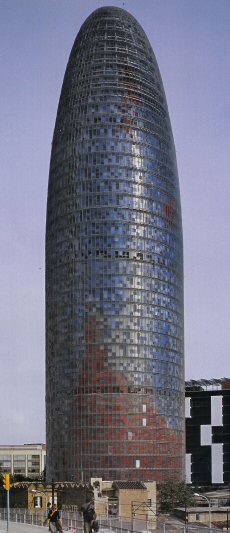
(image from January 2006 Architectural Record, by Philippe Rualt, of Barcelona's Agbar Tower by architect Jean Nouvel)
Subscribe to:
Posts (Atom)

