Blaine L. Reininger "Sons of the Silent Age" (Bowie cover - 1982)
James William Hindle "Silence" (2004)
Blanket Music "Hips" (2002)

1.31.2006

1.29.2006
karma bites me in the ass
Okay, the other day I sent off a pissy little post to a mailing list I'm on all about certain musical devices I generally hate. The list included: harmonica, particularly when played either in a "mellow" or egregiously bluesy mode (and most particularly when played by some dope wandering around the streets); cheesy pseudo-soul female backing vocalists, particularly when outside their genre of origin (i.e., a lot of early '80s Bob Dylan records); and ghastly saxophones, particularly when they're playing mellow solos or arrayed into groupings and adding fake R&B accents to non-R&B music.
Really I was thinking, with the last one, of Phil Collins records and the like. But I should have known that such generalizations almost always sprout exceptions; as for instance, I will confess to still liking Steely Dan, even though there are moments on their records where all three hated factors are in effect simultaneously (admittedly, those are moments that either make me cringe or force me to sniff out irony in the very arrangements: not all that hard, in fact, since Becker and Fagen are on record as saying they intentionally like to contrast the bitterness and cynicism of their lyrics with a very smooth surface). Still further, it's not horns I don't like; it's bad arranging and playing. Anyway, the ass-biting referred to above is simply that here I am feeling compelled, a mere two days later, to post three songs by a band with a three-piece horn section (two saxes and a trombone). I should learn.
Anyway: so last night we went out to the reunion show (first in ten years) of that band, former local institution Blue in the Face. Seems some friends of the band got married, and one drunken idea led to actual serious thinking led to arrangements for this show. The band looked good - some hair a little less glossy, foreheads extended a bit further back on the scalp, some facial features sporting a bit more texture - but really, nobody looked like a disaster area. And they played well, enthusiastically and accurately. The show was (they say) a one-off - people have lives, kids and jobs and the like - but they didn't sound to have lost a step at all.
The band's main strength is the songwriting of singer and guitarist Mike Stefaniak, whose "pretend name" (as he said onstage last night) is Mike Benign (oh those wacky punk-rock days of yore). Stefaniak worked for years as a bartender, and his lyrics present keenly observed moments of hope, frustration, and folly - in all of which he most certainly includes himself: no sense putting yourself above it. (It hadn't occurred to me until now, but Benign also has that wiseguy singing-out-the-side-of-the-mouth sound I mentioned in my Wrens post last week.)
"No Better Off" is the b-side of Blue in the Face's first single, from 1992. Every word is true, whether or not it happened to anyone in particular. The line about "Catholic guilt" is a true classic (Elvis reference and all). This track also shows up on a mopping-up CD called Went Well with Bourbon, theoretically available only at last night's show, which contains both sides of that single, a couple demos for the unfinished third album, and live versions of a couple of songs presumably also intended for that album.
The band released its first full-length in 1993, called Kicks & Deals. It led off with "Dot Dot Dot," a track that shoulda-coulda been a hit - not a million miles from what Elvis Costello was doing circa Punch the Clock, but the band missed confusing the folks who'd believe "bands with horns play ska" by a couple of years (and the "bands with horns play 'swing'" craze by a few more). The song is a smarter cousin of the Police's annoying (but catchy) "De Do Do Do, De Da Da Da" - and the title's way easier to type as well. (Incidentally, and unrelated to anything else, in my fingers' opinion the most irksome title to type is Midnight Oil's 10, 9, 8, 7, 6, 5, 4, 3, 2, 1 - it's all that moving from the off-angle numerals back and forth to the commas and trying to toss the space bar in there too.)
The band's final album was called Curtains either presciently or knowingly (you'd have to be in the band to know, I guess). No one I'd trust could resist a song called "The Fountain of Act Your Age," so here it is. That little sax intro almost sounds like a quote from an early '60s jazz track...I can't place it if so. That, by the way, is one thing that makes the horns less objectionable: when the players are rooted in jazz (you can hear it more clearly in their solos, especially live - although the trombone solo here is pretty straightforward).
Incidentally, I can think of no better summation of a certain rust-belted Milwaukee in the late '80s and early '90s than the first few lines (and title) of "Land of 1000 Drinking Problems" (from Kicks & Deals): "I met my love in the city of pickled eggs and varicose veins. I kissed her lips amidst a flannel-shirted barfight, by tanneries and tallow factories and ghosts... No one thinks to drink the world away; you just drink away the part you know."
I'll drink to that.
Blue in the Face "No Better Off"
Blue in the Face "Dot Dot Dot"
Blue in the Face "The Fountain of Act Your Age"
Really I was thinking, with the last one, of Phil Collins records and the like. But I should have known that such generalizations almost always sprout exceptions; as for instance, I will confess to still liking Steely Dan, even though there are moments on their records where all three hated factors are in effect simultaneously (admittedly, those are moments that either make me cringe or force me to sniff out irony in the very arrangements: not all that hard, in fact, since Becker and Fagen are on record as saying they intentionally like to contrast the bitterness and cynicism of their lyrics with a very smooth surface). Still further, it's not horns I don't like; it's bad arranging and playing. Anyway, the ass-biting referred to above is simply that here I am feeling compelled, a mere two days later, to post three songs by a band with a three-piece horn section (two saxes and a trombone). I should learn.
Anyway: so last night we went out to the reunion show (first in ten years) of that band, former local institution Blue in the Face. Seems some friends of the band got married, and one drunken idea led to actual serious thinking led to arrangements for this show. The band looked good - some hair a little less glossy, foreheads extended a bit further back on the scalp, some facial features sporting a bit more texture - but really, nobody looked like a disaster area. And they played well, enthusiastically and accurately. The show was (they say) a one-off - people have lives, kids and jobs and the like - but they didn't sound to have lost a step at all.
The band's main strength is the songwriting of singer and guitarist Mike Stefaniak, whose "pretend name" (as he said onstage last night) is Mike Benign (oh those wacky punk-rock days of yore). Stefaniak worked for years as a bartender, and his lyrics present keenly observed moments of hope, frustration, and folly - in all of which he most certainly includes himself: no sense putting yourself above it. (It hadn't occurred to me until now, but Benign also has that wiseguy singing-out-the-side-of-the-mouth sound I mentioned in my Wrens post last week.)
"No Better Off" is the b-side of Blue in the Face's first single, from 1992. Every word is true, whether or not it happened to anyone in particular. The line about "Catholic guilt" is a true classic (Elvis reference and all). This track also shows up on a mopping-up CD called Went Well with Bourbon, theoretically available only at last night's show, which contains both sides of that single, a couple demos for the unfinished third album, and live versions of a couple of songs presumably also intended for that album.
The band released its first full-length in 1993, called Kicks & Deals. It led off with "Dot Dot Dot," a track that shoulda-coulda been a hit - not a million miles from what Elvis Costello was doing circa Punch the Clock, but the band missed confusing the folks who'd believe "bands with horns play ska" by a couple of years (and the "bands with horns play 'swing'" craze by a few more). The song is a smarter cousin of the Police's annoying (but catchy) "De Do Do Do, De Da Da Da" - and the title's way easier to type as well. (Incidentally, and unrelated to anything else, in my fingers' opinion the most irksome title to type is Midnight Oil's 10, 9, 8, 7, 6, 5, 4, 3, 2, 1 - it's all that moving from the off-angle numerals back and forth to the commas and trying to toss the space bar in there too.)
The band's final album was called Curtains either presciently or knowingly (you'd have to be in the band to know, I guess). No one I'd trust could resist a song called "The Fountain of Act Your Age," so here it is. That little sax intro almost sounds like a quote from an early '60s jazz track...I can't place it if so. That, by the way, is one thing that makes the horns less objectionable: when the players are rooted in jazz (you can hear it more clearly in their solos, especially live - although the trombone solo here is pretty straightforward).
Incidentally, I can think of no better summation of a certain rust-belted Milwaukee in the late '80s and early '90s than the first few lines (and title) of "Land of 1000 Drinking Problems" (from Kicks & Deals): "I met my love in the city of pickled eggs and varicose veins. I kissed her lips amidst a flannel-shirted barfight, by tanneries and tallow factories and ghosts... No one thinks to drink the world away; you just drink away the part you know."
I'll drink to that.
Blue in the Face "No Better Off"
Blue in the Face "Dot Dot Dot"
Blue in the Face "The Fountain of Act Your Age"
1.24.2006
the most vivid things
So ads tell me that Scott Stapp of Creed (or ex- of Creed: I don't know or care) is going to be performing in town in a week or so. Until I saw those ads, I hadn't realized that I had been confusing him and his band with Travis Meeks and Days of the New. This distinction among egomaniacal leaders of incredibly crappy bands is probably the most useless piece of information I now know.
Anyway: Creed has a specially carved-out hellish little cell in the most pestilential regions of my heart, because they're the band that became the golden apple in the eye of whatever their label was called...and thereby doomed the Wrens, formerly on that same label under its earlier incarnation as Grass Records, to several years wandering in the Jersey desert. (My knowledge of New Jersey geographical features is only marginally more keen than my knowledge of crap bands.) Actually, that's not the real problem: the real problem is that this label also refuses to either rerelease the first few Wrens albums or sell rights to them, having impacted same up their Creed-relishing bungholes.
So here's a track each from those first two, big-buck eBay-bait albums, Silver and Secaucus, along with a track from the apparently-still-going-to-eventually-be-reissued-with-bonus-tracks EP Abbott 1135 (not on that label). From Silver, here's an early example of the Wrens' mastery of texture, "Strange as Family." While in the context of some of Silver's other tracks, which maybe owe a bit too much to bug-eyed Pixies influence, this track is somewhat restrained, it still contrasts those moments of aggression with some real delicacy like the closing piano bit (note Wrens' typical discord, patent pending).
From Secaucus, here's the heartbreaking "Won't Get Too Far." For me its despondency is enhanced by the guitar parts, which sound to me as if they were recorded several keys higher and correspondingly faster and then tape-slowed for that murky effect. Plus, you can actually understand the lyrics for once: Wrens tend to sing out the sides of their mouths, often sounding as if they're chewing gum at the same time or something. Half the time, even with lyrics in front of me I can barely make them out. (See "Strange as Family" above: for a gold star, pick out the phrase "johns the greater"...or this entry's titular phrase.)
"I Guess We're Done" is one of the most famous Wrens songs, even if relatively underheard given Abbott 1135's scarcity, since it's referenced in couple of other lyrics (notably "Boys, You Won't"). Somewhere someone is probably writing a dissertation on the "conceptual continuity" (to borrow Zappa's phrase) in Wrens songs - I'll note only that the bridge mentioned in this song's lyrics ("shots of Dad's bridge still on the fridge") is presumably the same bridge whose presence forms the central metaphor of "Won't Get Too Far." Some day I should sit down and figure out all the chords to this one (I'll need a lot of paper) - in particular, the modulation from the opening into the first verse is a thing of wonder. Overall the song feels like a '50s ballad turned sideways: phrases extend a little longer than you'd expect, wander through neighboring chords like those interesting shortcuts you might take that aren't really shortcuts but are more interesting than the direct route...and then there's that bridge (not the one on the fridge) which, aptly, sounds as if flown in from another song entirely until it, too, slithers through a serpentine modulation back to the main chord sequence. Plus...tubular bells!
The Wrens "Strange as Family"
The Wrens "Won't Get Too Far"
The Wrens "I Guess We're Done"
Anyway: Creed has a specially carved-out hellish little cell in the most pestilential regions of my heart, because they're the band that became the golden apple in the eye of whatever their label was called...and thereby doomed the Wrens, formerly on that same label under its earlier incarnation as Grass Records, to several years wandering in the Jersey desert. (My knowledge of New Jersey geographical features is only marginally more keen than my knowledge of crap bands.) Actually, that's not the real problem: the real problem is that this label also refuses to either rerelease the first few Wrens albums or sell rights to them, having impacted same up their Creed-relishing bungholes.
So here's a track each from those first two, big-buck eBay-bait albums, Silver and Secaucus, along with a track from the apparently-still-going-to-eventually-be-reissued-with-bonus-tracks EP Abbott 1135 (not on that label). From Silver, here's an early example of the Wrens' mastery of texture, "Strange as Family." While in the context of some of Silver's other tracks, which maybe owe a bit too much to bug-eyed Pixies influence, this track is somewhat restrained, it still contrasts those moments of aggression with some real delicacy like the closing piano bit (note Wrens' typical discord, patent pending).
From Secaucus, here's the heartbreaking "Won't Get Too Far." For me its despondency is enhanced by the guitar parts, which sound to me as if they were recorded several keys higher and correspondingly faster and then tape-slowed for that murky effect. Plus, you can actually understand the lyrics for once: Wrens tend to sing out the sides of their mouths, often sounding as if they're chewing gum at the same time or something. Half the time, even with lyrics in front of me I can barely make them out. (See "Strange as Family" above: for a gold star, pick out the phrase "johns the greater"...or this entry's titular phrase.)
"I Guess We're Done" is one of the most famous Wrens songs, even if relatively underheard given Abbott 1135's scarcity, since it's referenced in couple of other lyrics (notably "Boys, You Won't"). Somewhere someone is probably writing a dissertation on the "conceptual continuity" (to borrow Zappa's phrase) in Wrens songs - I'll note only that the bridge mentioned in this song's lyrics ("shots of Dad's bridge still on the fridge") is presumably the same bridge whose presence forms the central metaphor of "Won't Get Too Far." Some day I should sit down and figure out all the chords to this one (I'll need a lot of paper) - in particular, the modulation from the opening into the first verse is a thing of wonder. Overall the song feels like a '50s ballad turned sideways: phrases extend a little longer than you'd expect, wander through neighboring chords like those interesting shortcuts you might take that aren't really shortcuts but are more interesting than the direct route...and then there's that bridge (not the one on the fridge) which, aptly, sounds as if flown in from another song entirely until it, too, slithers through a serpentine modulation back to the main chord sequence. Plus...tubular bells!
The Wrens "Strange as Family"
The Wrens "Won't Get Too Far"
The Wrens "I Guess We're Done"
1.19.2006
a lamb jumping for the knife
Mark Eitzel has, of course, a well-deserved reputation as one of the finest songwriters working today. That designation "songwriter," though, tends to focus on a couple of musical qualities (lyrics, and melodic/chordal/structural issues) sometimes to the exclusion of other important aspects of the music. (Or to put it another way: sometimes you'll hear someone say that so-and-so's a good songwriter but his or her songs work better when other people do them. In other words, what's not as good is the elements not traditionally regarded as "songwriter" territory: playing, arranging, performance, sound and recording quality.)
What this means for Eitzel is that his reputation as songwriter eclipses his reputation as a singer and American Music Club's reputation as arrangers and performers. And in both cases, that's very unfortunate: Eitzel at his best is one of the best singers around, and (as evidenced by the very fine - but not as impactful - set of solo albums Eitzel recorded during AMC's breakup) the band is capable of providing extraordinarily effective settings, both for Eitzel's songwriting as such and for his performances.
To take Eitzel as singer first, here's a live solo acoustic performance of "Outside This Bar." The song's melody is sketchy at first - it seems to emerge almost conversationally, gradually - until the chorus at which point it's clear this is a song and not a sort of improvisation. That might seem like a weakness - as if it took Eitzel awhile to find the right approach to the melody - but I think it mirrors the song's mood, more specifically the moment he mentions in the liner notes of Songs of Love Live (where this track is from) that this song is about the "'turned over a rock' feeling of emerging from a bar...after drinking 3 or 6 Long Island Ice Teas onto an empty North High Street at 3 on a Sunday afternoon in 100 degrees of heat." Those of us who are less dedicated drinkers might have experienced a glimmer of this feeling when, if you usually go to movies in the evening, you go to a matinee and then emerge from the theater, momentarily shocked to discover that it's high daylight still, feeling lost for a moment until you remember that, oh yeah, it is only three in the afternoon. But what kills me is Eitzel's delivery of the final line after the chorus (interestingly, not in the song's studio recording): "I remember when your girlfriend would put you on display / Yeah, you'd be the life of the party / You'd be so fucking funny..." On the page, that line reads as a toss-off - but as Eitzel sings it, it's desperate, exasperated, exhausted, regretful, contemptful, and more - and clearly applies in all those aspects not only to the song's "you" but to the narrator as well.
So what does the band bring to these songs? On "Johnny Mathis' Feet" (certainly a title that doesn't raise too many expectations), Eitzel's narrator (and with Eitzel, it's hard to resist the temptation to just say "Eitzel") conducts an imaginary conversation with Mathis, whom he apparently idolizes, presumably as an avatar of old-school big-American entertainment. (In other words, about as far from AMC's success and style as can be imagined: I can't remember which song it was for, but I remember a video the band did that featured them in their usual dank-looking, coffee-brown and grey attire, wandering along a glaringly lit beach with airbrushed Hollywood beach babes and boys, looking as out of place as possible. Glad someone recognizes that Eitzel can be, uh, so fucking funny.) The narrator "lay[s] all [his] songs / at Johnny Mathis' feet," and asks Mathis to tell him "how to live." Mathis at first is contemptuous, asking the narrator, "Why do say everything as if you were a thief / and what you stole has no value...?" This seems to suggest that the problem with the songs is that they're tentative, that the narrator lacks confidence in them, that he should (unlike a thief, and using some apt jargon) own them, sell them, rather than steal them and hide them. But that's not it: no, far from opening yourself up, being sincere, being real and all that '70s Rolling Stone rock-crit rhetoric, "a real showman," Mathis says, "knows how to disappear in the silk and amphetamine," "how to disappear in the spotlight." The band matches Eitzel's intentionally overblown images ("with a wave of his red-white-and-blue hand across a glittering Hollywood scene") with a grand slow waltz, mellotron strings and brass, and synthetic timpani accents. The irony, for anyone who knows Eitzel's songwriting, is that his emotions appear ripped raw; he audibly breaks into tears at the close of his performance of "Western Sky" on the live acoustic album, for example. It's probably also relevant for Eitzel, who'd fairly recently come out as bisexual around this time, that Mathis is gay - and although the older singer had come out fairly early (in the early '80s), during his peak years as a singer he was closeted (like nearly everyone else in the 1950s and early 1960s). Eitzel's narrator feels like a surgical student after the first time a patient he'd worked on dies: if he didn't care at all, he couldn't do the work - but if he cares too much, he can't do the work either. As usual for Eitzel's narrators, it's uncertain which costs more: the open-heart surgery of Eitzel's typical performances, or the heart that's hidden under silken sleeves, artificially stimulated from its timorous quietude by amphetamines.
The last album recorded by American Music Club before their 2004 reunion (resulting in the excellent album Love Songs for Patriots) is the much-maligned San Francisco. I've never gotten the criticism; there seems the usual (high) proportion of fine songs to not-as-fine ones. At any rate, one of my favorites from that album is "What Holds the World Together." Here you can hear the ghostly interplay between Vudi's electric guitars and Bruce Kaphan's pedal steel that characterized a lot of their best material, as well as a good example of Eitzel's sometimes almost jazz-like harmonic sensibility. The odd note on pedal steel that alters the chord right after the first line of the chorus is one of those moments that, simple as it is to describe, causes an entire song to cohere around it, its discord the irritant grain of sand that catalyzes the pearl. At the band's best, sometimes it's hard to discern what individual instruments are doing; instead the whole band works as a single sound source, painting the song's texture along with Eitzel's words and singing.
Mark Eitzel "Outside This Bar"
American Music Club "Johnny Mathis' Feet"
American Music Club "What Holds the World Together"
What this means for Eitzel is that his reputation as songwriter eclipses his reputation as a singer and American Music Club's reputation as arrangers and performers. And in both cases, that's very unfortunate: Eitzel at his best is one of the best singers around, and (as evidenced by the very fine - but not as impactful - set of solo albums Eitzel recorded during AMC's breakup) the band is capable of providing extraordinarily effective settings, both for Eitzel's songwriting as such and for his performances.
To take Eitzel as singer first, here's a live solo acoustic performance of "Outside This Bar." The song's melody is sketchy at first - it seems to emerge almost conversationally, gradually - until the chorus at which point it's clear this is a song and not a sort of improvisation. That might seem like a weakness - as if it took Eitzel awhile to find the right approach to the melody - but I think it mirrors the song's mood, more specifically the moment he mentions in the liner notes of Songs of Love Live (where this track is from) that this song is about the "'turned over a rock' feeling of emerging from a bar...after drinking 3 or 6 Long Island Ice Teas onto an empty North High Street at 3 on a Sunday afternoon in 100 degrees of heat." Those of us who are less dedicated drinkers might have experienced a glimmer of this feeling when, if you usually go to movies in the evening, you go to a matinee and then emerge from the theater, momentarily shocked to discover that it's high daylight still, feeling lost for a moment until you remember that, oh yeah, it is only three in the afternoon. But what kills me is Eitzel's delivery of the final line after the chorus (interestingly, not in the song's studio recording): "I remember when your girlfriend would put you on display / Yeah, you'd be the life of the party / You'd be so fucking funny..." On the page, that line reads as a toss-off - but as Eitzel sings it, it's desperate, exasperated, exhausted, regretful, contemptful, and more - and clearly applies in all those aspects not only to the song's "you" but to the narrator as well.
So what does the band bring to these songs? On "Johnny Mathis' Feet" (certainly a title that doesn't raise too many expectations), Eitzel's narrator (and with Eitzel, it's hard to resist the temptation to just say "Eitzel") conducts an imaginary conversation with Mathis, whom he apparently idolizes, presumably as an avatar of old-school big-American entertainment. (In other words, about as far from AMC's success and style as can be imagined: I can't remember which song it was for, but I remember a video the band did that featured them in their usual dank-looking, coffee-brown and grey attire, wandering along a glaringly lit beach with airbrushed Hollywood beach babes and boys, looking as out of place as possible. Glad someone recognizes that Eitzel can be, uh, so fucking funny.) The narrator "lay[s] all [his] songs / at Johnny Mathis' feet," and asks Mathis to tell him "how to live." Mathis at first is contemptuous, asking the narrator, "Why do say everything as if you were a thief / and what you stole has no value...?" This seems to suggest that the problem with the songs is that they're tentative, that the narrator lacks confidence in them, that he should (unlike a thief, and using some apt jargon) own them, sell them, rather than steal them and hide them. But that's not it: no, far from opening yourself up, being sincere, being real and all that '70s Rolling Stone rock-crit rhetoric, "a real showman," Mathis says, "knows how to disappear in the silk and amphetamine," "how to disappear in the spotlight." The band matches Eitzel's intentionally overblown images ("with a wave of his red-white-and-blue hand across a glittering Hollywood scene") with a grand slow waltz, mellotron strings and brass, and synthetic timpani accents. The irony, for anyone who knows Eitzel's songwriting, is that his emotions appear ripped raw; he audibly breaks into tears at the close of his performance of "Western Sky" on the live acoustic album, for example. It's probably also relevant for Eitzel, who'd fairly recently come out as bisexual around this time, that Mathis is gay - and although the older singer had come out fairly early (in the early '80s), during his peak years as a singer he was closeted (like nearly everyone else in the 1950s and early 1960s). Eitzel's narrator feels like a surgical student after the first time a patient he'd worked on dies: if he didn't care at all, he couldn't do the work - but if he cares too much, he can't do the work either. As usual for Eitzel's narrators, it's uncertain which costs more: the open-heart surgery of Eitzel's typical performances, or the heart that's hidden under silken sleeves, artificially stimulated from its timorous quietude by amphetamines.
The last album recorded by American Music Club before their 2004 reunion (resulting in the excellent album Love Songs for Patriots) is the much-maligned San Francisco. I've never gotten the criticism; there seems the usual (high) proportion of fine songs to not-as-fine ones. At any rate, one of my favorites from that album is "What Holds the World Together." Here you can hear the ghostly interplay between Vudi's electric guitars and Bruce Kaphan's pedal steel that characterized a lot of their best material, as well as a good example of Eitzel's sometimes almost jazz-like harmonic sensibility. The odd note on pedal steel that alters the chord right after the first line of the chorus is one of those moments that, simple as it is to describe, causes an entire song to cohere around it, its discord the irritant grain of sand that catalyzes the pearl. At the band's best, sometimes it's hard to discern what individual instruments are doing; instead the whole band works as a single sound source, painting the song's texture along with Eitzel's words and singing.
Mark Eitzel "Outside This Bar"
American Music Club "Johnny Mathis' Feet"
American Music Club "What Holds the World Together"
1.17.2006
Things Hidden Since At Least Breakfast
Okay, actually: things I found while looking for other things.
Some years ago, author Neil Gaiman interviewed Lou Reed. And lived to tell the tale. Verbally en route to the actual interview, Gaiman tells this story:
A friend is in a band that covers Reed's song "Perfect Day," but somehow has never heard Reed's version. Gaiman plays it for him. The friend's response: "He's singing flat."
"He can't be singing flat. It's his song."
Some years ago, author Neil Gaiman interviewed Lou Reed. And lived to tell the tale. Verbally en route to the actual interview, Gaiman tells this story:
A friend is in a band that covers Reed's song "Perfect Day," but somehow has never heard Reed's version. Gaiman plays it for him. The friend's response: "He's singing flat."
"He can't be singing flat. It's his song."
1.16.2006
people like us
Perhaps we really are in a post-ironic age. At any rate, I sometimes think that what's "ironic," what's "sincere," and what's "naive" is more a function of the difference in angle between viewing and producing than anything else. A lot of material from the late sixties and early seventies seems so hopelessly naive now that it's almost hard not to read it ironically - but I'm persuaded that our general sense of what's appropriate, of what's possible or potential, has changed so dramatically since then that we almost can't comprehend any reasonably intelligent person being sincere about things that then were well within the range of the plausibly real.
All this is brought about by my viewing of David Byrne's True Stories - which, curiously given that I've always been a Talking Heads fan, I'd never seen until now. When it came out, reviews made it sound alternately boring and condescending, and the band was in a bit of a decline, so I never bothered. I should have.
The notion that the movie's condescending probably comes from its subject: a generic American small town (or nearly generic: it's set in Texas, which has always been both typically American and unique in its own sense of place) and its alternately mundane and quirky residents. In the '80s, I suppose, it was hard to imagine someone like Byrne - with his avowed interest in the avant-garde, with his New York City zip code - conceiving of such people with anything but the curiosity of a zookeeper or collector of oddities. That Byrne said in interviews that the genesis of the movie was a collection of newspaper clippings about unusual people probably didn't help, and I suppose a large number of journalists imagined that the Byrne who sang, of what was literally flyover country for the narrator, "I wouldn't live there if you paid me" must have been the same Byrne who made this movie. That might be wrong on at least two counts: people's attitudes change over time, and Byrne has always sung in character, even if the characters are often odd enough that many just assume they're sung from the perspective of Byrne's oddball self. Of course, most of those journalists don't know Byrne personally (nor do I), and so have no idea whether he actually is as "odd" as they imagined. (Judge for yourself: follow the link to his blog at right.)
Anyway, disregarding biography and just watching the movie, I don't see condescension at all. Yes, some of these folks are unusual...but many "typical" Americans have unusual beliefs or habits. Noticing that they're unusual doesn't imply a perspective of superiority, nor in fact does observing that oneself wouldn't enjoy the same things. But you know, artists, cultural producers, and people who live in New York City must feel superior to those different from them, right? Especially those cultural producers who are journalists.
And the critics who find the movie condescending also must have missed John Goodman's performance. Initially, he comes across as another in a parade of people whose perceptions and expectations consistently and sadly exceed their realities - but as the movie develops, Goodman lets us inside this character, and in so doing makes him more than a chubby guy with an eccentric (if snappy) wardrobe and unusual ideas about courtship.
Plus, many scenes are simply beautiful to look at, particularly the shots of the stage as it's assembled and the flatness of the Texas landscape, both rural and suburban.
I was also surprised at how improved many of the songs were by being sung by the characters they were written for. In Talking Heads' versions, the style-wardrobe changes and sometimes unexplained lyrical content felt a bit half-assed; inhabited by the characters - notably Goodman's climactic country song "People Like Us" and Pops Staples' voudon practitioner's "Papa Legba" - they make much more sense and attain a higher emotional resonance than they do in the band's versions.
True, the movie's first half is a bit slow-going, and the flatness of Byrne's affect clashes a bit with some over-the-top set design (such as Spalding Gray's Busby-Berkeley-as-food-artist/business-booster dinner piece, and the completely nutty fashion show). But I see the movie not as condescending, but as accepting: as asking us to recognize the everyday sorrows and everyday joys of people that might look at the world differently from the way we do. "Recognize," not "celebrate" - and perhaps it's that lack of celebration that, in a decade divided between ironic put-ons and frenzied multicultural celebration (both of which Byrne participated in, of course), made it harder for the movie to be seen on its own terms. Not the greatest film ever, of course, but certainly an enjoyable, even moving one.
All this is brought about by my viewing of David Byrne's True Stories - which, curiously given that I've always been a Talking Heads fan, I'd never seen until now. When it came out, reviews made it sound alternately boring and condescending, and the band was in a bit of a decline, so I never bothered. I should have.
The notion that the movie's condescending probably comes from its subject: a generic American small town (or nearly generic: it's set in Texas, which has always been both typically American and unique in its own sense of place) and its alternately mundane and quirky residents. In the '80s, I suppose, it was hard to imagine someone like Byrne - with his avowed interest in the avant-garde, with his New York City zip code - conceiving of such people with anything but the curiosity of a zookeeper or collector of oddities. That Byrne said in interviews that the genesis of the movie was a collection of newspaper clippings about unusual people probably didn't help, and I suppose a large number of journalists imagined that the Byrne who sang, of what was literally flyover country for the narrator, "I wouldn't live there if you paid me" must have been the same Byrne who made this movie. That might be wrong on at least two counts: people's attitudes change over time, and Byrne has always sung in character, even if the characters are often odd enough that many just assume they're sung from the perspective of Byrne's oddball self. Of course, most of those journalists don't know Byrne personally (nor do I), and so have no idea whether he actually is as "odd" as they imagined. (Judge for yourself: follow the link to his blog at right.)
Anyway, disregarding biography and just watching the movie, I don't see condescension at all. Yes, some of these folks are unusual...but many "typical" Americans have unusual beliefs or habits. Noticing that they're unusual doesn't imply a perspective of superiority, nor in fact does observing that oneself wouldn't enjoy the same things. But you know, artists, cultural producers, and people who live in New York City must feel superior to those different from them, right? Especially those cultural producers who are journalists.
And the critics who find the movie condescending also must have missed John Goodman's performance. Initially, he comes across as another in a parade of people whose perceptions and expectations consistently and sadly exceed their realities - but as the movie develops, Goodman lets us inside this character, and in so doing makes him more than a chubby guy with an eccentric (if snappy) wardrobe and unusual ideas about courtship.
Plus, many scenes are simply beautiful to look at, particularly the shots of the stage as it's assembled and the flatness of the Texas landscape, both rural and suburban.
I was also surprised at how improved many of the songs were by being sung by the characters they were written for. In Talking Heads' versions, the style-wardrobe changes and sometimes unexplained lyrical content felt a bit half-assed; inhabited by the characters - notably Goodman's climactic country song "People Like Us" and Pops Staples' voudon practitioner's "Papa Legba" - they make much more sense and attain a higher emotional resonance than they do in the band's versions.
True, the movie's first half is a bit slow-going, and the flatness of Byrne's affect clashes a bit with some over-the-top set design (such as Spalding Gray's Busby-Berkeley-as-food-artist/business-booster dinner piece, and the completely nutty fashion show). But I see the movie not as condescending, but as accepting: as asking us to recognize the everyday sorrows and everyday joys of people that might look at the world differently from the way we do. "Recognize," not "celebrate" - and perhaps it's that lack of celebration that, in a decade divided between ironic put-ons and frenzied multicultural celebration (both of which Byrne participated in, of course), made it harder for the movie to be seen on its own terms. Not the greatest film ever, of course, but certainly an enjoyable, even moving one.
boom-boom bang-a boom bang!
It has come to my attention that a lot of the music featured here is somewhat tricky, a characteristic perhaps magnified by my obsessive attention to goofy chords, strange time signatures, and curious instrumentation. Some folks might take this to mean that if music lacks such tricky traits it would fail to communicate with me - or worse, that it means I'm a freakin' snob.
In fact, I like music that sounds like monkeys banging on logs just as well as anyone else. Better still when the lyric basically expresses the timeless simian theme of (as noted scholar James Brown would put it) "uuggh!" And there's almost no better monkeys-banging-on-logs music than the deathless opening drum wallop of "My Sharona."
I wasn't old enough when the song came out to be the jailbait-drooling-at guy singing the song, but I was certainly old enough to get the "uuggh!" - something the single's cover model communicated quite effectively, in fact.
As brilliantly caveman as that riff is, the Knack was always regarded a bit suspiciously...mostly because caveman riffs are usually more effective coming from folks a lot less clever than Doug Fieger and company. (Note, though, that one James Osterberg was in fact valedictorian of his high school class in Ypsilanti, Michigan.) In fact, the thing that nearly ruined the song for me was the very long guitar solo - a solo that I just discovered was even damned longer on the original album, compared with the single version we know and love. It's nearly five minutes long forchrissakes - what kind of caveman widdles away forever on a far-too-fleet-fingered guitar solo? I swear, it's positively masturbatory...
Oh.
Anyway, I still felt the track would be immensely improved in a more svelte, sinewy package. So I whipped out the editing pencil earlier this evening, and with a few flicks of the wrist, here's a new, sleek version that comes in at a nice little 3:20.
The Knack "My Sharona" (album version)
The Knack "My Sharona" (Thighmaster Mix)
In fact, I like music that sounds like monkeys banging on logs just as well as anyone else. Better still when the lyric basically expresses the timeless simian theme of (as noted scholar James Brown would put it) "uuggh!" And there's almost no better monkeys-banging-on-logs music than the deathless opening drum wallop of "My Sharona."
I wasn't old enough when the song came out to be the jailbait-drooling-at guy singing the song, but I was certainly old enough to get the "uuggh!" - something the single's cover model communicated quite effectively, in fact.
As brilliantly caveman as that riff is, the Knack was always regarded a bit suspiciously...mostly because caveman riffs are usually more effective coming from folks a lot less clever than Doug Fieger and company. (Note, though, that one James Osterberg was in fact valedictorian of his high school class in Ypsilanti, Michigan.) In fact, the thing that nearly ruined the song for me was the very long guitar solo - a solo that I just discovered was even damned longer on the original album, compared with the single version we know and love. It's nearly five minutes long forchrissakes - what kind of caveman widdles away forever on a far-too-fleet-fingered guitar solo? I swear, it's positively masturbatory...
Oh.
Anyway, I still felt the track would be immensely improved in a more svelte, sinewy package. So I whipped out the editing pencil earlier this evening, and with a few flicks of the wrist, here's a new, sleek version that comes in at a nice little 3:20.
The Knack "My Sharona" (album version)
The Knack "My Sharona" (Thighmaster Mix)
1.14.2006
yellow spider dream key
Last months some friends visiting from out of town brought along a Netflix disc which they used to confuse the return envelope ("Nearest Netflix Shipping Facility" - but it was addressed to California. Gotcha!). Probably that's not why they brought it; more likely it was to enlighten us as to the confusing brilliance of the Paranoia Agent anime. Now, neither my friends nor Rose or I are anime fans - so this is probably, for anime fans, kinda like someone saying my god I heard this incredible band from somewhere in England that does this "I Wanna Hold Your Hand" song! - but I thought it was pretty cool. I lack the techno-axilocity to put up video excerpts; however, the theme song (curiously titled "Dream Island Obsessional Park," which probably is Japanese for "all your base are belong to us," to continue the "last century" theme of this post) is way cool, and I do know how to put those up. So shall I do, and indeed have done.
Because that song is Japanese, so are the other ones today. Once more into the Wayback Machine, dear friends, with The Spiders and their wacky wax pressing curiously titled "Furi Furi '66." Guess what year it's from.
Fifteen years later, we encounter Yellow Magic Orchestra and their song "Key." I like the sort of sparkly, clicky sound of the synths in this track. Incidentally, around this time YMO guy Yukihiro Takahashi was in a two-person band called The Beatniks that a friend of mine introduced to me in college - I remember really liking it, but not following up on it at all. I'd post a track but it's on a ratty old cassette. Maybe some other day after I've digitamized it.
The Spiders "Furi Furi '66"
Yellow Magic Orchestra "Key"
Susumu Hirasawa "Dream Island Obsessional Park (Paranoia Agent main title)"
Because that song is Japanese, so are the other ones today. Once more into the Wayback Machine, dear friends, with The Spiders and their wacky wax pressing curiously titled "Furi Furi '66." Guess what year it's from.
Fifteen years later, we encounter Yellow Magic Orchestra and their song "Key." I like the sort of sparkly, clicky sound of the synths in this track. Incidentally, around this time YMO guy Yukihiro Takahashi was in a two-person band called The Beatniks that a friend of mine introduced to me in college - I remember really liking it, but not following up on it at all. I'd post a track but it's on a ratty old cassette. Maybe some other day after I've digitamized it.
The Spiders "Furi Furi '66"
Yellow Magic Orchestra "Key"
Susumu Hirasawa "Dream Island Obsessional Park (Paranoia Agent main title)"
1.12.2006
Drink! For tomorrow we...wait, it'll be Friday - we'll drink!
For reasons that are surprisingly un-ego-driven, I recently Googled my own name. Along with the usual amusement about what all those impostors using my name are doing, I found that someone had eagle-eyedly spotted my entry about the discrepancy in reporting about Madison's Halloween debacle last year. It's an interesting article, from what appears to be the daily, online counterpart to Madison's long-running alternative paper Isthmus. (Note: Madisonians, along with Istanbulians? Istanbulites? people who live in Istanbul are among the only people on the planet who can correctly spell the word "isthmus" without aid of a dictionary.) I think Kristian Knutsen (who really oughta be from Minnesota with a name like that) is probably correct in pointing out the difference in perspective from Madison papers versus Milwaukee papers (except, of course, if it turns out that the Journal-Sentinel's writer had graduated from UW Madison...).
On a somewhat-related note, fans of Futurama really ought to be amused at the following IRS form - wait, did I just use the phrase "amused at the following IRS form"? How often is that going to happen? Anyway, here it is (as a PDF file): Internal Revenue Service Form 6478 - Credit for Alcohol Used as Fuel.
Shouldn't it be called "The Bender Credit"?
(Incidentally, the guy who voiced that character looks as if he's fairly well-acquainted with the Old Fortran Malt Liquor himself...)
On a somewhat-related note, fans of Futurama really ought to be amused at the following IRS form - wait, did I just use the phrase "amused at the following IRS form"? How often is that going to happen? Anyway, here it is (as a PDF file): Internal Revenue Service Form 6478 - Credit for Alcohol Used as Fuel.
Shouldn't it be called "The Bender Credit"?
(Incidentally, the guy who voiced that character looks as if he's fairly well-acquainted with the Old Fortran Malt Liquor himself...)
1.11.2006
1.10.2006
three songs (with a side of peeves)
These are three songs that have nothing to do with one another, at least not intentionally, but which I ran into recently for various reasons and felt like posting and writing about.
I've been upgrading my Who collection, since for years that band's catalog was a complete mess, served for a long time by ultracheapo Musicians' Cemetery of America (Zappa's name for the MCA label) bargain reissues. Perhaps because it was a dubious collection in the first place, Magic Bus has yet to see such treatment (you might recall that the cover led potential buyers to believe it was a live album...), yet I was shocked to read that it's still the only place one can readily buy John Entwistle's amusing (and slightly scary) track "Dr. Jekyll & Mr. Hyde." So I'm posting it, at least until someone over at MCA wises up and includes it somewhere in the band's discography (other than on an album worth buying primarily for this track alone).
Back before he was a gigajillionaire, before he was dashing off Broadway-esque slabs of soundtrack cheese more cartoonish than the movies they accompany, before he could demand that each day someone build him a solid-gold piano to be melted down each night and dumped in the Nile (since he bought the damned river, he can do what he wants with it, right?), and before he was bloody Sir Elton John*, the former Reginald Kenneth Dwight was just an interesting, quirky songwriter. He had a few good years wherein the quality of his songwriting meshed with the vast sacks of money in his bank vault, but sometime in the late '70s he seems to have lost it almost completely. Back in 1969, though, he was still figuring out what sort of writer and performer he was going to be. On Empty Sky, his first solo album (and first work with lyricist Bernie Taupin), he managed at various places to sound like a piano-based garden psychedelicist, a budding folk/prog artist (a couple tracks almost sound like songs that would slot neatly between the contemporaneous early work of Genesis and that band's Trespass album), a sappy romantic, or a sophisticated, somewhat jazzy/bluesy rocker. That last Elton John is the one we hear on "Sails," a song whose rhythm track and piano sound reminds me of early Steely Dan (whose first album wouldn't come out for another couple of years).
Pulling my head out of the Wayback Machine, all the way to, oh, Fall of 2005 or so**, here's Franz Ferdinand's cover of Air's "Sexy Boy." The most remarkable thing about this track, for me, is that the band seems to be channeling the Fall - the translation of the song's essential musical material to a riff, the clangorous drum production, the effects on the vocal, the general tone of that vocal, even the insouciant, nearly satirical "whoo"s - pretty much all of it drawn directly from the pages of the Fall songbook. And the Fall has covered such a bizarre and broad range of tracks, if they had covered Air it wouldn't have surprised me. (I mean, before Heads Roll I couldn't have begun to imagine them covering the Move's "I Can Hear the Grass Grow" - but once I heard it, it somehow made sense.)
* Two addenda to the peeve menagerie: when non-British people, particularly the US press, feel compelled to refer to "Sir Paul McCartney," "Sir Elton John," etc. Hey - you know we had this little revolution a few hundred years back partly to get away from all that nobility bullshit. Sheesh. And also: what is the point of that annoying sticky piece of plastic sealing the top of new CDs? Are people really that worried that they're not buying a new CD (as if someone couldn't fake the sticky plastic if need be)? Isn't the (also somewhat annoying, but easily removable) plastic wrap around the whole package sufficient to assure buyers they're not buying a CD Jim Bob has already sneezed on?
** I assure you, I did not realize that was a pun until I was proofreading this before posting. I hereby humbly apologize to all and sundry who might have been injured by my carelessness.
The Who "Dr. Jekyll & Mr. Hyde"
Elton John "Sails"
Franz Ferdinand "Sexy Boy"
I've been upgrading my Who collection, since for years that band's catalog was a complete mess, served for a long time by ultracheapo Musicians' Cemetery of America (Zappa's name for the MCA label) bargain reissues. Perhaps because it was a dubious collection in the first place, Magic Bus has yet to see such treatment (you might recall that the cover led potential buyers to believe it was a live album...), yet I was shocked to read that it's still the only place one can readily buy John Entwistle's amusing (and slightly scary) track "Dr. Jekyll & Mr. Hyde." So I'm posting it, at least until someone over at MCA wises up and includes it somewhere in the band's discography (other than on an album worth buying primarily for this track alone).
Back before he was a gigajillionaire, before he was dashing off Broadway-esque slabs of soundtrack cheese more cartoonish than the movies they accompany, before he could demand that each day someone build him a solid-gold piano to be melted down each night and dumped in the Nile (since he bought the damned river, he can do what he wants with it, right?), and before he was bloody Sir Elton John*, the former Reginald Kenneth Dwight was just an interesting, quirky songwriter. He had a few good years wherein the quality of his songwriting meshed with the vast sacks of money in his bank vault, but sometime in the late '70s he seems to have lost it almost completely. Back in 1969, though, he was still figuring out what sort of writer and performer he was going to be. On Empty Sky, his first solo album (and first work with lyricist Bernie Taupin), he managed at various places to sound like a piano-based garden psychedelicist, a budding folk/prog artist (a couple tracks almost sound like songs that would slot neatly between the contemporaneous early work of Genesis and that band's Trespass album), a sappy romantic, or a sophisticated, somewhat jazzy/bluesy rocker. That last Elton John is the one we hear on "Sails," a song whose rhythm track and piano sound reminds me of early Steely Dan (whose first album wouldn't come out for another couple of years).
Pulling my head out of the Wayback Machine, all the way to, oh, Fall of 2005 or so**, here's Franz Ferdinand's cover of Air's "Sexy Boy." The most remarkable thing about this track, for me, is that the band seems to be channeling the Fall - the translation of the song's essential musical material to a riff, the clangorous drum production, the effects on the vocal, the general tone of that vocal, even the insouciant, nearly satirical "whoo"s - pretty much all of it drawn directly from the pages of the Fall songbook. And the Fall has covered such a bizarre and broad range of tracks, if they had covered Air it wouldn't have surprised me. (I mean, before Heads Roll I couldn't have begun to imagine them covering the Move's "I Can Hear the Grass Grow" - but once I heard it, it somehow made sense.)
* Two addenda to the peeve menagerie: when non-British people, particularly the US press, feel compelled to refer to "Sir Paul McCartney," "Sir Elton John," etc. Hey - you know we had this little revolution a few hundred years back partly to get away from all that nobility bullshit. Sheesh. And also: what is the point of that annoying sticky piece of plastic sealing the top of new CDs? Are people really that worried that they're not buying a new CD (as if someone couldn't fake the sticky plastic if need be)? Isn't the (also somewhat annoying, but easily removable) plastic wrap around the whole package sufficient to assure buyers they're not buying a CD Jim Bob has already sneezed on?
** I assure you, I did not realize that was a pun until I was proofreading this before posting. I hereby humbly apologize to all and sundry who might have been injured by my carelessness.
The Who "Dr. Jekyll & Mr. Hyde"
Elton John "Sails"
Franz Ferdinand "Sexy Boy"
1.08.2006
resident of peeve menagerie
Can someone explain to me why so many smokers don't recognize the function of their cars' ashtrays, and instead prefer to flick burning ashes out the windows of their cars so they can, say, land in the faces of drivers following who happen to have their car windows open? And is it related to the logic whereby people who would never think of tossing a soda can or candy wrapper on the ground nevertheless litter cigarette butts without a thought? A local grocery store (Koppa's on Farwell) has posted a sign near its outdoor tables reminding smokers that, contrary to their apparent belief, there is no such creature as the Butt Gnome who comes along and magically vanishes cigarette butts.
Grrr.
Grrr.
1.06.2006
hello?
In Blogger one setting allows you to receive e-mail copies of any comments readers leave. That's all very cool...but there's no way to tell which entry the comment is addressing (when it's not clear from context). So, for example, someone out there recently commented and mentioned Belle and Sebastian and linked to a choral version of a Kaiser Chiefs song...now, I've mentioned the Kaiser Chiefs only once (I think), but the comment isn't replying to that entry. And I don't know when I talked about Belle and Sebastian. So I'm totally context-free and confused on that comment. Oh well. (Anyway, thanks for the link...)
Silly Blogger!
Along the same lines: a public plea to please correctly label mp3 files! (I'm not absolutely perfect on this score...I think I missed one or two.) This is an entirely selfish request, as I am now trying to figure out where I got a particular track...
Silly Blogger!
Along the same lines: a public plea to please correctly label mp3 files! (I'm not absolutely perfect on this score...I think I missed one or two.) This is an entirely selfish request, as I am now trying to figure out where I got a particular track...
1.05.2006
imaginary European tour
I recently found a used copy on CD of an album some friends had introduced me to back in college, Breton musician Alan Stivell's Journée à la Maison (or, since I know I have a number of readers fluent in Breton*, its original title An Dewezh 'Barzh 'Gêr). Stivell, like seemingly everyone else of his age, had a few embarrassing moments in the mid-sixties when "Flower Power" in its most insipid guise had its influences on him. In fact, he recorded a song of that title, which may be one reason the French had for a long time such a poor reputation in rock music. (Actually, there's a relatively fine squalling guitar, but it's buried in the mix beneath cheesy sub-Sgt. Pepper horns and flutey goopiness.)
Anyway, Stivell left Paris with his paisley between his legs, returning to his hometown in Brittany and, in the midst of that era's widespread rediscovery of musical and linguistic roots, soaking up the local culture. An Dewezh 'Barzh 'Gêr was originally released in 1978. I heard it probably three years later, courtesy a couple of college friends into various Celtic musics. The song that really knocked me out was "An Try Marrak (The Three Knights)," primarily for its rich, very complex vocal harmonies. (And the damned cello, which I can never resist.) That song was one of the first that opened my ears to the way "dissonant" harmonies work texturally.
In fact, the harmonies rather remind me of the close vocal textures characteristic of more Eastern European musics, in particular the Bulgarian women's choirs so celebrated in the early '90s, or the less celebrated (but released shortly afterwards, in the Bulgarians' tailwind and on the same label) Georgian Rustavi male choir. (This is less unlikely than it sounds: Stivell looked simultaneously backward and outward, incorporating some rock rhythms and definitely non-Celtic instrumentation, such as a sitar, into his recordings; it's quite possible his folk-music research might have brought him eastward and southerly to Eastern Europe or even the Caucasus.) The textures of "Lashgvash" are much more emphatic (it is described in the recordings' liner notes as a march). Curiously, I just now noticed a common harmonic feature of both songs: the use of what would be called a "false relation" in Western music. That is, each song establishes a particular scale or mode, and then introduces a chord one of whose notes seems to clash with that scale or mode, particularly at a harmonically crucial interval such as the third or seventh. Stivell's song reads more or less as being in C minor, thereby implying an A-flat (which indeed, one hears often: chords are even rooted on it), but in the second half of the second phrase of the verse, the melody descends from the C ending the previous phrase down by way of B-flat to A natural. The Georgian piece is a lot harder to fit into any particular (Western) scale or mode, but roughly, the chordal outline of the melody is a suspension-like chord of A, D, and E; F with a major seventh; G minor; then F with a minor seventh (whose E-flat is used as a sort of turnaround in the bass melody, and from whose depths the song's distinctive and startling rise - back to that A-D-E triad - takes flight).
So, back to 1967 (and away from the garage-sale music theory): while Stivell was embarrassing himself, some Americans, it seems, had already found some of those Eastern European folk harmonies. Damned if I can find it anywhere online, but years and years ago, I remember reading an interview with Paul Kantner of Jefferson Airplane in which he claimed that a lot of the band's vocal harmonies in 1967 and 1968 were influenced by his listening to Bulgarian folk music. And indeed, the piercing, vibrato-free dissonances heard throughout Kantner's "Won't You Try/Saturday Afternoon" (from After Bathing at Baxter's) support that claim.
* Okay, I don't know whether the title is in Breton - I suspect so - or in Cornish, a closely related language and one in which "An Try Marrak" is sung. Is there a linguist in the house?
Alan Stivell "Flower Power"
Alan Stivell "An Try Marrak (The Three Knights)"
The Rustavi Choir "Lashgvash"
Jefferson Airplane "Won't You Try/Saturday Afternoon"
Anyway, Stivell left Paris with his paisley between his legs, returning to his hometown in Brittany and, in the midst of that era's widespread rediscovery of musical and linguistic roots, soaking up the local culture. An Dewezh 'Barzh 'Gêr was originally released in 1978. I heard it probably three years later, courtesy a couple of college friends into various Celtic musics. The song that really knocked me out was "An Try Marrak (The Three Knights)," primarily for its rich, very complex vocal harmonies. (And the damned cello, which I can never resist.) That song was one of the first that opened my ears to the way "dissonant" harmonies work texturally.
In fact, the harmonies rather remind me of the close vocal textures characteristic of more Eastern European musics, in particular the Bulgarian women's choirs so celebrated in the early '90s, or the less celebrated (but released shortly afterwards, in the Bulgarians' tailwind and on the same label) Georgian Rustavi male choir. (This is less unlikely than it sounds: Stivell looked simultaneously backward and outward, incorporating some rock rhythms and definitely non-Celtic instrumentation, such as a sitar, into his recordings; it's quite possible his folk-music research might have brought him eastward and southerly to Eastern Europe or even the Caucasus.) The textures of "Lashgvash" are much more emphatic (it is described in the recordings' liner notes as a march). Curiously, I just now noticed a common harmonic feature of both songs: the use of what would be called a "false relation" in Western music. That is, each song establishes a particular scale or mode, and then introduces a chord one of whose notes seems to clash with that scale or mode, particularly at a harmonically crucial interval such as the third or seventh. Stivell's song reads more or less as being in C minor, thereby implying an A-flat (which indeed, one hears often: chords are even rooted on it), but in the second half of the second phrase of the verse, the melody descends from the C ending the previous phrase down by way of B-flat to A natural. The Georgian piece is a lot harder to fit into any particular (Western) scale or mode, but roughly, the chordal outline of the melody is a suspension-like chord of A, D, and E; F with a major seventh; G minor; then F with a minor seventh (whose E-flat is used as a sort of turnaround in the bass melody, and from whose depths the song's distinctive and startling rise - back to that A-D-E triad - takes flight).
So, back to 1967 (and away from the garage-sale music theory): while Stivell was embarrassing himself, some Americans, it seems, had already found some of those Eastern European folk harmonies. Damned if I can find it anywhere online, but years and years ago, I remember reading an interview with Paul Kantner of Jefferson Airplane in which he claimed that a lot of the band's vocal harmonies in 1967 and 1968 were influenced by his listening to Bulgarian folk music. And indeed, the piercing, vibrato-free dissonances heard throughout Kantner's "Won't You Try/Saturday Afternoon" (from After Bathing at Baxter's) support that claim.
* Okay, I don't know whether the title is in Breton - I suspect so - or in Cornish, a closely related language and one in which "An Try Marrak" is sung. Is there a linguist in the house?
Alan Stivell "Flower Power"
Alan Stivell "An Try Marrak (The Three Knights)"
The Rustavi Choir "Lashgvash"
Jefferson Airplane "Won't You Try/Saturday Afternoon"
1.03.2006
disgusting foodstuffs
I have no idea what on earth the makers of this stuff were thinking...
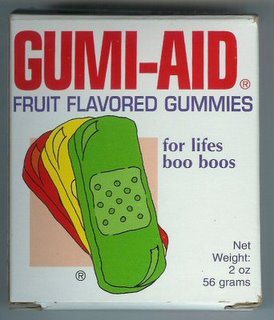
...but the combination of "food" and "bandage" is just...ick. Even more squicksome is that if you, uh, imagine putting a... God, I can't even write it. Just let's say that the "Gummi" texture is all too apt.
(Incidentally, that's why this product is more disgusting than the Archie McPhee bacon bandages.)
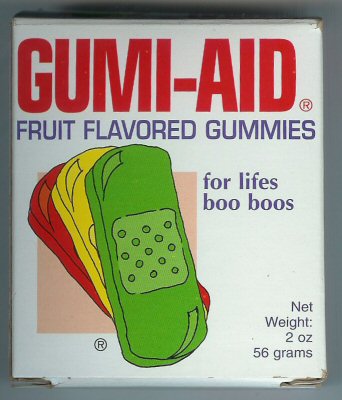
...but the combination of "food" and "bandage" is just...ick. Even more squicksome is that if you, uh, imagine putting a... God, I can't even write it. Just let's say that the "Gummi" texture is all too apt.
(Incidentally, that's why this product is more disgusting than the Archie McPhee bacon bandages.)
1.02.2006
Listy!
For the past few years, I've been keeping tracks of books I've read and movies I've watched. On the off chance that anyone cares, or would care to make fun of my taste in books or movies (or, of course, the usual lameness of things I have not read or seen), following is a pig-alphabetized list of each for 2005.
Read:
Viewed:
* saw twice
** actually got off my ass and saw in a movie theatre, complete with yapping patrons, sticky floors, uncomfortable seats, and ads for the goddamned Marines
Read:
Anonymous - Imperial Hubris: Why the West Is Losing the War on Terror
Bill Bryson - A Walk in the Woods
Bob Dylan - Chronicles Volume One
Chuck Palahniuk - Survivor
Dave Eggers - A Heartbreaking Work of Staggering Genius
Dave Eggers - How We Are Hungry
Dave Morice - The Dictionary of Wordplay
Donald Westlake - Don't Ask
Elmore Leonard - LaBrava
Emmanuel Carrère - I Am Alive and You Are Dead: A Journey into the Mind of Philip K. Dick
J.K. Rowling - Harry Potter and the Half-Blood Prince
Jared Diamond - Collapse
Jasper Fforde - Something Rotten
Judith Rich Harris - The Nurture Assumption
Malcolm Gladwell - Blink
Philip Roth - The Plot Against America
R.A. Lafferty - Not to Mention Camels
Robert M. Pirsig - Lila
Stephen Thompson, ed. - The Tenacity of the Cockroach
Susanna Clarke - Jonathan Strange & Mr Norrell
The Paris Review Book of People with Problems
Tony Hillerman - Skeleton Man
Yann Martel - Life of Pi (halfway through)
Viewed:
A Mighty Wind
A Trip to the Orphanage
American Splendor
Annie Hall
Bad Santa
Black Hawk Down
Bruce Almighty
Bubba Ho-Tep
Chicago
Crouching Tiger, Hidden Dragon
Dirty Pretty Things
Don't Look Now
Drop Dead Gorgeous
Gerry
Good Night, and Good Luck**
Harry Potter & the Goblet of Fire**
Holes
Igby Goes Down
Intolerable Cruelty
Lawrence of Arabia**
Lovely and Amazing
Lover Come Back
Million Dollar Baby**
Morvern Callar
My Architect: A Son's Journey
Ocean's 12
On the Waterfront
Paycheck
Pillow Talk
Rat Pfink a Boo Boo
Seconds
Serenity*, **
Seven
Sideways
Silence of the Lambs
Sissy-Boy Slap-Party
Sombra Dolorosa
Spartan
Spellbound (documentary, not the Hitchcock film)
Spider
Swimming Pool
Teddy Bears' Picnic
The Bank
The Cabinet of Dr. Caligari
The Contender
The Corporation
The Girl from Monday
The Hidden Fortress
The Hitchhiker's Guide to the Galaxy**
The Incredibles*
The Italian Job (1969)
The Italian Job (2003)
The Ladykillers (Coen Bros.)
The Lord of the Rings: The Return of the King (extended)
The Manchurian Candidate (2004)
The Parallax View
The Saddest Music in the World
The Triplets of Belleville
The Yes Men
* saw twice
** actually got off my ass and saw in a movie theatre, complete with yapping patrons, sticky floors, uncomfortable seats, and ads for the goddamned Marines
Subscribe to:
Posts (Atom)

