This is part two of my year-end wrap-up, in this case covering stray tracks that came my way, selections that aren't from things I actually own. It will be much shorter than the other entry, in case you're sitting in a hardbacked chair and are worried about the condition of your spine or something.
Songs from Recordings that Haven't Been Released Yet
"Roommate" Don Dixon (demo): I can't remember where this track came from, except that whoever directed me to it did so as a quiz of sorts: "guess who this is?" I failed - although I did know I knew him, and that his voice was maddeningly familiar. Anyway: a song that spent lots of time in my eardrums regardless of whether it was in the air.
"Are We Are" The Willis: The songwriter guy is a grad student in the department I work in. I don't know him, but when some other folks mentioned the band's website, I checked it out. I was pleasantly surprised that this wasn't just another half-assed amateur act that was someone's buddy. Full-length Bathtub.Lightbulb.Heartattack due in January on Minneapolis's Doubleplusgood Records. (By the way: Minneapolis and Milwaukee are not the same city. I'm just saying.)
Very Old Songs
"Dr. Root's Garden" Chrysalis: Downloaded from the late, lamented Mystical Beast, which had a commendably broad notion of what made good music and was well-written as well. Okay, Liz Phair fans probably thought things were a bit too heavy on the snark (and I'd agree, at times), but the site will be missed. Anyway: this is a bit of proto-prog (check the odd vocal harmonies and organ interjections) from 1968. If I weren't lazy, I'd go back to The Mystical Beast's archives to find more info. But you can do that, and you're not lazy (unless you are, in which case you won't.)
"Sam" Bill Fay Group: Another track from 1968 (I think), and one whose subject, sadly, is all too contemporary.
Does Humor Belong in Music?
"Famous Last Words" 9353: Another Mystical Beast joint. "It's okay... It's not loaded... I'm a good driver... Don't worry honey..." Cracks me up. I'm a sick bastard.
"Three Little Kittens" Ben Folds Laundry: [quiet announcer v.o.] We've secretly replaced Ben Folds with a clever, kid-friendly impostor who shouts 'more pie!' instead of 'kiss my ass!' Let's see if anyone notices..." From a series of kiddified "covers" of popular (?) songs called Mother Goose Rocks.
Tired of Verse-Chorus-Verse?
"Codomatopeia" Kimono vs. Ghostigital (ft. Mark E. Smith): From the excellent Spoilt Victorian Child. Cod!
"An Animated Description of Mr. Maps" The Books: Talking drums.
The Ongoing Fuckup
"Portlandtown" A Hawk and a Hacksaw
"Dry Drunk Emperor" TV on the Radio
(Oh, and thanks to valis over at Art of the Mix for naming a recent CD mix of mine Mix of the Week. Too many "mix"es in that sentence...)


12.27.2005
some lists
Once again, I succumb to the peculiar year-end urge to make lists. I have not, however, checked them twice, nor have I spied on you for dubious purposes of national security.
None of these lists are in any particular order: my ranking abilities freeze up in the face of too much discrimination. Links are generally to external sites containing mp3s or streams; native mp3s will be linked from a parenthetical song title.
In no particular order, acclaimed CDs I am too lame to have heard yet (even if some are on order): The National Alligator, The White Stripes Get Behind Me Satan, The Raveonettes Pretty in Black, 50 Foot Wave Golden Ocean, Mark Eitzel Candy Ass, Chris Stamey A Question of Temperature, Nothing Painted Blue Taste the Flavor, The Chap Ham, Jens Lekman Oh You're So Silent Jens, Broadcast Tender Buttons, Wolf Parade Apologies to the Queen Mary, Chad VanGaalen Infiniheart, Rogue Wave Out of the Shadow, Fripp & Eno Equatorial Stars, Beck Guero, Liz Phair Somebody's Miracle, The 88 Over and Over, Brendan Benson The Alternative to Love, and others I am too lame even to think of. Why yes, since you ask, I do accept gifts! Acclaimed CDs not listed are probably too lame for me to have heard yet.
2005 CDs that were a bit of a disappointment: Julian Cope Citizen Cain'd (hmm...maybe the "acid-fried maniac" thing is true after all), Aimee Mann The Forgotten Arm, Michael Penn Mr. Hollywood Jr., 1947 (terminal World Cafeitis), The Oranges Band The World & Everything In It (edgeless), Monade A Few Steps More (hmm...maybe there is such a thing as too much Stereolab), Great Lake Swimmers s/t (the guy wrote the same great song ten times).
CDs that aren't really part of my main best-of list because my obnoxious, rigid criteria excludes them (EPs, compilations, live albums): Stereolab Kyberneticka Bablicka (add diacritics to taste), Caribou Yeti (the only two actual EPs I bought this year, other than those included as bonus discs with regular releases), The Fiery Furnaces EP (10 songs, 41 minutes: that's no EP! It is, however, a compilation); Wilco Kicking Television: Live in Chicago (nice to hear the slightly more straightforward presentations, often augmented with some scorching lead guitar).
Three Levels of Not-Quite-There, from least- to most-there:
Brian Eno Another Day on Earth
Bullette The Secrets: Impressive debut from unsigned musician benefiting from the Blarin' o' the Blogs.
Four Tet Everything Ecstatic
Engineers s/t
The Fall Fall Heads Roll: Perversely as usual, begins with its weakest track, followed by two songs that use the exact same riff as one another.
The Kingsbury Manx The Fast Rise and Fall of the South: Nicely done, but a bit too nicely, at least until the last track lets loose the guitar hounds.
Mazarin We're Already There
The Decemberists Picaresque: I like a lot of this, but Colin Meloy needs to stop reading his press. No more barrow boys in bellies of whales next time...
Mercury Rev The Secret Migration: Huge glassy heaps of beautiful sound melt into inconsequential puddles...what happened to the insanity of their first few records?
Of Montreal The Sunlandic Twins: This one's growing on me, actually: in a few months it likely would be in my top 20.
Mary Timony Ex Hex: A criminally underrated guitarist, but the songs aren't quite as good this time around.
The Lower Reaches of the Top 20:
Caribou The Milk of Human Kindness: Dan Snaith continues to successfully meld songs, electronics, and noise. Last album got compared to Mercury Rev: perhaps they should work together.
Damon & Naomi The Earth Is Blue: Beautiful songs, beautiful playing and arranging, beautiful lead guitar from Michio Kurihara, beautiful trumpet accents...only problem is, it's almost too...beautiful.
Death Cab for Cutie Plans: I got this rather late in the year; typically, the subtlety of their material means it grows on me over time. I see no reason this album will be any different.
Doleful Lions Shaded Lodge and Mausoleum: Still spooky and weird, but lead Lion Jonathan Scott's voice seems a bit scuffed here, and the record misses the female voice of Aynslie Pirtle (what a name!) featured on 2002's Out Like a Lamb, my favorite release of theirs.
Hood Outside Closer: Textural, atmospheric. I like texture and atmosphere.
The Ponys Celebration Castle: Parts of this sound like Robert Smith fronting a garage band - which is, in fact, an excellent idea. Their second vocalist, a woman with a tough, powerful voice, provides good contrast and variety. ("Today")
Stuck in the Middle (of the top 20):
Momus Otto Spooky: This one's been growing in my estimation steadily. Initially a bit offputting - every track seems to be from a completely different musical universe, most of them rather odd - its cleverness and sneaky catchiness, as well as its sheer audacity, keep me coming back.
John Cale Black Acetate: Old dog relearns some old tricks he hadn't performed for years (such as loud electric guitar and catchy tunes), as well as, unaccountably, growing a falsetto at age 63.
The Caribbean Plastic Explosives: My favorite pocket band is still excellent, but the length of this release means that my typically slow growing-into period is extended even further. It would probably place higher later in the year - except there isn't any later left in the year.
The Go-Betweens Oceans Apart: This is the first post-reunion Go-Betweens album that really feels like a band album, and not coincidentally is the first to stack up to their first, great set of recordings. And surprisingly, the opening track "Here Comes a City" actually rocks - not usually what one looks to this band to do. (Granted, it rocks by borrowing quite liberally from "Life During Wartime" - but taste in theft is underrated.) ("This Night's for You")
Stephen Malkmus Face the Truth: Another grower. The arrangements are sometimes gimmicky (Fluxblog posted a live version of "Malediction" a year or so back that crushes the album's oversynthified version like a limp grape), but the songs are solid, so long as you don't mind that Malkmus is still sometimes in the grip of a Grateful Dead fascination (or if you love that fact).
Sufjan Stevens Illinois (or Come On Feel the Illinoise, depending whether you trust the cover or the spine): This year's favorite by acclamation...and I'm not bucking the tide. I was resistant at first: it's true that some tracks do exude a rather high-school theater-production vibe, and one really shouldn't take the damned 50 states in 50 albums thing seriously (I sure hope Stevens doesn't). But Stevens' earnestness, power, and inventiveness cannot be denied - and more than one song here makes my heart do that thing it does when I think there's one more step at the top of the stairs than there really is.
Tenement Halls Knitting Needles & Bicycle Bells: Chris Lopez, late of the Rock*A*Teens (one of my most-missed acts), returns slightly older, maybe a little wiser, a little less likely to hoarsely scream to the rafters, but still the same impassioned doomed romantic he's always been. And the songs are still great; Lopez still draws from an endless well of outdated rhythms and pawnshop keyboards to color those songs.
John Vanderslice Pixel Revolt: At first, I was disappointed by this one. A little too polite, refined, quiet, subdued...I wanted at least one track with some edge. Of course, I was looking in the wrong places, for the wrong kinds of edge: it's tempting, given the apparent lack of overarching concept here (atypical for Vanderslice), to assume these personal-sounding songs are, in fact, personal. I don't know, and anyone who's written as effectively in character as Vanderslice shouldn't be assumed to suddenly have become a confessional singer-songwriter. Regardless, the emotional subtleties these songs limn (gotta include this word for rock-critic cred) are reflected in the endlessly inventive arrangements - the real reason this album's grown steadily in my estimation.
At the moment, my favorite releases of 2005:
Audible Sky Signal: I'm imagining Brian Eno producing a collaboration between ...Amazing Letdowns-era Lilys and Game Theory circa Two Steps from the Middle Ages. If you're imagining that, and it sounds like a fine idea, you'll like this.
Maxïmo Park A Certain Trigger: I picked this up primarily on the recommendation of Flasshe, last month or so: in that time it's rocketed nearly to the top of my year-end list. Yeah, there's sort of an '80s feel to some of the guitar and rhythm ideas here, but every damned song has hooks enough to populate whole albums (more than some of the somewhat disappointing records mentioned above), and the damned thing just makes you want to jump around the room. Dangerous if you're driving a car: thank god steering columns make excellent surrogate drum kits. ("Graffiti")
The New Pornographers Twin Cinema: My favorite review of this one comes from The Onion A.V. Club's Noel Murray: he says it took a little while for his reaction to go from "Ho-hum, another good New Pornographers album" to "Holy balls, how do they do it?"
The Spinto Band Nice and Nicely Done: I think I heard of these folks via Aaron Mandel's Paste Mob; this is tuneful pop along the lines of a homemade kite - clever, lightweight, idiosyncratic construction.
Spoon Gimme Fiction: Another band on an impressive winning streak: while retaining the stripped-down feel that's marked their last two albums, they've added a bit more color this time, such as cello and mellotron, yet the songs never feel overburdened by their arrangements (this ain't no ELO).
The Sugarplastic Will: It took a couple of years (and a 7-single set of good-to-indifferent tracks released every few months in between), but Ben Eshbach, Kiara Geller, and company have released their most coherent, fully realized album. It's also, curiously, their strangest: even though several tracks (such as "Autumn All the Time") are among their most effervescently poppish, others are highly abstract and knotty. But unlike the often annoying diversions on their last full-length, Resin, these seem earned, weighted, not toss-offs. Perhaps this is a result of the album being (in part) an homage to their late friend Will Glenn; regardless, Will also has an emotional richness that sometimes was lacking in The Sugarplastic's earlier, sometimes facile work.
Whew! Next time: some stray tracks from records I don't own...some of them not even from this year.
None of these lists are in any particular order: my ranking abilities freeze up in the face of too much discrimination. Links are generally to external sites containing mp3s or streams; native mp3s will be linked from a parenthetical song title.
In no particular order, acclaimed CDs I am too lame to have heard yet (even if some are on order): The National Alligator, The White Stripes Get Behind Me Satan, The Raveonettes Pretty in Black, 50 Foot Wave Golden Ocean, Mark Eitzel Candy Ass, Chris Stamey A Question of Temperature, Nothing Painted Blue Taste the Flavor, The Chap Ham, Jens Lekman Oh You're So Silent Jens, Broadcast Tender Buttons, Wolf Parade Apologies to the Queen Mary, Chad VanGaalen Infiniheart, Rogue Wave Out of the Shadow, Fripp & Eno Equatorial Stars, Beck Guero, Liz Phair Somebody's Miracle, The 88 Over and Over, Brendan Benson The Alternative to Love, and others I am too lame even to think of. Why yes, since you ask, I do accept gifts! Acclaimed CDs not listed are probably too lame for me to have heard yet.
2005 CDs that were a bit of a disappointment: Julian Cope Citizen Cain'd (hmm...maybe the "acid-fried maniac" thing is true after all), Aimee Mann The Forgotten Arm, Michael Penn Mr. Hollywood Jr., 1947 (terminal World Cafeitis), The Oranges Band The World & Everything In It (edgeless), Monade A Few Steps More (hmm...maybe there is such a thing as too much Stereolab), Great Lake Swimmers s/t (the guy wrote the same great song ten times).
CDs that aren't really part of my main best-of list because my obnoxious, rigid criteria excludes them (EPs, compilations, live albums): Stereolab Kyberneticka Bablicka (add diacritics to taste), Caribou Yeti (the only two actual EPs I bought this year, other than those included as bonus discs with regular releases), The Fiery Furnaces EP (10 songs, 41 minutes: that's no EP! It is, however, a compilation); Wilco Kicking Television: Live in Chicago (nice to hear the slightly more straightforward presentations, often augmented with some scorching lead guitar).
Three Levels of Not-Quite-There, from least- to most-there:
Brian Eno Another Day on Earth
Bullette The Secrets: Impressive debut from unsigned musician benefiting from the Blarin' o' the Blogs.
Four Tet Everything Ecstatic
Engineers s/t
The Fall Fall Heads Roll: Perversely as usual, begins with its weakest track, followed by two songs that use the exact same riff as one another.
The Kingsbury Manx The Fast Rise and Fall of the South: Nicely done, but a bit too nicely, at least until the last track lets loose the guitar hounds.
Mazarin We're Already There
The Decemberists Picaresque: I like a lot of this, but Colin Meloy needs to stop reading his press. No more barrow boys in bellies of whales next time...
Mercury Rev The Secret Migration: Huge glassy heaps of beautiful sound melt into inconsequential puddles...what happened to the insanity of their first few records?
Of Montreal The Sunlandic Twins: This one's growing on me, actually: in a few months it likely would be in my top 20.
Mary Timony Ex Hex: A criminally underrated guitarist, but the songs aren't quite as good this time around.
The Lower Reaches of the Top 20:
Caribou The Milk of Human Kindness: Dan Snaith continues to successfully meld songs, electronics, and noise. Last album got compared to Mercury Rev: perhaps they should work together.
Damon & Naomi The Earth Is Blue: Beautiful songs, beautiful playing and arranging, beautiful lead guitar from Michio Kurihara, beautiful trumpet accents...only problem is, it's almost too...beautiful.
Death Cab for Cutie Plans: I got this rather late in the year; typically, the subtlety of their material means it grows on me over time. I see no reason this album will be any different.
Doleful Lions Shaded Lodge and Mausoleum: Still spooky and weird, but lead Lion Jonathan Scott's voice seems a bit scuffed here, and the record misses the female voice of Aynslie Pirtle (what a name!) featured on 2002's Out Like a Lamb, my favorite release of theirs.
Hood Outside Closer: Textural, atmospheric. I like texture and atmosphere.
The Ponys Celebration Castle: Parts of this sound like Robert Smith fronting a garage band - which is, in fact, an excellent idea. Their second vocalist, a woman with a tough, powerful voice, provides good contrast and variety. ("Today")
Stuck in the Middle (of the top 20):
Momus Otto Spooky: This one's been growing in my estimation steadily. Initially a bit offputting - every track seems to be from a completely different musical universe, most of them rather odd - its cleverness and sneaky catchiness, as well as its sheer audacity, keep me coming back.
John Cale Black Acetate: Old dog relearns some old tricks he hadn't performed for years (such as loud electric guitar and catchy tunes), as well as, unaccountably, growing a falsetto at age 63.
The Caribbean Plastic Explosives: My favorite pocket band is still excellent, but the length of this release means that my typically slow growing-into period is extended even further. It would probably place higher later in the year - except there isn't any later left in the year.
The Go-Betweens Oceans Apart: This is the first post-reunion Go-Betweens album that really feels like a band album, and not coincidentally is the first to stack up to their first, great set of recordings. And surprisingly, the opening track "Here Comes a City" actually rocks - not usually what one looks to this band to do. (Granted, it rocks by borrowing quite liberally from "Life During Wartime" - but taste in theft is underrated.) ("This Night's for You")
Stephen Malkmus Face the Truth: Another grower. The arrangements are sometimes gimmicky (Fluxblog posted a live version of "Malediction" a year or so back that crushes the album's oversynthified version like a limp grape), but the songs are solid, so long as you don't mind that Malkmus is still sometimes in the grip of a Grateful Dead fascination (or if you love that fact).
Sufjan Stevens Illinois (or Come On Feel the Illinoise, depending whether you trust the cover or the spine): This year's favorite by acclamation...and I'm not bucking the tide. I was resistant at first: it's true that some tracks do exude a rather high-school theater-production vibe, and one really shouldn't take the damned 50 states in 50 albums thing seriously (I sure hope Stevens doesn't). But Stevens' earnestness, power, and inventiveness cannot be denied - and more than one song here makes my heart do that thing it does when I think there's one more step at the top of the stairs than there really is.
Tenement Halls Knitting Needles & Bicycle Bells: Chris Lopez, late of the Rock*A*Teens (one of my most-missed acts), returns slightly older, maybe a little wiser, a little less likely to hoarsely scream to the rafters, but still the same impassioned doomed romantic he's always been. And the songs are still great; Lopez still draws from an endless well of outdated rhythms and pawnshop keyboards to color those songs.
John Vanderslice Pixel Revolt: At first, I was disappointed by this one. A little too polite, refined, quiet, subdued...I wanted at least one track with some edge. Of course, I was looking in the wrong places, for the wrong kinds of edge: it's tempting, given the apparent lack of overarching concept here (atypical for Vanderslice), to assume these personal-sounding songs are, in fact, personal. I don't know, and anyone who's written as effectively in character as Vanderslice shouldn't be assumed to suddenly have become a confessional singer-songwriter. Regardless, the emotional subtleties these songs limn (gotta include this word for rock-critic cred) are reflected in the endlessly inventive arrangements - the real reason this album's grown steadily in my estimation.
At the moment, my favorite releases of 2005:
Audible Sky Signal: I'm imagining Brian Eno producing a collaboration between ...Amazing Letdowns-era Lilys and Game Theory circa Two Steps from the Middle Ages. If you're imagining that, and it sounds like a fine idea, you'll like this.
Maxïmo Park A Certain Trigger: I picked this up primarily on the recommendation of Flasshe, last month or so: in that time it's rocketed nearly to the top of my year-end list. Yeah, there's sort of an '80s feel to some of the guitar and rhythm ideas here, but every damned song has hooks enough to populate whole albums (more than some of the somewhat disappointing records mentioned above), and the damned thing just makes you want to jump around the room. Dangerous if you're driving a car: thank god steering columns make excellent surrogate drum kits. ("Graffiti")
The New Pornographers Twin Cinema: My favorite review of this one comes from The Onion A.V. Club's Noel Murray: he says it took a little while for his reaction to go from "Ho-hum, another good New Pornographers album" to "Holy balls, how do they do it?"
The Spinto Band Nice and Nicely Done: I think I heard of these folks via Aaron Mandel's Paste Mob; this is tuneful pop along the lines of a homemade kite - clever, lightweight, idiosyncratic construction.
Spoon Gimme Fiction: Another band on an impressive winning streak: while retaining the stripped-down feel that's marked their last two albums, they've added a bit more color this time, such as cello and mellotron, yet the songs never feel overburdened by their arrangements (this ain't no ELO).
The Sugarplastic Will: It took a couple of years (and a 7-single set of good-to-indifferent tracks released every few months in between), but Ben Eshbach, Kiara Geller, and company have released their most coherent, fully realized album. It's also, curiously, their strangest: even though several tracks (such as "Autumn All the Time") are among their most effervescently poppish, others are highly abstract and knotty. But unlike the often annoying diversions on their last full-length, Resin, these seem earned, weighted, not toss-offs. Perhaps this is a result of the album being (in part) an homage to their late friend Will Glenn; regardless, Will also has an emotional richness that sometimes was lacking in The Sugarplastic's earlier, sometimes facile work.
Whew! Next time: some stray tracks from records I don't own...some of them not even from this year.
12.20.2005
making the robots dance
We tend to oppose, to imagine as contrasting, bodies, passion, physicality on the one hand, and technology, science, and systems, structures, and society on the other, with the former being personal and irreducible to analysis, while the latter are regarded as distant, cold, imposed from without, and inexpressive. But perhaps we're wrong, and perhaps there's some way that the former set of qualities might be reached through the latter. But don't take my perhaps-pretentious word for it; look at the culture around us, in particular the cultures that arose in response to the first wave of readily controllable musical machinery, and as part of musical genres in some sense reacting against (but also working alongside) earlier modes of musical production. Okay, what the hell am I talking about? I'm thinking of postpunk, on the one hand: punk as reaction against excessively technocratic, excessively technical, and just plain excessive; early hip-hop, reacting against the slickness of commercial soul - but in both cases, realizing that the mechanical could speak as well as merely be used.
It didn't take very long for synths to travel from Emerson-Lake-and-Palmer ridiculed pretentiousness to new, easy-to-use tools to make music by non-musicians (of course, technology helped out immensely here), and so, by 1977, Ultravox could use synths in its simultaneously robotic and haunting (and also by turns laughable and moving) "My Sex." I like to imagine this as the attempt of an android, having come to consciousness, to realize its burgeoning awareness of the sensual responsiveness of its artificial flesh, perhaps having been programmed with the poetry of Andrew Marvell and the films of Jean-Luc Godard. John Foxx's delivery is intentionally flat and monotone (if you imagine a robot attempting to rap, you might approximate its halting mechanical flow), and while some lines are likely to produce the sort of awkward laughter we might have at an Ed Wood film ("my sex / is often solo"...yeah, I'd guess so...), it also achieves, in moments, highly evocative and poetic images (mostly in fragments: "Suburban photographs / Skyscraper shadows on a carcrash overpass"; "an image lost in faded films / A neon outline / On a high-rise overspill"). Musically, we have a static bass and drum figure (later used to more conventional effect in the post-Foxx, and career-making, Ultravox track "Vienna") with repetitive keyboard parts. But it's Brian Eno's production of those elements that makes the track work for me; specifically, the bell-like textures his treatments evoke, and the polytonality evident both in terms of key and intonation (that is, not only are some parts apparently in different keys from others, they're not even playable on the same keyboard: they're out of tune, relatively). I think bells are so haunting not only because of various cultural connotations, but because they're alien in terms of their overtone series: they're discordant within themselves, they do not fit in the scale. (Unsurprisingly, perhaps, Eno's recently displayed a fascination with bells: see the notes to his January 07003 album: click on the album itself to activate the javascript ya hey.)
For another example of the way the robotic can be used to evoke its cultural opposite, the emotional, consider Gary Numan's track "The Aircrash Bureau." While the verses are very stiff, with a rigid bassline squaring out fifths and octaves and moving suddenly from one chord to the next, along with blatantly mechanical percussion, the instrumental "choruses" inhabit the most lush soundscapes possible, even stereotypically so (the piano tinkling on the second runthrough of this section is positively Liberace-like). Actual (i.e., acoustic) strings double synthetic strings in a rising pattern that then descends, arch-like, back to a somewhat wandering melodic line that leads back to the verse parts. What's interesting is that the harmonic richness of this section is actually achieved in a fairly mechanical fashion: the melody simply goes up, up, up by thirds, passing from seventh, through ninth, through eleventh and thirteenth, all the way back to the octave (some octave switching occurs, but the overall effect is of a line that keeps rising). It's also true that this section, despite the melodic line, is harmonically static, with the bass holding steady on one chord then moving to another. One could argue that the essence of "mechanism" isn't that static quality but arbitrary change; but still, the track certainly makes use of contrasting moments of stasis and movement.
Okay, I mentioned hip-hop - which might seem odd after talking about weedy British lads like Numan and the Ultravox boys - and I'm certainly no expert...but it strikes me that even though dance and its physicality has been a strong component of hip-hop, in its early days at least, a lot of hip-hop movement played with an almost mechanical rigidity, a robotic sort of jerkiness. It's therefore no accident that looming large amongst early hip-hop influences is, of all people, the very white, German act Kraftwerk (notably that band's "Trans-Europe Express"), which practically made a fetish of disappearing its bodies, to the extent of building robots to replace its members in performance and videos. Here's an academic but relatively comprehensible essay by Mark Dery (which mentions Tricia Rose, Greg Tate, Erik Davis...man, this brings me back to my grad student days...) pointing out the persistent "Afro-futurist" motif in African-American culture, including hip-hop. Rose, I recall, at a lecture she gave at UWM sometime in the mid-'90s, pointed out that for a lot of African-American males, some of the only viable career options were technically oriented: working with electronic gear, mastering the equipment the (white) rest of us needed to function was one way of making one's way in the world. And of course, the most basic, origin-al mode of hip-hop repurposed technology: turntables, microphones, stereo systems. Foregrounding the technological, the mechanical, was also a bit of a rebellion against the smoothness of '60s soul and '70s disco/R&B loverman moves; rather than work within the commercial music system (as both Motown and disco had done), hip-hop was both from the streets and (at first) independent, and in those ways paralleled early punk and postpunk. (Perhaps no accident that both musics valorized Jamaican reggae...)
So the robots danced. And the androids dreamed of electric sheep.
Ultravox "My Sex"
Gary Numan "The Aircrash Bureau"
It didn't take very long for synths to travel from Emerson-Lake-and-Palmer ridiculed pretentiousness to new, easy-to-use tools to make music by non-musicians (of course, technology helped out immensely here), and so, by 1977, Ultravox could use synths in its simultaneously robotic and haunting (and also by turns laughable and moving) "My Sex." I like to imagine this as the attempt of an android, having come to consciousness, to realize its burgeoning awareness of the sensual responsiveness of its artificial flesh, perhaps having been programmed with the poetry of Andrew Marvell and the films of Jean-Luc Godard. John Foxx's delivery is intentionally flat and monotone (if you imagine a robot attempting to rap, you might approximate its halting mechanical flow), and while some lines are likely to produce the sort of awkward laughter we might have at an Ed Wood film ("my sex / is often solo"...yeah, I'd guess so...), it also achieves, in moments, highly evocative and poetic images (mostly in fragments: "Suburban photographs / Skyscraper shadows on a carcrash overpass"; "an image lost in faded films / A neon outline / On a high-rise overspill"). Musically, we have a static bass and drum figure (later used to more conventional effect in the post-Foxx, and career-making, Ultravox track "Vienna") with repetitive keyboard parts. But it's Brian Eno's production of those elements that makes the track work for me; specifically, the bell-like textures his treatments evoke, and the polytonality evident both in terms of key and intonation (that is, not only are some parts apparently in different keys from others, they're not even playable on the same keyboard: they're out of tune, relatively). I think bells are so haunting not only because of various cultural connotations, but because they're alien in terms of their overtone series: they're discordant within themselves, they do not fit in the scale. (Unsurprisingly, perhaps, Eno's recently displayed a fascination with bells: see the notes to his January 07003 album: click on the album itself to activate the javascript ya hey.)
For another example of the way the robotic can be used to evoke its cultural opposite, the emotional, consider Gary Numan's track "The Aircrash Bureau." While the verses are very stiff, with a rigid bassline squaring out fifths and octaves and moving suddenly from one chord to the next, along with blatantly mechanical percussion, the instrumental "choruses" inhabit the most lush soundscapes possible, even stereotypically so (the piano tinkling on the second runthrough of this section is positively Liberace-like). Actual (i.e., acoustic) strings double synthetic strings in a rising pattern that then descends, arch-like, back to a somewhat wandering melodic line that leads back to the verse parts. What's interesting is that the harmonic richness of this section is actually achieved in a fairly mechanical fashion: the melody simply goes up, up, up by thirds, passing from seventh, through ninth, through eleventh and thirteenth, all the way back to the octave (some octave switching occurs, but the overall effect is of a line that keeps rising). It's also true that this section, despite the melodic line, is harmonically static, with the bass holding steady on one chord then moving to another. One could argue that the essence of "mechanism" isn't that static quality but arbitrary change; but still, the track certainly makes use of contrasting moments of stasis and movement.
Okay, I mentioned hip-hop - which might seem odd after talking about weedy British lads like Numan and the Ultravox boys - and I'm certainly no expert...but it strikes me that even though dance and its physicality has been a strong component of hip-hop, in its early days at least, a lot of hip-hop movement played with an almost mechanical rigidity, a robotic sort of jerkiness. It's therefore no accident that looming large amongst early hip-hop influences is, of all people, the very white, German act Kraftwerk (notably that band's "Trans-Europe Express"), which practically made a fetish of disappearing its bodies, to the extent of building robots to replace its members in performance and videos. Here's an academic but relatively comprehensible essay by Mark Dery (which mentions Tricia Rose, Greg Tate, Erik Davis...man, this brings me back to my grad student days...) pointing out the persistent "Afro-futurist" motif in African-American culture, including hip-hop. Rose, I recall, at a lecture she gave at UWM sometime in the mid-'90s, pointed out that for a lot of African-American males, some of the only viable career options were technically oriented: working with electronic gear, mastering the equipment the (white) rest of us needed to function was one way of making one's way in the world. And of course, the most basic, origin-al mode of hip-hop repurposed technology: turntables, microphones, stereo systems. Foregrounding the technological, the mechanical, was also a bit of a rebellion against the smoothness of '60s soul and '70s disco/R&B loverman moves; rather than work within the commercial music system (as both Motown and disco had done), hip-hop was both from the streets and (at first) independent, and in those ways paralleled early punk and postpunk. (Perhaps no accident that both musics valorized Jamaican reggae...)
So the robots danced. And the androids dreamed of electric sheep.
Ultravox "My Sex"
Gary Numan "The Aircrash Bureau"
12.16.2005
Git-R-Dum
Damn the internets! I'd love to give proper credit for my finding this wonderful comeback by David Cross to "Larry the Cable Guy"'s ignorant rantings...but it ended up several links down from where I started, after which I wandered all over the place in some other tabs, so I completely don't remember where I heard of it. Oh well - anyway, Cross makes Dan Whitney (the actual human behind the "Larry" shtick) look like a real jerk. Not hard, of course...
12.14.2005
bearded weirdy!
Conspiracy Theory Time! Although I hadn't heard the song for years, at three different commercial outlets, I'm hearing "This Christmas" (I think Donny Hathaway's version) alla sudden. (More likely: these places are paying for the same music stream. What format do those thingies come in? Way back when, I remember a place I worked at had a tape that looked a little larger than an 8-track that played on a continuous loop of several hours.) Anyway, it's a good song - I don't have the Hathaway version - but wait! I do have a rare-ish cover by the Dismemberment Plan.
One of the more silly Christmas songs (yes, that's today's actual theme) is Elton John's "Ho! Ho! Ho! Who'd Be a Turkey at Christmas" (incidentally, I've seen the title with parentheses around the Ho!s, parentheses around the last phrase, and no parentheses. As my copy (clears throat) lacks physical existence (although somewhere buried in my basement, I have it on an old cassette), I can't verify. Anyway, this song is clearly a '70s artifact...as evidenced by the EXTREMELY SUBTLE coke reference. I'm sure much nog and other holiday enhancers were consumed during the making of this recording.
The Dismemberment Plan "This Christmas"
Elton John "Ho! Ho! Ho! Who'd Be a Turkey at Christmas"
One of the more silly Christmas songs (yes, that's today's actual theme) is Elton John's "Ho! Ho! Ho! Who'd Be a Turkey at Christmas" (incidentally, I've seen the title with parentheses around the Ho!s, parentheses around the last phrase, and no parentheses. As my copy (clears throat) lacks physical existence (although somewhere buried in my basement, I have it on an old cassette), I can't verify. Anyway, this song is clearly a '70s artifact...as evidenced by the EXTREMELY SUBTLE coke reference. I'm sure much nog and other holiday enhancers were consumed during the making of this recording.
The Dismemberment Plan "This Christmas"
Elton John "Ho! Ho! Ho! Who'd Be a Turkey at Christmas"
12.13.2005
An interesting entry over at Antipopper exploring the nexus between gender and technology, with some insightful and amusing connections drawn therein... Scroll up to more recent entries, and the same writer has a powerful perspective (as an Australian of Asian descent educated in cultural theory and working in advertising) on the ugly racial-revanchist riots in Australia. Although Australia is, of course, geographically Asian/Polynesian, it has a long history of forcibly whitening itself, both in its treatment of its native population and in explicitly racist restrictions on immigration, which were restricted to white Europeans until recent decades. Australian cities are increasingly becoming what they are - Asian metropolises - but clearly (and similarly to large swathes of the U.S. returning to their historically Hispanic and Native populations) a lot of folks can't handle that.
Relatedly, Antipopper's site also has some interesting discussion on the recent British trend of dissing "chav" taste (working class style - which seems, interestingly, largely borrowed from black American trends and styles). Finally (to complete our mini-tour of international discussions about race and culture), here's Momus discussing his perceptions of Japanese fascination with African(-American) culture. Be sure to read the comments as well.
Relatedly, Antipopper's site also has some interesting discussion on the recent British trend of dissing "chav" taste (working class style - which seems, interestingly, largely borrowed from black American trends and styles). Finally (to complete our mini-tour of international discussions about race and culture), here's Momus discussing his perceptions of Japanese fascination with African(-American) culture. Be sure to read the comments as well.
12.10.2005
The Return of Stashus Mute
Thanks to the kindness of a radio personality who can name himself if he reads this (not sure if he wants to be ID'd), I've recently come into possession of a CD-R of the lone single billed to Thirteen-One-Eleven, or 13111 - a song called "My Bible Is the Latest T.V. Guide" backed with a cover of the New Colony Six track "Things I'd Like to Say," which was released as a single by Jefferson Holt's Dog Gone Records in 1989. If you scrawl that band name (13111) really quick, you might find it looks a bit like the name BILL - and indeed, this is the lone (so far? we can hope) solo release by Bill Berry formerly from R.E.M.
Not much here to support those who'd argue that Berry was the true heart of the band - although the a-side is an amusing faux-country number and the b-side a nice cover of a song that was regionally popular around the time Berry was living in (it's true) Milwaukee for a year or so. I'm more impressed by the cover, actually - Berry's arrangement and playing (I couldn't find info, but I know he plays guitar and piano in addition to drums, so I'm assuming he plays at least those instruments) show a fine grasp of the song while downplaying the soupiness of the original. Not a masterpiece - but it's nice to have - and I'm sure there are some R.E.M. completists whom this post will please. So enjoy.
13111 "My Bible Is the Latest T.V. Guide"
13111 "Things I'd Like to Say"
New Colony Six "Things I'd Like to Say"
Not much here to support those who'd argue that Berry was the true heart of the band - although the a-side is an amusing faux-country number and the b-side a nice cover of a song that was regionally popular around the time Berry was living in (it's true) Milwaukee for a year or so. I'm more impressed by the cover, actually - Berry's arrangement and playing (I couldn't find info, but I know he plays guitar and piano in addition to drums, so I'm assuming he plays at least those instruments) show a fine grasp of the song while downplaying the soupiness of the original. Not a masterpiece - but it's nice to have - and I'm sure there are some R.E.M. completists whom this post will please. So enjoy.
13111 "My Bible Is the Latest T.V. Guide"
13111 "Things I'd Like to Say"
New Colony Six "Things I'd Like to Say"
12.08.2005
something warm sudden cold
It was a Monday evening. It had snowed a few days earlier, so the streets and sidewalks were full of slushy, dirty snow. I was in my first year of college at the University of Michigan and working as a pizza delivery guy for a company that was then only a regional business but which was within a few years to dominate the pizza delivery world. Since it was Monday, it was pretty slow - although because it was near the end of the semester, more students were staying home and studying over pizza, so it was a little busier than usual for a Monday. The banged-up car the company had me driving - some sort of Ford or Chevy, I can't remember - only had AM radio, so I was probably listening to CKLW out of Windsor, Ontario, just south of the border (Canada is south of the US at this point, curiously), because Canadian content rules meant that there was a bit more musical variety than AM stations in Ann Arbor or Detroit could provide. Of course, that sometimes meant April Wine...but it also meant the occasional Bruce Cockburn or Klaatu track.
I don't remember exactly where I was when I first heard the news that he'd been shot - I think for a while I was driving in a bit of a daze - but I know exactly where I was, twenty-five years ago this evening, when the radio announcer confirmed that he was dead. I don't remember the street names, but if I were in Ann Arbor I could drive directly to the intersection where I was when I heard the news, on the way back to the store, where I pulled over, because I was unable to drive anymore.
I wouldn't have dreamed that I would be so affected. I wouldn't have imagined it would mean as much to me as it did. I think the whole measure of joy I'd taken from his music snapped back in reverse, all at once, as stinging sorrow. I worked the rest of the shift and walked the few blocks back to my dorm room. I couldn't think of anything else to do, so I cleaned off the little dry-erase board my roommate and I had on our door and wrote:
John Lennon
October 9, 1940 - December 8, 1980
John Lennon "#9 Dream"
I don't remember exactly where I was when I first heard the news that he'd been shot - I think for a while I was driving in a bit of a daze - but I know exactly where I was, twenty-five years ago this evening, when the radio announcer confirmed that he was dead. I don't remember the street names, but if I were in Ann Arbor I could drive directly to the intersection where I was when I heard the news, on the way back to the store, where I pulled over, because I was unable to drive anymore.
I wouldn't have dreamed that I would be so affected. I wouldn't have imagined it would mean as much to me as it did. I think the whole measure of joy I'd taken from his music snapped back in reverse, all at once, as stinging sorrow. I worked the rest of the shift and walked the few blocks back to my dorm room. I couldn't think of anything else to do, so I cleaned off the little dry-erase board my roommate and I had on our door and wrote:
John Lennon
October 9, 1940 - December 8, 1980
John Lennon "#9 Dream"
12.07.2005
eleven...
For some reason, I found myself wondering the other day about time zones. Initially, it was because it occurred to me that near the poles, because the zones are based on longitude lines which run north-south from pole to pole, the concept of "time zone" becomes an absurdity, in that the closer one gets to the geographic pole, the easier it is to, say, traverse several "hours"' worth of time in less than those clock hours. (In fact, in terms of the sun, a "day" is effectively equal to a year - and it's apparently conventional merely to use Greenwich Mean Time in Antarctic research facilities.)
Looking at a world time-zone map (click on the small image to view an enlarged image), I'm struck by the oddity of certain artifacts. For practical reasons, people don't want time zone changes right in the middle of major geographic entities (a city, say - or even a smallish state), and as a result, some zones are distended several hours from the time they'd be basing their time solely on solar noon. One of the more striking examples is Alaska (unfortunately split in half on this map), which from east to west would span four time zones, but is almost entirely in a zone one hour later than U.S. Pacific time. This already places the bulk of the state an hour earlier than its geographic location would suggest...but a further absurdity arises when a handful of the westernmost Aleutian Islands is in the next westerly time zone - even though its location is about three hours west of the central meridian for 9 hours after GMT, and in fact would cross the International Date Line if not for a convenient bend. Is there that much going on out there that two hours' difference would cause such havoc?
On the other hand, some locations seem almost absurdly punctilious in attempting to match local time to solar time, with their time being half an hour different from the adjacent time zone (India, Newfoundland) and - in the case of the tiny Chatham Islands off New Zealand, forty-five minutes different. Wouldn't it be easier just to be fifteen minutes late?
Anyway, here's a Cold War artifact on certain implications of this subject:
Negativland "Time Zones"
Looking at a world time-zone map (click on the small image to view an enlarged image), I'm struck by the oddity of certain artifacts. For practical reasons, people don't want time zone changes right in the middle of major geographic entities (a city, say - or even a smallish state), and as a result, some zones are distended several hours from the time they'd be basing their time solely on solar noon. One of the more striking examples is Alaska (unfortunately split in half on this map), which from east to west would span four time zones, but is almost entirely in a zone one hour later than U.S. Pacific time. This already places the bulk of the state an hour earlier than its geographic location would suggest...but a further absurdity arises when a handful of the westernmost Aleutian Islands is in the next westerly time zone - even though its location is about three hours west of the central meridian for 9 hours after GMT, and in fact would cross the International Date Line if not for a convenient bend. Is there that much going on out there that two hours' difference would cause such havoc?
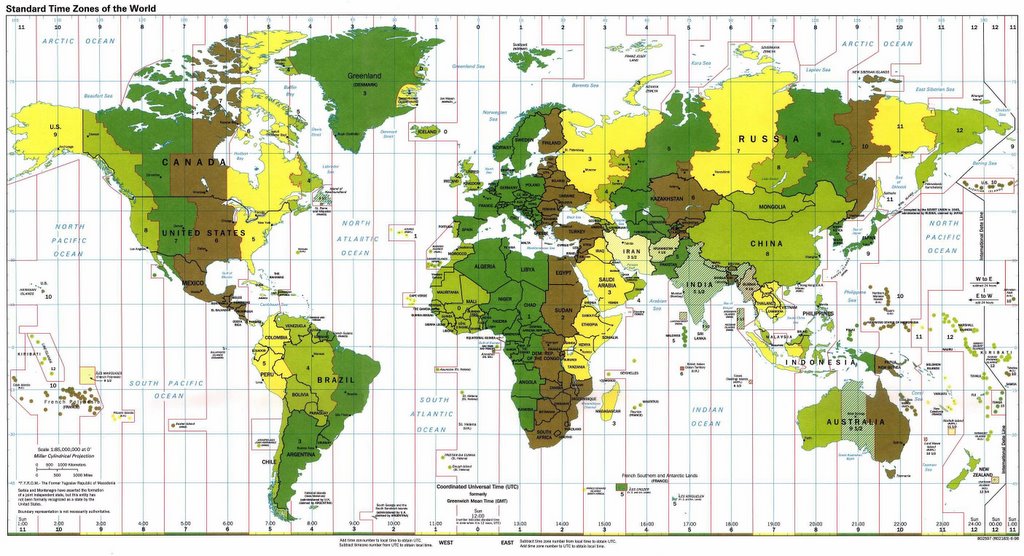
On the other hand, some locations seem almost absurdly punctilious in attempting to match local time to solar time, with their time being half an hour different from the adjacent time zone (India, Newfoundland) and - in the case of the tiny Chatham Islands off New Zealand, forty-five minutes different. Wouldn't it be easier just to be fifteen minutes late?
Anyway, here's a Cold War artifact on certain implications of this subject:
Negativland "Time Zones"
12.05.2005
la-la la-la, I can't hear you...
All but ignored by major media: prisoners tortured to death by US forces.
I don't know who the hell we are anymore.
I don't know who the hell we are anymore.
12.04.2005
ringing through my open ears (part 2 of 2)
Like most Beatles songs, "Across the Universe" has had a prolific afterlife of covers. Not as prolific as some Beatles songs, but a significant number anyway. Here are four - but first, a word about a subtlety of the song's construction that I'd never noticed before (which I found while looking for the lyrics online, coincidentally by the same guy, Ian Hammond, who wrote the lengthy explication of "Revolution 9" I linked to last week). As Hammond explains, the verse lyrics fall readily into two groups of three, with parallel phrasing and ideas aligning the different lines. But Lennon inserts the chorus after every second line, thereby breaking up what might have seemed too precious a set of parallelisms. Lennon's reputation as instinctive musician, doing what he felt rather than consciously following strategies or typical musical logic, overlooks the incredible intuitive sense of sound and structure his music displays. He's not just playing guitar out in some cornfield waiting for a trained professional (in this case, producer George Martin) to tell him when he's tapped into some primitive urge (to paraphrase Scott Miller's clever analysis from this interview).
So, once the song was out there, what did other people do with it? David Bowie covered the song on Bowie's Young Americans album recorded in 1974, I suppose because Lennon was hanging around and added some guitar and vocals to a couple of tracks on the album, including this one. That is, to me it doesn't sound like Bowie has any compelling reason to do the song. The phrasing and texture are sort of blanded out, the "jai guru deva" is replaced by an electric guitar, and Bowie's "nothing's gonna change my world" sounds less accepting and hopeful than defiant and challenged. That would be fine, except the rest of the music doesn't really work with that mood, and the lyrics of the song don't work with it at all. Plus we have a bad example of a "truck driver's gearchange" modulation for the last verse. (Bowie's covers seldom do much for me. He utterly ruined "Let's Spend the Night Together," for example, with his version's campy thrustiness.)
10cc covered the song on a reunion tour in 1993 that yielded a live album recorded in Tokyo. The arrangement is a bit too early-'90s Adult Contemporary (that keyboard string synth - ick), although I like the fact that they brought back the dropped backing vocal (re-scored for organ). They also wrote an ending for the song, basically reprising the opening with an altered chord that leads to a very "She Loves You" sixth-chord at the end. That altered chord also shows up at the end of the rather out-of-place guitar solo, and in that context it just sort of hangs there, oddly, before the band plunges back into the "jai guru deva" part. Of most value for imagining what the song would have sounded like if Paul McCartney had sung it, given Eric Stewart's rather McCartney-esque voice.
The most recent version I've heard is Rufus Wainwright's (from the I Am Sam soundtrack, then reworked as a bonus track on the US release of Poses, the version I've posted). Both the original demo (as heard on the Beatles' Anthology 2) and the Let it Be version are a bit static in their arrangements. While this sort of makes sense as an illustration of "nothing's gonna change my world," it's not the only viable approach to the arrangement. Wainwright's arrangement builds steadily, notably through the percussion, which becomes more propulsive as the song continues, and he achieves a rich texture that isn't cloying, by using a smaller string section and lots of single vocals (as opposed to a choral approach in which many singers sing each note). He also thickens the harmonies on the chorus each time through, stacking higher degrees each time (7ths, 9ths, etc.). Like 10cc, he writes a true ending for the song, cutting back from his densest scoring to just his voice against a droning, even monastic, open fifth harmony. Very nice.
Finally, I'm not sure whether Laibach's version is as nice as it might appear to be...the bizarre croaking at the end (on the album - a song-for-song cover of Let it Be, sans title track - it crossfades into the next track, "Dig It") might suggest not.
(Do you think blogs should have hidden bonus tracks?)
David Bowie "Across the Universe"
10cc "Across the Universe"
Rufus Wainwright "Across the Universe"
Laibach "Across the Universe"
So, once the song was out there, what did other people do with it? David Bowie covered the song on Bowie's Young Americans album recorded in 1974, I suppose because Lennon was hanging around and added some guitar and vocals to a couple of tracks on the album, including this one. That is, to me it doesn't sound like Bowie has any compelling reason to do the song. The phrasing and texture are sort of blanded out, the "jai guru deva" is replaced by an electric guitar, and Bowie's "nothing's gonna change my world" sounds less accepting and hopeful than defiant and challenged. That would be fine, except the rest of the music doesn't really work with that mood, and the lyrics of the song don't work with it at all. Plus we have a bad example of a "truck driver's gearchange" modulation for the last verse. (Bowie's covers seldom do much for me. He utterly ruined "Let's Spend the Night Together," for example, with his version's campy thrustiness.)
10cc covered the song on a reunion tour in 1993 that yielded a live album recorded in Tokyo. The arrangement is a bit too early-'90s Adult Contemporary (that keyboard string synth - ick), although I like the fact that they brought back the dropped backing vocal (re-scored for organ). They also wrote an ending for the song, basically reprising the opening with an altered chord that leads to a very "She Loves You" sixth-chord at the end. That altered chord also shows up at the end of the rather out-of-place guitar solo, and in that context it just sort of hangs there, oddly, before the band plunges back into the "jai guru deva" part. Of most value for imagining what the song would have sounded like if Paul McCartney had sung it, given Eric Stewart's rather McCartney-esque voice.
The most recent version I've heard is Rufus Wainwright's (from the I Am Sam soundtrack, then reworked as a bonus track on the US release of Poses, the version I've posted). Both the original demo (as heard on the Beatles' Anthology 2) and the Let it Be version are a bit static in their arrangements. While this sort of makes sense as an illustration of "nothing's gonna change my world," it's not the only viable approach to the arrangement. Wainwright's arrangement builds steadily, notably through the percussion, which becomes more propulsive as the song continues, and he achieves a rich texture that isn't cloying, by using a smaller string section and lots of single vocals (as opposed to a choral approach in which many singers sing each note). He also thickens the harmonies on the chorus each time through, stacking higher degrees each time (7ths, 9ths, etc.). Like 10cc, he writes a true ending for the song, cutting back from his densest scoring to just his voice against a droning, even monastic, open fifth harmony. Very nice.
Finally, I'm not sure whether Laibach's version is as nice as it might appear to be...the bizarre croaking at the end (on the album - a song-for-song cover of Let it Be, sans title track - it crossfades into the next track, "Dig It") might suggest not.
(Do you think blogs should have hidden bonus tracks?)
David Bowie "Across the Universe"
10cc "Across the Universe"
Rufus Wainwright "Across the Universe"
Laibach "Across the Universe"
12.03.2005
rain into a paper cup (part 1 of 2)
This morning before one of my classes, one of my students (hi, Crystal!) was talking about her unusual, context-light preferences in consuming music (favoring the music strongly over its packaging, physical and informational), which led to an amusing set of confusions over the authorship of the song "Across the Universe." Essentially, she experienced the song in reverse chronological order.
But it gave me an idea: since there are a number of tracks in my collection that I have in multiple versions, why not trace the evolution of a particular track by walking through several of them in order? So, sure 'nuff, that's what I'm doing. "Across the Universe" is as good a place as any to start.
First up is the version found on Anthology 2, recorded on February 3, 1968. This version features autoharp, two acoustic guitars, and a tamboura drone (at least that's what I think it is). We have a rare, relatively un-FX'd Lennon vocal as well. (Beatles scribe Mark Lewisohn tells us that Lennon often insisted on having effects on his vocals even in his headphones as he recorded, so insecure was he about the sound of his voice.)
Next is the version released on a charity album for the World Wildlife Fund in December 1969. This version was recorded a month or so after the first one (it appears on the Past Masters: Volume Two compilation). It's noticeably sped-up, the distinction between the two guitar parts is lacking, the autoharp is gone (replaced by a wah-wah electric, more or less), and there are backing vocals on the chorus, by two schoolgirls who were apparently called in off the street (or so the story goes) as well as by Lennon. I'm particularly fond of the wordless, descending line after "nothing's gonna change my world." This version is also the first to feature that ascending bassline you hear on the fade of the best-known version (Phil Spector's arrangement).
The next version, recorded in January of 1969, wasn't officially released until a couple of years ago, on the unfortunately titled Let it Be...Naked CD. True to the CD title, there seems to be little on this track except Lennon's voice and one acoustic guitar...although the tamboura drone shows up on the second verse and afterwards. On the last chorus, there's something or other that sounds like a backwards guitar run through a Leslie speaker. The fadeout adds a lot of reverb, and we're more or less back to the original pitch (slightly flat relative to the 2/3/69 version).
Finally, the most familiar version, the one most people heard first, as it appeared on Let it Be after Phil Spector worked on it during the first few months of 1970. The base track is the same version as on Past Masters, slowed down somewhat (if you have ears sensitive to concert pitch, my apologies for the havoc this set of songs plays with that sensitivity) and slathered in hovering strings, a celestial choir, and I think a harp or two. Lennon's vocal is phased so it sounds as if he's been hitting the cough syrup hard (the slowed-down effect contributes to that feel as well). Additionally, note the percussion provided by Spector rhythmically riddling members of the orchestra with bullets. (Okay, that didn't actually happen. At least, it's not audible.)
My preference? The initial demo - although I do like that backing vocal line I mention above as well as that ascending bassline from the second version. So Yoko? Get right on that, 'kay?
Tomorrow (or whenever I get around to it): four covers.
The Beatles "Across the Universe" (Anthology 2 version)
The Beatles "Across the Universe" (Past Masters version)
The Beatles "Across the Universe" (Let it Be...Naked version)
The Beatles "Across the Universe" (Let it Be version)
But it gave me an idea: since there are a number of tracks in my collection that I have in multiple versions, why not trace the evolution of a particular track by walking through several of them in order? So, sure 'nuff, that's what I'm doing. "Across the Universe" is as good a place as any to start.
First up is the version found on Anthology 2, recorded on February 3, 1968. This version features autoharp, two acoustic guitars, and a tamboura drone (at least that's what I think it is). We have a rare, relatively un-FX'd Lennon vocal as well. (Beatles scribe Mark Lewisohn tells us that Lennon often insisted on having effects on his vocals even in his headphones as he recorded, so insecure was he about the sound of his voice.)
Next is the version released on a charity album for the World Wildlife Fund in December 1969. This version was recorded a month or so after the first one (it appears on the Past Masters: Volume Two compilation). It's noticeably sped-up, the distinction between the two guitar parts is lacking, the autoharp is gone (replaced by a wah-wah electric, more or less), and there are backing vocals on the chorus, by two schoolgirls who were apparently called in off the street (or so the story goes) as well as by Lennon. I'm particularly fond of the wordless, descending line after "nothing's gonna change my world." This version is also the first to feature that ascending bassline you hear on the fade of the best-known version (Phil Spector's arrangement).
The next version, recorded in January of 1969, wasn't officially released until a couple of years ago, on the unfortunately titled Let it Be...Naked CD. True to the CD title, there seems to be little on this track except Lennon's voice and one acoustic guitar...although the tamboura drone shows up on the second verse and afterwards. On the last chorus, there's something or other that sounds like a backwards guitar run through a Leslie speaker. The fadeout adds a lot of reverb, and we're more or less back to the original pitch (slightly flat relative to the 2/3/69 version).
Finally, the most familiar version, the one most people heard first, as it appeared on Let it Be after Phil Spector worked on it during the first few months of 1970. The base track is the same version as on Past Masters, slowed down somewhat (if you have ears sensitive to concert pitch, my apologies for the havoc this set of songs plays with that sensitivity) and slathered in hovering strings, a celestial choir, and I think a harp or two. Lennon's vocal is phased so it sounds as if he's been hitting the cough syrup hard (the slowed-down effect contributes to that feel as well). Additionally, note the percussion provided by Spector rhythmically riddling members of the orchestra with bullets. (Okay, that didn't actually happen. At least, it's not audible.)
My preference? The initial demo - although I do like that backing vocal line I mention above as well as that ascending bassline from the second version. So Yoko? Get right on that, 'kay?
Tomorrow (or whenever I get around to it): four covers.
The Beatles "Across the Universe" (Anthology 2 version)
The Beatles "Across the Universe" (Past Masters version)
The Beatles "Across the Universe" (Let it Be...Naked version)
The Beatles "Across the Universe" (Let it Be version)
12.01.2005
vandalism
A little more than a year ago, I happened to dig out the two-disc set Elektra Records put out for its 40th anniversary, Rubaiyat, which featured contemporary Elektra bands covering tracks from the label's catalog. Included was a version of Television's "Marquee Moon" arranged for string quartet and played by Kronos Quartet. I never liked Kronos' version all that much, actually, although moments were intriguing. Somewhere I read about someone either actually combining this version with the original, or just talking about doing so - and I decided that would be a good idea.
Easier said than done. One thing you find out quite quickly is that pre-drum machine rock music has a much more flexible sense of tempo than your ears are likely to pick out. This meant it was much harder to pick out a chunk of the Kronos recording and layer it over the corresponding section of the Television recording each time that section recurs...because the sections might have been played slightly faster or slower each time. Or at least, that would have been the problem...had Kronos not played the whole damned thing way too fast (in my opinion).
Anyway, first I slowed down the Kronos recording so the tempos roughly matched (without altering the pitch, since at least they played in the same key). The doohickey that does this in GoldWave (the software I used) turns out to be not as good as the one in Audacity (but I wasn't aware of that application at the time), so the sound quality got a bit murky. Fortunately, my guiding aesthetic here was to be subtle: I didn't want to try to slather the original recording with wall-to-wall string quartet. My guideline was the subtle way Television deployed keyboards in the original: after the first listen, you might not even remember there were any keyboards on the track, but if you listen for them, you realize they're essential to some key moments of the song. What this meant, in terms of matching up tempos and such, is that I didn't have to match up entire phrases (with one exception); instead, I could cut and paste very short phrases, sometimes single notes, and manually match tempos.
The biggest difficulty was the phrase leading into the chorus. Because the song drops in two bars of 3/4 during that section, and because the feel of the song at that point is flowing rather than the repetitious staccato of the main riff, it wouldn't do to try to put a chopped-and-channeled edit of the string parts there, and I couldn't just set up a loop of 4/4 and let it go. And to make things worse, Kronos decided to play with loads of rubato (for non-musicians: that means letting the song's speed reel about like a drunken sailor) in this section. I was about to give up on this part, when I thought, well, hey, what if instead of trying to sync up the parts at the beginning, I just make sure they end together? I tried that, adjusted the volume of the strings so they nearly fade in...and it worked pretty well, creating a sort of swirling countermelody that finally locks in at the very end of the phrase - conveniently, right when the flowing feel of Verlaine's guitar lines stop dead, before the stiff but off-center rhythms of the chorus come in ("life in the hive...").
The other main head-scratcher? On what I came to call The Big Scale (the scalar buildup to the piano-and-twittering-bird-guitar part, after the lengthy, beautifully architectonic guitar solo), Kronos went all goofy and changed the time to 6/4. Not so bad - I could just double the last two beats of each bar so it matched up with the original.
One other minor bit of creative problem-solving: Kronos' version comes in at a slim four-and-a-half minutes. Now, granted, I wasn't going to use the whole thing (I ultimately used only a few bars, in fact), but Television's original has that huge honking guitar solo in the middle: what should the strings do during that solo? Should they endlessly repeat and double the riff along with the rhythm guitar? Boring. Should they just disappear? That seemed pointless, and an easy way out. So instead, I found a moment in the Kronos track that was just an open fifth (I believe it was double-stopped on the cello) on D and A; fortunately, the note was long enough that I could sand down both edges, layer it atop itself repeatedly, and essentially create a drone. Then I faded that drone in over about three minutes, from inaudibility to being nearly balanced with the rest of the instruments' volume. If you're not listening for it, you don't notice it's there, really.
Happy accident: there's a really nice moment near the end where the parts sync up almost perfectly, then scatter.
Anyway, enjoy. And please don't have the band come and beat me up.
Television "Marquee Moon" (original)
Television/Kronos Quartet "Marquee Moon" (2F'd-Up mix)
Easier said than done. One thing you find out quite quickly is that pre-drum machine rock music has a much more flexible sense of tempo than your ears are likely to pick out. This meant it was much harder to pick out a chunk of the Kronos recording and layer it over the corresponding section of the Television recording each time that section recurs...because the sections might have been played slightly faster or slower each time. Or at least, that would have been the problem...had Kronos not played the whole damned thing way too fast (in my opinion).
Anyway, first I slowed down the Kronos recording so the tempos roughly matched (without altering the pitch, since at least they played in the same key). The doohickey that does this in GoldWave (the software I used) turns out to be not as good as the one in Audacity (but I wasn't aware of that application at the time), so the sound quality got a bit murky. Fortunately, my guiding aesthetic here was to be subtle: I didn't want to try to slather the original recording with wall-to-wall string quartet. My guideline was the subtle way Television deployed keyboards in the original: after the first listen, you might not even remember there were any keyboards on the track, but if you listen for them, you realize they're essential to some key moments of the song. What this meant, in terms of matching up tempos and such, is that I didn't have to match up entire phrases (with one exception); instead, I could cut and paste very short phrases, sometimes single notes, and manually match tempos.
The biggest difficulty was the phrase leading into the chorus. Because the song drops in two bars of 3/4 during that section, and because the feel of the song at that point is flowing rather than the repetitious staccato of the main riff, it wouldn't do to try to put a chopped-and-channeled edit of the string parts there, and I couldn't just set up a loop of 4/4 and let it go. And to make things worse, Kronos decided to play with loads of rubato (for non-musicians: that means letting the song's speed reel about like a drunken sailor) in this section. I was about to give up on this part, when I thought, well, hey, what if instead of trying to sync up the parts at the beginning, I just make sure they end together? I tried that, adjusted the volume of the strings so they nearly fade in...and it worked pretty well, creating a sort of swirling countermelody that finally locks in at the very end of the phrase - conveniently, right when the flowing feel of Verlaine's guitar lines stop dead, before the stiff but off-center rhythms of the chorus come in ("life in the hive...").
The other main head-scratcher? On what I came to call The Big Scale (the scalar buildup to the piano-and-twittering-bird-guitar part, after the lengthy, beautifully architectonic guitar solo), Kronos went all goofy and changed the time to 6/4. Not so bad - I could just double the last two beats of each bar so it matched up with the original.
One other minor bit of creative problem-solving: Kronos' version comes in at a slim four-and-a-half minutes. Now, granted, I wasn't going to use the whole thing (I ultimately used only a few bars, in fact), but Television's original has that huge honking guitar solo in the middle: what should the strings do during that solo? Should they endlessly repeat and double the riff along with the rhythm guitar? Boring. Should they just disappear? That seemed pointless, and an easy way out. So instead, I found a moment in the Kronos track that was just an open fifth (I believe it was double-stopped on the cello) on D and A; fortunately, the note was long enough that I could sand down both edges, layer it atop itself repeatedly, and essentially create a drone. Then I faded that drone in over about three minutes, from inaudibility to being nearly balanced with the rest of the instruments' volume. If you're not listening for it, you don't notice it's there, really.
Happy accident: there's a really nice moment near the end where the parts sync up almost perfectly, then scatter.
Anyway, enjoy. And please don't have the band come and beat me up.
Television "Marquee Moon" (original)
Television/Kronos Quartet "Marquee Moon" (2F'd-Up mix)
Subscribe to:
Posts (Atom)

